







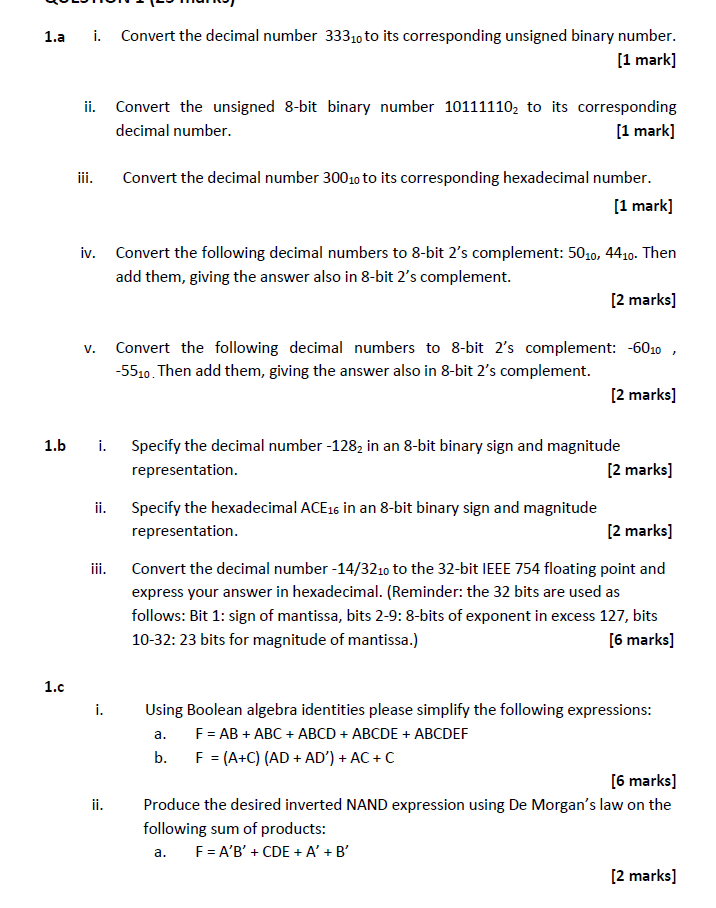
Question: 1 . a i . Convert the decimal number 3 3 3 1 0 to its corresponding unsigned binary number. [ 1 mark ] ii
a i Convert the decimal number to its corresponding unsigned binary number.
mark
ii Convert the unsigned bit binary number to its corresponding decimal number.
mark
iii. Convert the decimal number to its corresponding hexadecimal number.
mark
iv Convert the following decimal numbers to bit s complement: Then add them, giving the answer also in bit s complement.
marks
v Convert the following decimal numbers to bit s complement: Then add them, giving the answer also in bit s complement.
marks
b i Specify the decimal number in an bit binary sign and magnitude representation.
marks
ii Specify the hexadecimal in an bit binary sign and magnitude representation.
marks
iii. Convert the decimal number to the bit IEEE floating point and express your answer in hexadecimal. Reminder: the bits are used as follows: Bit : sign of mantissa, bits : bits of exponent in excess bits : bits for magnitude of mantissa.
marks
c
i Using Boolean algebra identities please simplify the following expressions:
aABCABCDABCDEABCDEF
b
marks
ii Produce the desired inverted NAND expression using De Morgan's law on the following sum of products:
aCDE
marks
Step by Step Solution
There are 3 Steps involved in it
1 Expert Approved Answer
Step: 1 Unlock

Question Has Been Solved by an Expert!
Get step-by-step solutions from verified subject matter experts
Step: 2 Unlock
Step: 3 Unlock
 Study Help