



Question: 1. A market has demand given by QD = 80 2PD and supply given by QS = PS 10. There is a per-unit tax on
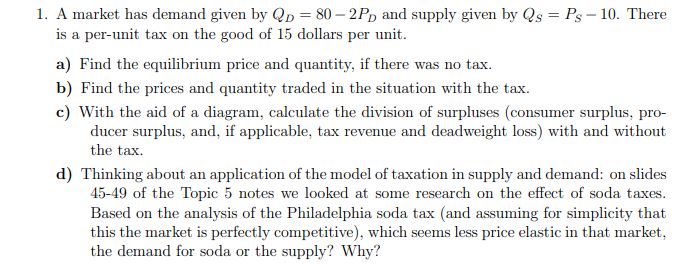
1. A market has demand given by QD = 80 2PD and supply given by QS = PS 10. There is a per-unit tax on the good of 15 dollars per unit.
a) Find the equilibrium price and quantity, if there was no tax.
b) Find the prices and quantity traded in the situation with the tax.
c) With the aid of a diagram, calculate the division of surpluses (consumer surplus, producer surplus, and, if applicable, tax revenue and deadweight loss) with and without the tax.
d) Thinking about an application of the model of taxation in supply and demand: on slides 45-49 of the Topic 5 notes we looked at some research on the effect of soda taxes. Based on the analysis of the Philadelphia soda tax (and assuming for simplicity that this the market is perfectly competitive), which seems less price elastic in that market, the demand for soda or the supply? Why?
1. A market has demand given by Q5 = 30 - 2135 and supply given by Q3 = 13'3- l. There is a per-unit tax on the good of 15 dollars per unit. a] Find the equilibrium price and quantity, if there was no tax. b} Find the prices and quantity traded in the situation with the tax. C} With the aid of a diagram, calculate the division of surpluses [consumer surplus1 pro ducer surplus, and1 if applicable1 tax revenue and deadweight loss} with and without the tax. d) Thinking about an application of the model of taxation in supply and demand: on slides 4549 of the Topic 5 notes we looked at some research on the effect of soda taxes. Based on the analysis of the Philadelphia soda tax [and assuming for simplicity that this the market is perfectly competitive}, which seems less price elastic in that marketT the demand for soda or the supply? \"lily
Step by Step Solution
There are 3 Steps involved in it

Get step-by-step solutions from verified subject matter experts