







Question: 1 A mathematical model for the forces on a car suspension system The goal of this project is to describe one of the ways in
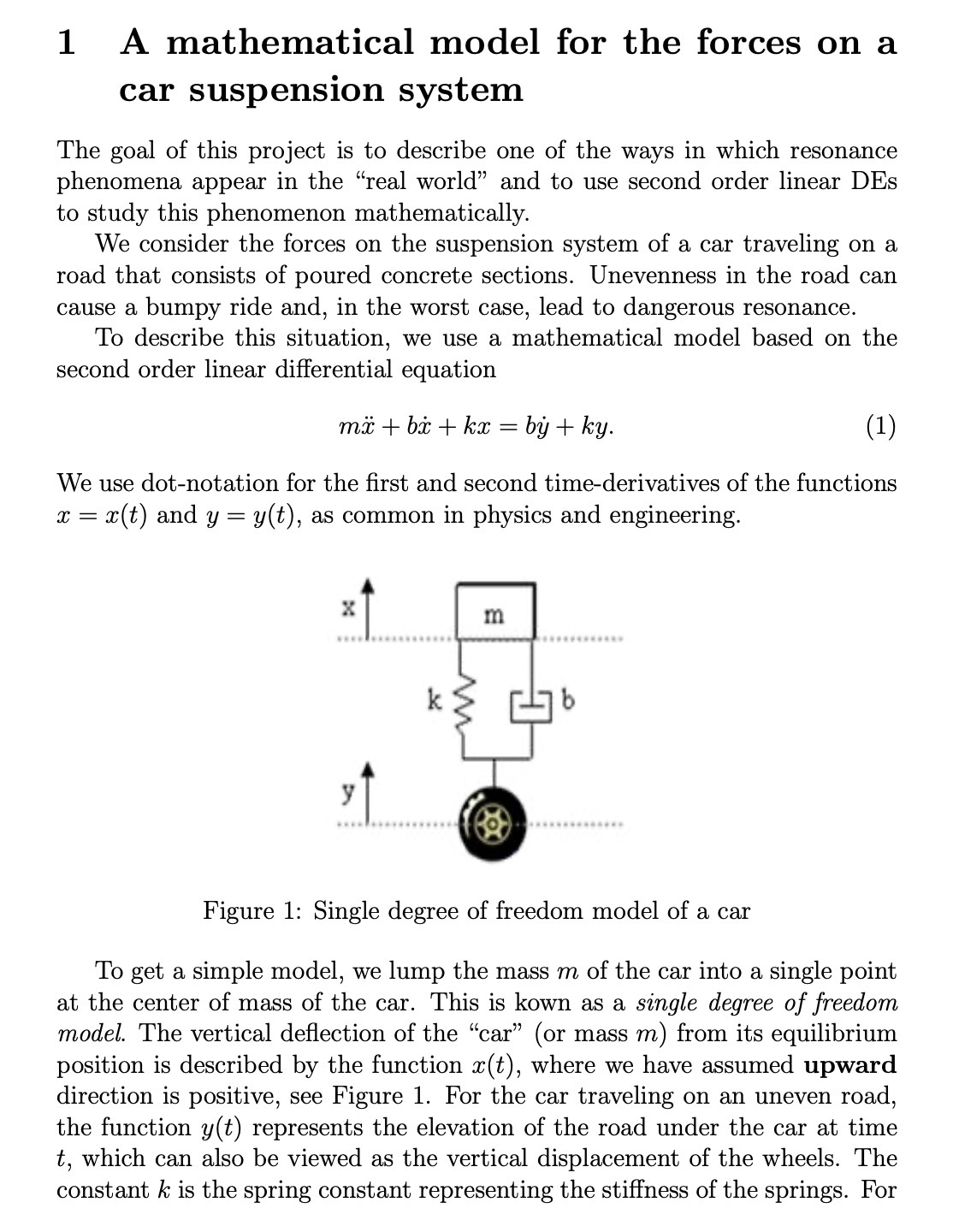
1 A mathematical model for the forces on a car suspension system The goal of this project is to describe one of the ways in which resonance phenomena appear in the \"real world\" and to use second order linear DEs to study this phenomenon mathematically. We consider the forces on the suspension system of a car traveling on a road that consists of poured concrete sections. Unevenness in the road can cause a bumpy ride and, in the worst case, lead to dangerous resonance. To describe this situation, we use a mathematical model based on the second order linear differential equation mii+bdc+kx=by+ky (1) We use dot-notation for the rst and second time-derivatives of the functions a: = a:(t) and y = y(t), as common in physics and engineering. Figure 1: Single degree of freedom model of a car To get a simple model, we lump the mass m of the car into a single point at the center of mass of the car. This is kown as a single degree of freedom model. The vertical deection of the \"car\" (or mass m) from its equilibrium position is described by the function 93(t), where we have assumed upward direction is positive, see Figure 1. For the car traveling on an uneven road, the function y(t) represents the elevation of the road under the car at time t, which can also be viewed as the vertical displacement of the wheels. The constant k is the spring constant representing the stiffness of the springs. For
Step by Step Solution
There are 3 Steps involved in it

Get step-by-step solutions from verified subject matter experts
 Study Help