







Question: 1. A matrix addition takes two input matrices A and B and produces one output matrix C. Each element of the output matrix C is
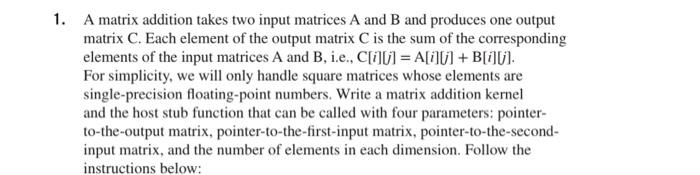

1. A matrix addition takes two input matrices A and B and produces one output matrix C. Each element of the output matrix C is the sum of the corresponding elements of the input matrices A and B, i.e., C[ 161 = A[i][i] +B[i][j]. For simplicity, we will only handle square matrices whose elements are single-precision floating-point numbers. Write a matrix addition kernel and the host stub function that can be called with four parameters: pointer- to-the-output matrix, pointer-to-the-first-input matrix, pointer-to-the-second- input matrix, and the number of elements in each dimension. Follow the instructions below: E. Analyze the pros and cons of each kernel design above. tornati ontmotiv Dand 1. A matrix addition takes two input matrices A and B and produces one output matrix C. Each element of the output matrix C is the sum of the corresponding elements of the input matrices A and B, i.e., C[ 161 = A[i][i] +B[i][j]. For simplicity, we will only handle square matrices whose elements are single-precision floating-point numbers. Write a matrix addition kernel and the host stub function that can be called with four parameters: pointer- to-the-output matrix, pointer-to-the-first-input matrix, pointer-to-the-second- input matrix, and the number of elements in each dimension. Follow the instructions below: E. Analyze the pros and cons of each kernel design above. tornati ontmotiv Dand
Step by Step Solution
There are 3 Steps involved in it

Get step-by-step solutions from verified subject matter experts
 Study Help