







Question: 1. A proposed project requires an initial investment in fixed asset of $1,500,000 and is depreciated straight-line to zero over its 3-year life. The project
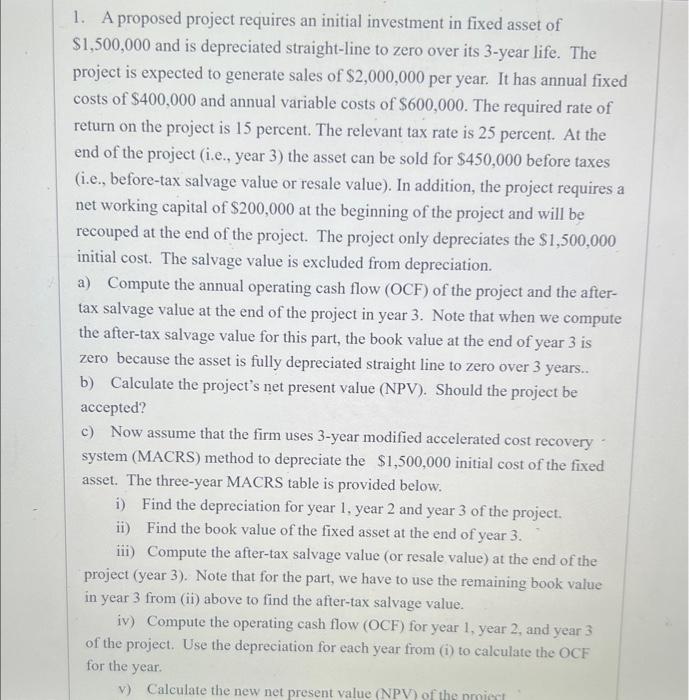
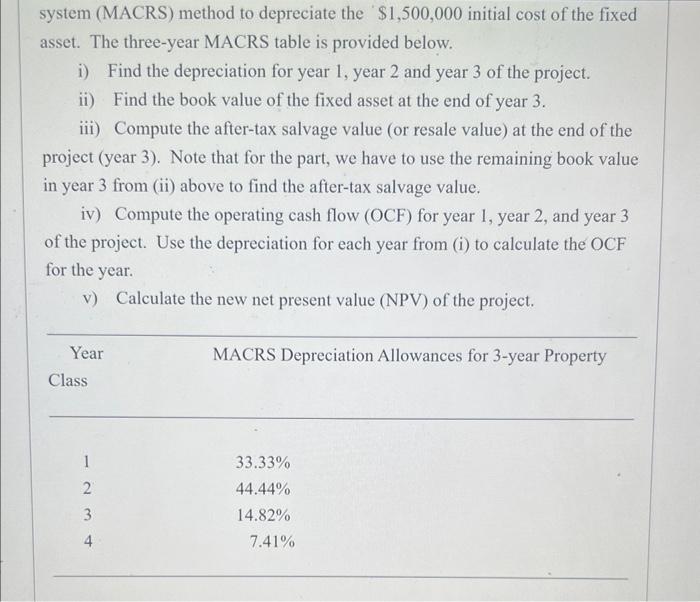
1. A proposed project requires an initial investment in fixed asset of $1,500,000 and is depreciated straight-line to zero over its 3-year life. The project is expected to generate sales of $2,000,000 per year. It has annual fixed costs of $400,000 and annual variable costs of $600,000. The required rate of return on the project is 15 percent. The relevant tax rate is 25 percent. At the end of the project (i.e., year 3 ) the asset can be sold for $450,000 before taxes (i.e., before-tax salvage value or resale value). In addition, the project requires a net working capital of $200,000 at the beginning of the project and will be recouped at the end of the project. The project only depreciates the $1,500,000 initial cost. The salvage value is excluded from depreciation. a) Compute the annual operating cash flow (OCF) of the project and the aftertax salvage value at the end of the project in year 3 . Note that when we compute the after-tax salvage value for this part, the book value at the end of year 3 is zero because the asset is fully depreciated straight line to zero over 3 years.. b) Calculate the project's net present value (NPV). Should the project be accepted? c) Now assume that the firm uses 3-year modified accelerated cost recovery system (MACRS) method to depreciate the $1,500,000 initial cost of the fixed asset. The three-year MACRS table is provided below. i) Find the depreciation for year 1 , year 2 and year 3 of the project. ii) Find the book value of the fixed asset at the end of year 3. iii) Compute the after-tax salvage value (or resale value) at the end of the project (year 3). Note that for the part, we have to use the remaining book value in year 3 from (ii) above to find the after-tax salvage value. iv) Compute the operating cash flow (OCF) for year 1, year 2, and year 3 of the project. Use the depreciation for each year from (i) to calculate the OCF for the year. v) Calculate the new net present value (NPV) of the nmiect system (MACRS) method to depreciate the $1,500,000 initial cost of the fixed asset. The three-year MACRS table is provided below. i) Find the depreciation for year 1 , year 2 and year 3 of the project. ii) Find the book value of the fixed asset at the end of year 3 . iii) Compute the after-tax salvage value (or resale value) at the end of the project (year 3). Note that for the part, we have to use the remaining book value in year 3 from (ii) above to find the after-tax salvage value. iv) Compute the operating cash flow (OCF) for year 1, year 2 , and year 3 of the project. Use the depreciation for each year from (i) to calculate the OCF for the year. v) Calculate the new net present value (NPV) of the project
Step by Step Solution
There are 3 Steps involved in it

Get step-by-step solutions from verified subject matter experts
 Study Help