







Question: (1) (a) Repeat example 2.2.1 on x+y.Z.W'. (b) Remove all parentheses from the result in part (a) of this problem. Example 2.2.1: Form the dual

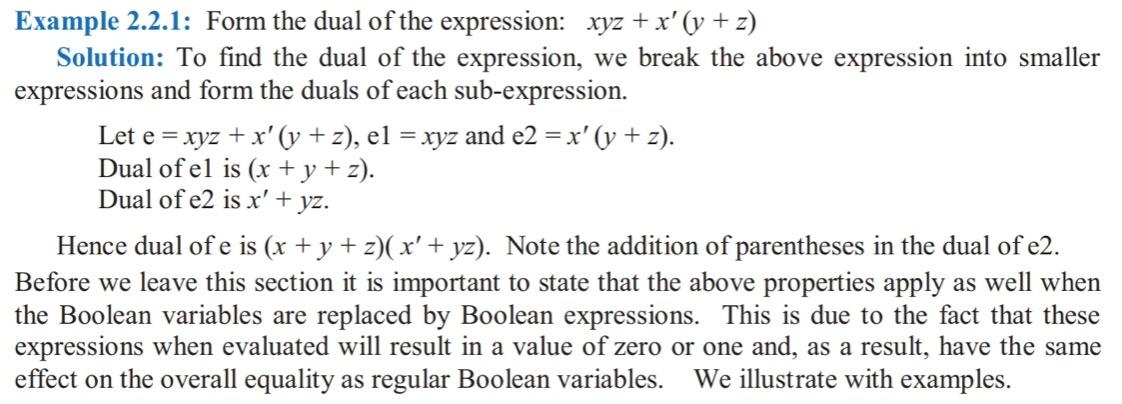
(1) (a) Repeat example 2.2.1 on x+y.Z.W'. (b) Remove all parentheses from the result in part (a) of this problem. Example 2.2.1: Form the dual of the expression: xyz + x' (y + 2) Solution: To find the dual of the expression, we break the above expression into smaller expressions and form the duals of each sub-expression. Let e = xyz + x' (y + z), el = xyz and e2 = x' (y + z). Dual of el is (x + y + z). Dual of e2 is x' + yz. Hence dual of e is (x + y + x)( x' + yz). Note the addition of parentheses in the dual of e2. Before we leave this section it is important to state that the above properties apply as well when the Boolean variables are replaced by Boolean expressions. This is due to the fact that these expressions when evaluated will result in a value of zero or one and, as a result, have the same effect on the overall equality as regular Boolean variables. We illustrate with examples
Step by Step Solution
There are 3 Steps involved in it

Get step-by-step solutions from verified subject matter experts
 Study Help