







Question: 1. A sample is obtained from a population with u = 100 and o = 20. Which of the following samples would produce the z-
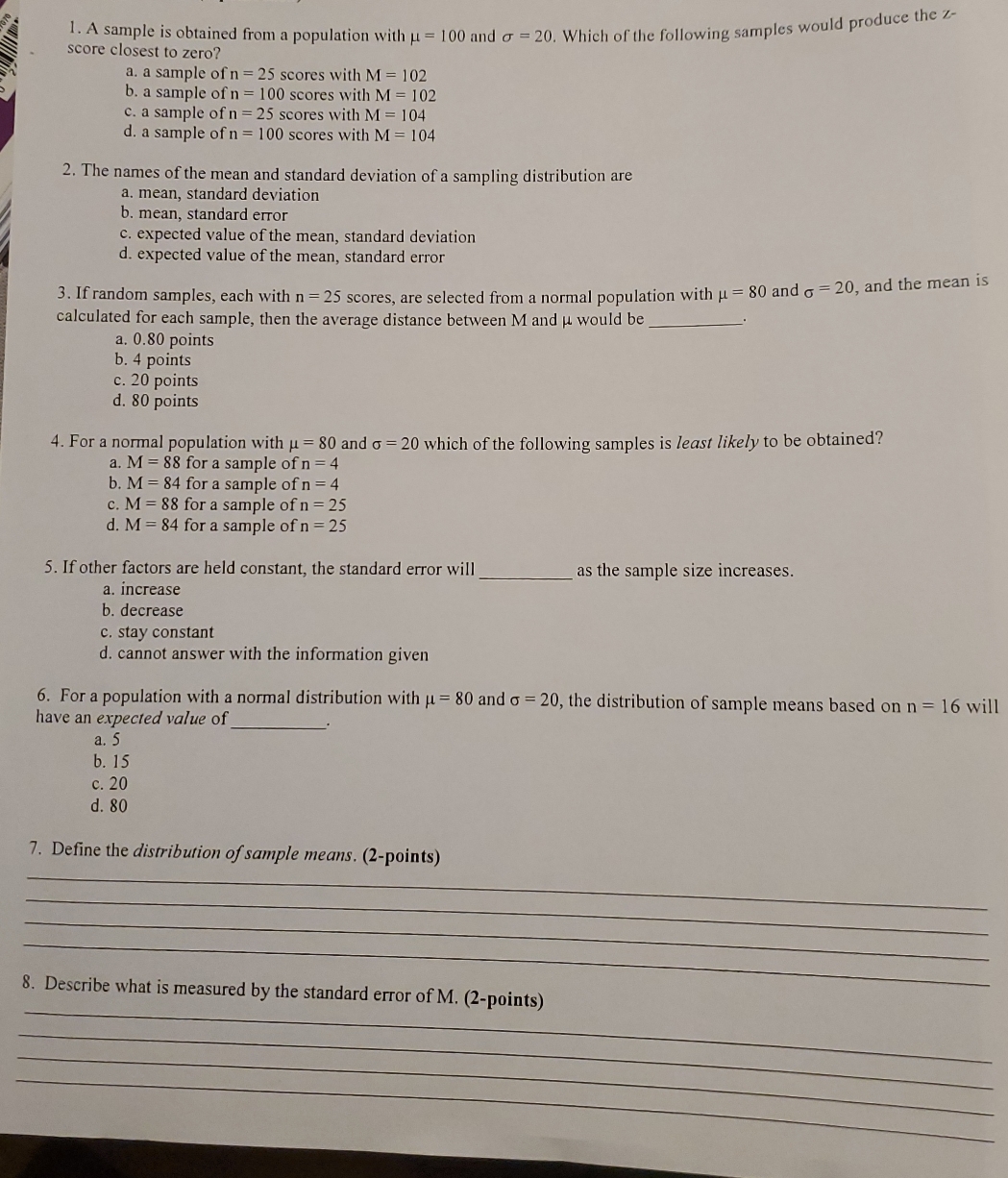
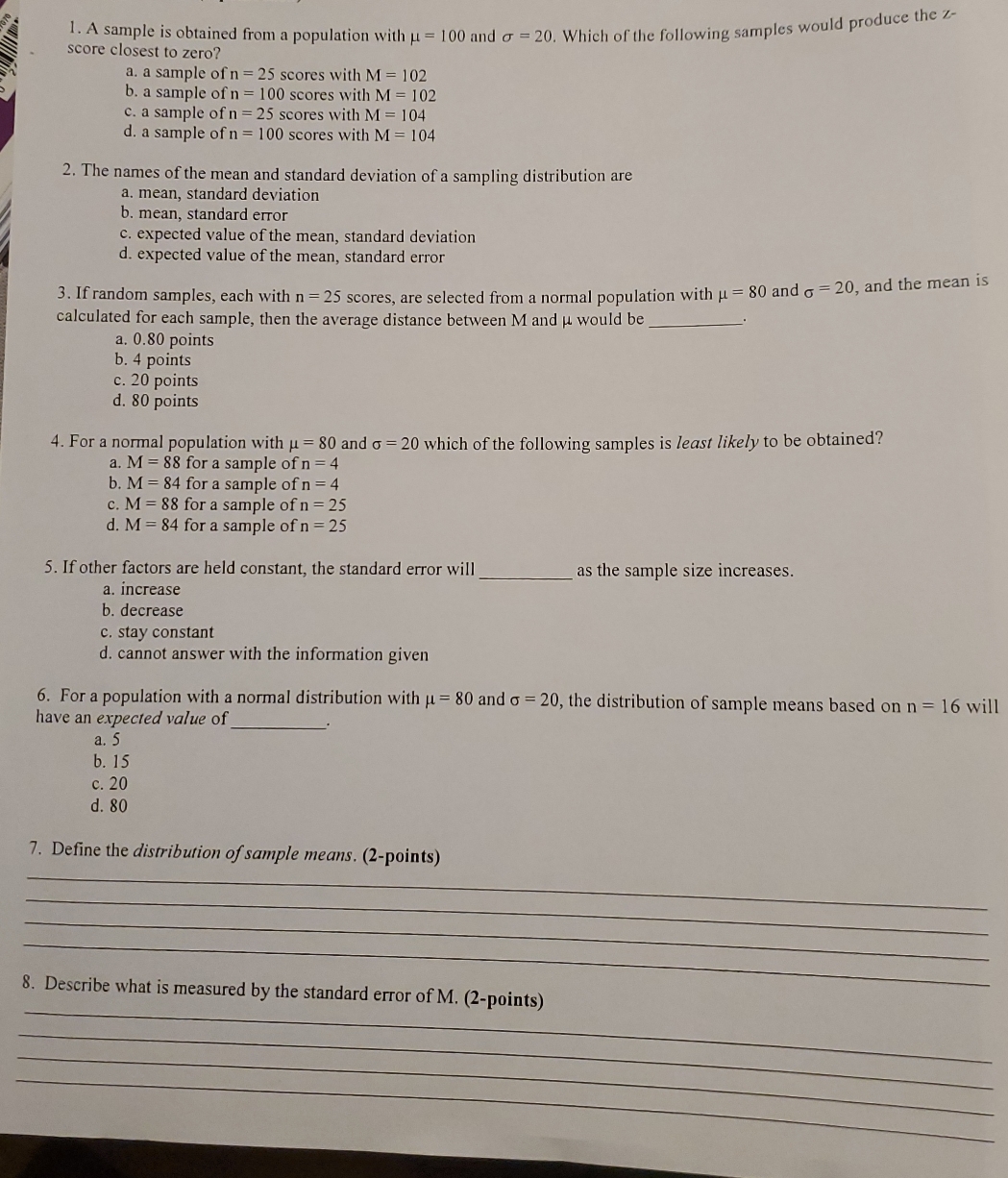
1. A sample is obtained from a population with u = 100 and o = 20. Which of the following samples would produce the z- score closest to zero? a. a sample of n = 25 scores with M = 102 b. a sample of n = 100 scores with M = 102 c. a sample of n = 25 scores with M = 104 d. a sample of n = 100 scores with M = 104 2. The names of the mean and standard deviation of a sampling distribution are a. mean, standard deviation b. mean, standard error c. expected value of the mean, standard deviation d. expected value of the mean, standard error 3. If random samples, each with n = 25 scores, are selected from a normal population with u = 80 and o = 20, and the mean is calculated for each sample, then the average distance between M and u would be a. 0.80 points b. 4 points c. 20 points d. 80 points 4. For a normal population with u = 80 and o = 20 which of the following samples is least likely to be obtained? a. M = 88 for a sample of n = 4 b. M = 84 for a sample of n = 4 c. M = 88 for a sample of n = 25 d. M = 84 for a sample of n = 25 5. If other factors are held constant, the standard error will as the sample size increases. a. increase b. decrease c. stay constant d. cannot answer with the information given 6. For a population with a normal distribution with u = 80 and o = 20, the distribution of sample means based on n = 16 will have an expected value of a. 5 b. 15 c. 20 d. 80 7. Define the distribution of sample means. (2-points) 8. Describe what is measured by the standard error of M. (2-points)
Step by Step Solution
There are 3 Steps involved in it

Get step-by-step solutions from verified subject matter experts
 Study Help