





Question: 1. A score is a person's value on a variable. 1. 2. Census data are an example of aggregate data. 2. 3 3. A group
1. A score is a person's value on a variable. 1.
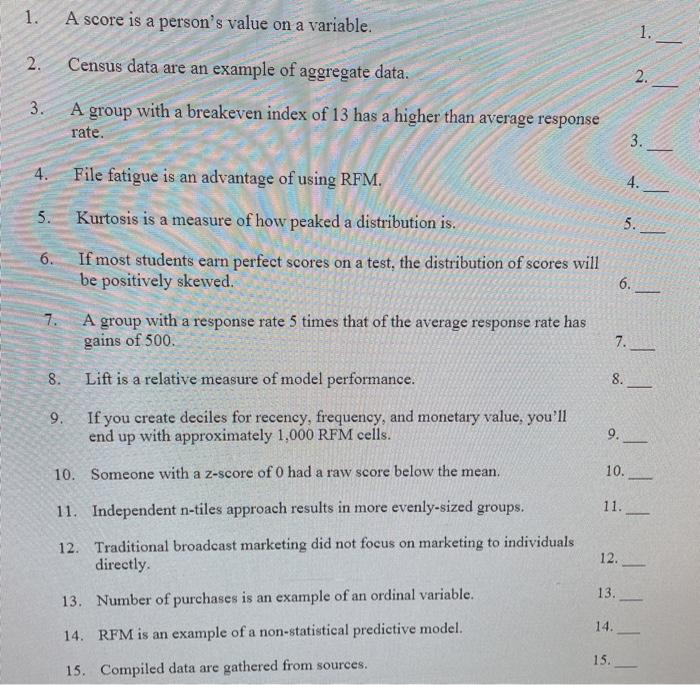
1. A score is a person's value on a variable. 1. 2. Census data are an example of aggregate data. 2. 3 3. A group with a breakeven index of 13 has a higher than average response rate. 3. 4. File fatigue is an advantage of using RFM. 4. 5. Kurtosis is a measure of how peaked a distribution is. 5. 6. If most students earn perfect scores on a test, the distribution of scores will be positively skewed. 6. 7. A group with a response rate 5 times that of the average response rate has gains of 500. 7. 8. Lift is a relative measure of model performance. 8. 9. If you create deciles for recency, frequency, and monetary value, you'll end up with approximately 1,000 RFM cells. 9. 10. Someone with a Z-score of 0 had a raw score below the mean. 10. 11. 11. Independent n-tiles approach results in more evenly-sized groups. 12. Traditional broadcast marketing did not focus on marketing to individuals directly. 12. 13. 13. Number of purchases is an example of an ordinal variable. 14. 14. RFM is an example of a non-statistical predictive model. 15. 15. Compiled data are gathered from sources. 1. A score is a person's value on a variable. 1. 2. Census data are an example of aggregate data. 2. 3 3. A group with a breakeven index of 13 has a higher than average response rate. 3. 4. File fatigue is an advantage of using RFM. 4. 5. Kurtosis is a measure of how peaked a distribution is. 5. 6. If most students earn perfect scores on a test, the distribution of scores will be positively skewed. 6. 7. A group with a response rate 5 times that of the average response rate has gains of 500. 7. 8. Lift is a relative measure of model performance. 8. 9. If you create deciles for recency, frequency, and monetary value, you'll end up with approximately 1,000 RFM cells. 9. 10. Someone with a Z-score of 0 had a raw score below the mean. 10. 11. 11. Independent n-tiles approach results in more evenly-sized groups. 12. Traditional broadcast marketing did not focus on marketing to individuals directly. 12. 13. 13. Number of purchases is an example of an ordinal variable. 14. 14. RFM is an example of a non-statistical predictive model. 15. 15. Compiled data are gathered from sources

Step by Step Solution

There are 3 Steps involved in it

1 Expert Approved Answer
Step: 1 Unlock blur-text-image

Question Has Been Solved by an Expert!

Get step-by-step solutions from verified subject matter experts

Step: 2 Unlock
Step: 3 Unlock

Students Have Also Explored These Related General Management Questions!