







Question: 1. A sustainable decoupling process would eventually lead to a multi-polar world-a world economy in which the engines of growth could comprise the United States,
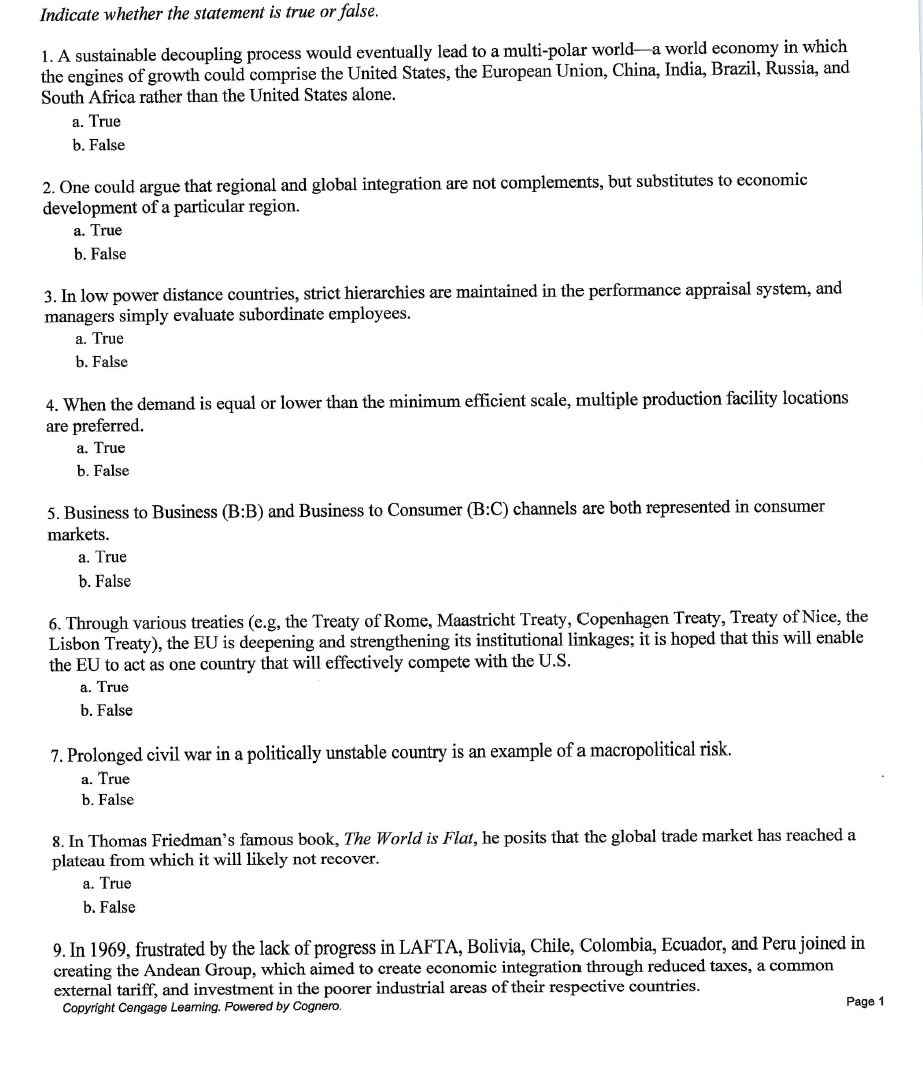
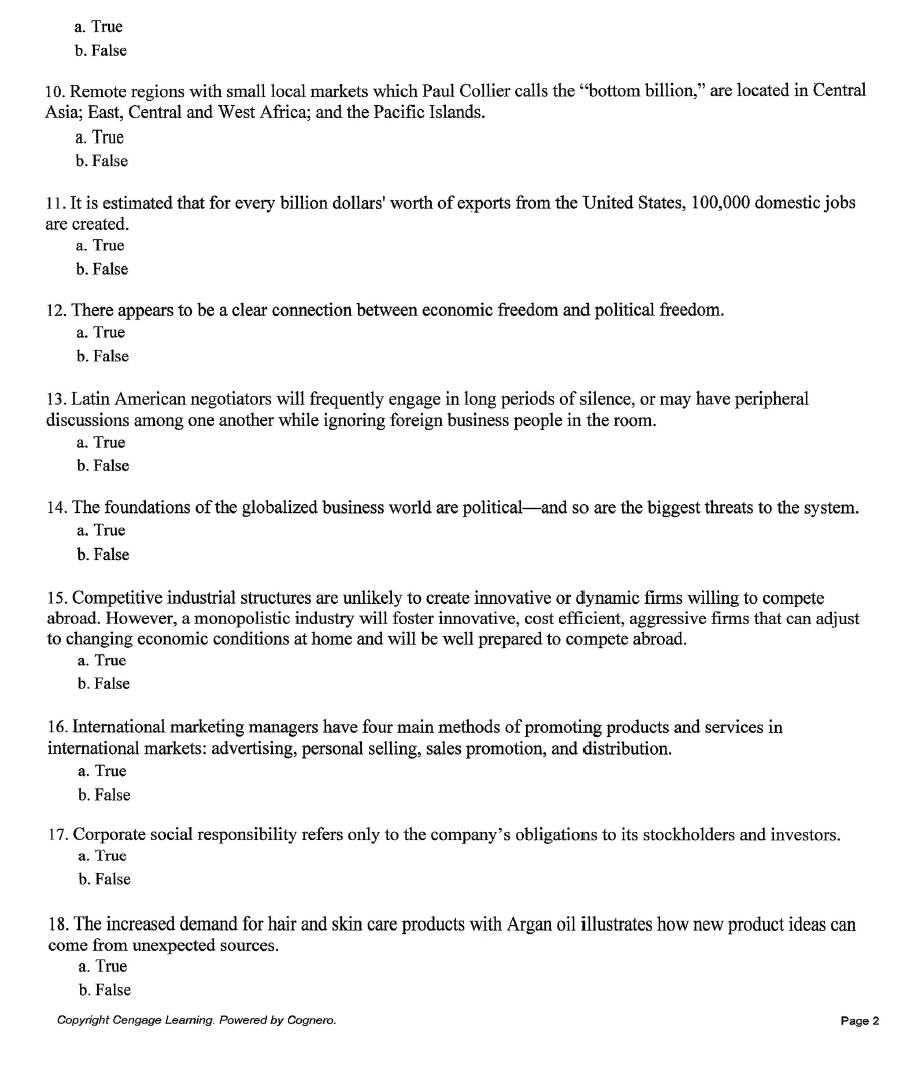
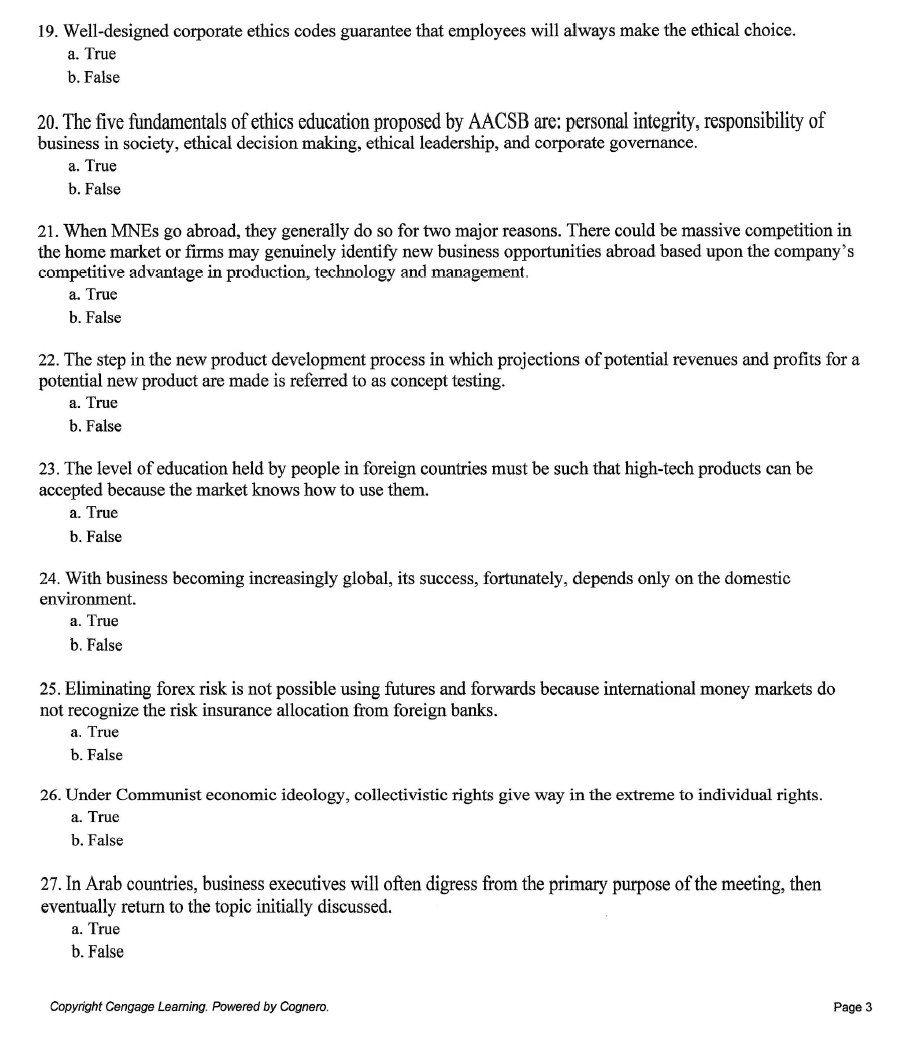
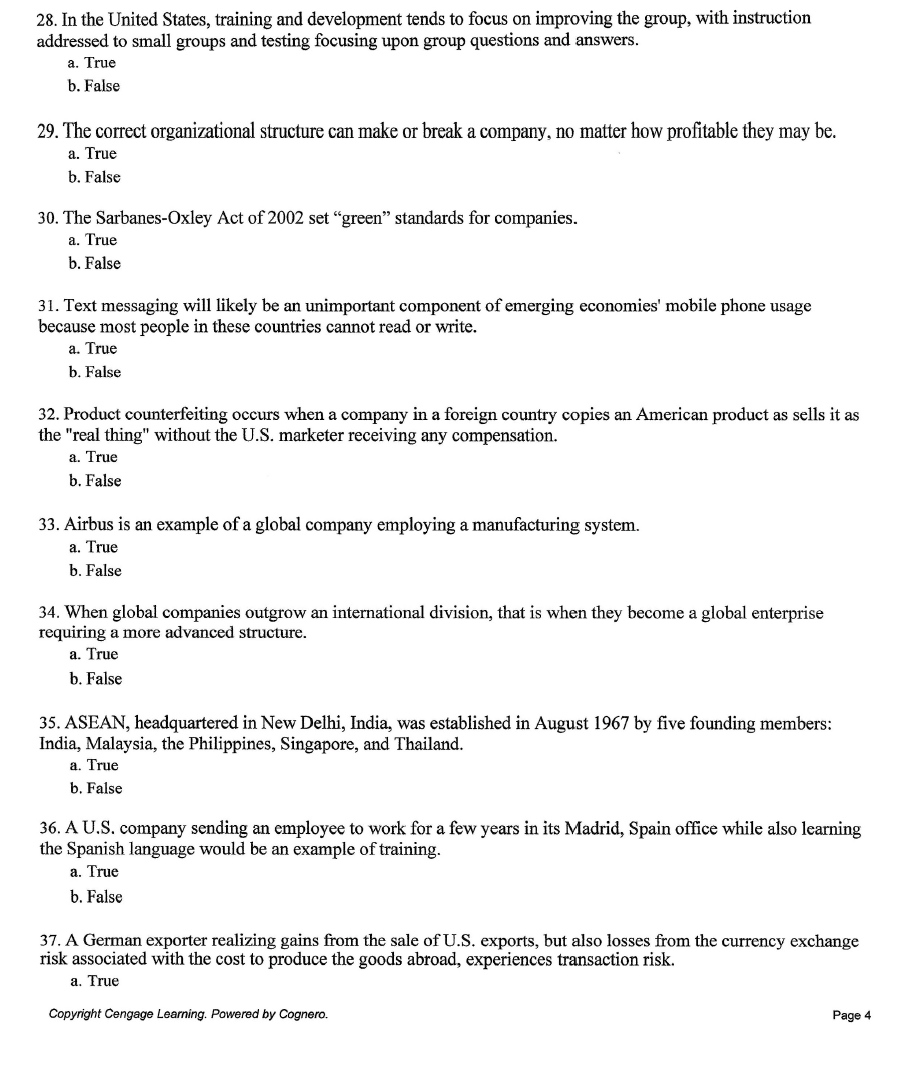
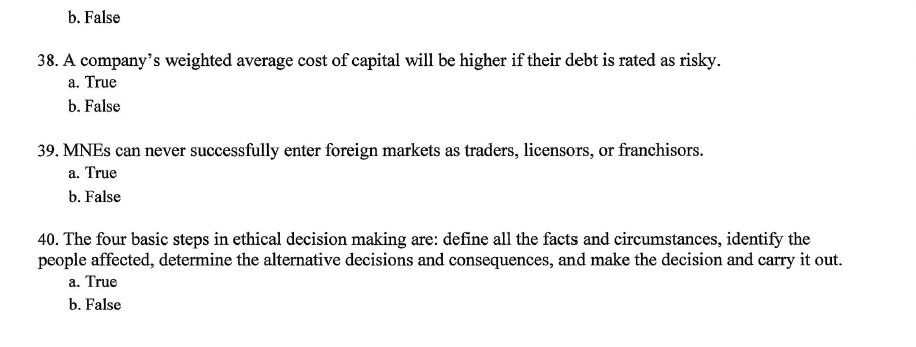
1. A sustainable decoupling process would eventually lead to a multi-polar world-a world economy in which the engines of growth could comprise the United States, the European Union, China, India, Brazil, Russia, and South Africa rather than the United States alone. a. True b. False 2. One could argue that regional and global integration are not complements, but substitutes to economic development of a particular region. a. True b. False 3. In low power distance countries, strict hierarchies are maintained in the performance appraisal system, and managers simply evaluate subordinate employees. a. True b. False 4. When the demand is equal or lower than the minimum efficient scale, multiple production facility locations are preferred. a. True b. False 5. Business to Business ( B:B) and Business to Consumer (B:C) channels are both represented in consumer markets. a. True b. False 6. Through various treaties (e.g, the Treaty of Rome, Maastricht Treaty, Copenhagen Treaty, Treaty of Nice, the Lisbon Treaty), the EU is deepening and strengthening its institutional linkages; it is hoped that this will enable the EU to act as one country that will effectively compete with the U.S. a. True b. False 7. Prolonged civil war in a politically unstable country is an example of a macropolitical risk. a. True b. False 8. In Thomas Friedman's famous book, The World is Flat, he posits that the global trade market has reached a plateau from which it will likely not recover. a. True b. False 9. In 1969, frustrated by the lack of progress in LAFTA, Bolivia, Chile, Colombia, Ecuador, and Peru joined in creating the Andean Group, which aimed to create economic integration through reduced taxes, a common external tariff, and investment in the poorer industrial areas of their respective countries. Copyright Cengage Leaming. Powered by Cognero. Page 1 a. True b. False 10. Remote regions with small local markets which Paul Collier calls the "bottom billion," are located in Central Asia; East, Central and West Africa; and the Pacific Islands. a. True b. False 11. It is estimated that for every billion dollars' worth of exports from the United States, 100,000 domestic jobs are created. a. True b. False 12. There appears to be a clear connection between economic freedom and political freedom. a. True b. False 13. Latin American negotiators will frequently engage in long periods of silence, or may have peripheral discussions among one another while ignoring foreign business people in the room. a. True b. False 14. The foundations of the globalized business world are political and so are the biggest threats to the system. a. True b. False 15. Competitive industrial structures are unlikely to create innovative or dynamic firms willing to compete abroad. However, a monopolistic industry will foster innovative, cost efficient, aggressive firms that can adjust to changing economic conditions at home and will be well prepared to compete abroad. a. True b. False 16. International marketing managers have four main methods of promoting products and services in international markets: advertising, personal selling, sales promotion, and distribution. a. True b. False 17. Corporate social responsibility refers only to the company's obligations to its stockholders and investors. a. True b. False 18. The increased demand for hair and skin care products with Argan oil illustrates how new product ideas can come from unexpected sources. a. True b. False Copyright Cengage Learning. Powered by Cognero. Page 2 19. Well-designed corporate ethics codes guarantee that employees will always make the ethical choice. a. True b. False 20. The five fundamentals of ethics education proposed by AACSB are: personal integrity, responsibility of business in society, ethical decision making, ethical leadership, and corporate governance. a. True b. False 21. When MNEs go abroad, they generally do so for two major reasons. There could be massive competition in the home market or firms may genuinely identify new business opportunities abroad based upon the company's competitive advantage in production, technology and management. a. True b. False 22. The step in the new product development process in which projections of potential revenues and profits for potential new product are made is referred to as concept testing. a. True b. False 23. The level of education held by people in foreign countries must be such that high-tech products can be accepted because the market knows how to use them. a. True b. False 24. With business becoming increasingly global, its success, fortunately, depends only on the domestic environment. a. True b. False 25. Eliminating forex risk is not possible using futures and forwards because international money markets do not recognize the risk insurance allocation from foreign banks. a. True b. False 26. Under Communist economic ideology, collectivistic rights give way in the extreme to individual rights. a. True b. False 27. In Arab countries, business executives will often digress from the primary purpose of the meeting, then eventually return to the topic initially discussed. a. True b. False 28. In the United States, training and development tends to focus on improving the group, with instruction addressed to small groups and testing focusing upon group questions and answers. a. True b. False 29. The correct organizational structure can make or break a company, no matter how profitable they may be. a. True b. False 30. The Sarbanes-Oxley Act of 2002 set "green" standards for companies. a. True b. False 31. Text messaging will likely be an unimportant component of emerging economies' mobile phone usage because most people in these countries cannot read or write. a. True b. False 32. Product counterfeiting occurs when a company in a foreign country copies an American product as sells it as the "real thing" without the U.S. marketer receiving any compensation. a. True b. False 33. Airbus is an example of a global company employing a manufacturing system. a. True b. False 34. When global companies outgrow an international division, that is when they become a global enterprise requiring a more advanced structure. a. True b. False 35. ASEAN, headquartered in New Delhi, India, was established in August 1967 by five founding members: India, Malaysia, the Philippines, Singapore, and Thailand. a. True b. False 36. A U.S. company sending an employee to work for a few years in its Madrid, Spain office while also learning the Spanish language would be an example of training. a. True b. False 37. A German exporter realizing gains from the sale of U.S. exports, but also losses from the currency exchange risk associated with the cost to produce the goods abroad, experiences transaction risk. a. True Copyright Cengage Learning. Powered by Cognero. Page 4 38. A company's weighted average cost of capital will be higher if their debt is rated as risky. a. True b. False 39. MNEs can never successfully enter foreign markets as traders, licensors, or franchisors. a. True b. False 40. The four basic steps in ethical decision making are: define all the facts and circumstances, identify the people affected, determine the alternative decisions and consequences, and make the decision and carry it out. a. True b. False
Step by Step Solution
There are 3 Steps involved in it

Get step-by-step solutions from verified subject matter experts
 Study Help