



Question: 1) A two-bed carbon adsorption system is to be designed to handle 237 actual m3/m of flue gas containing 700ppm of hexane. Laboratory studies indicate
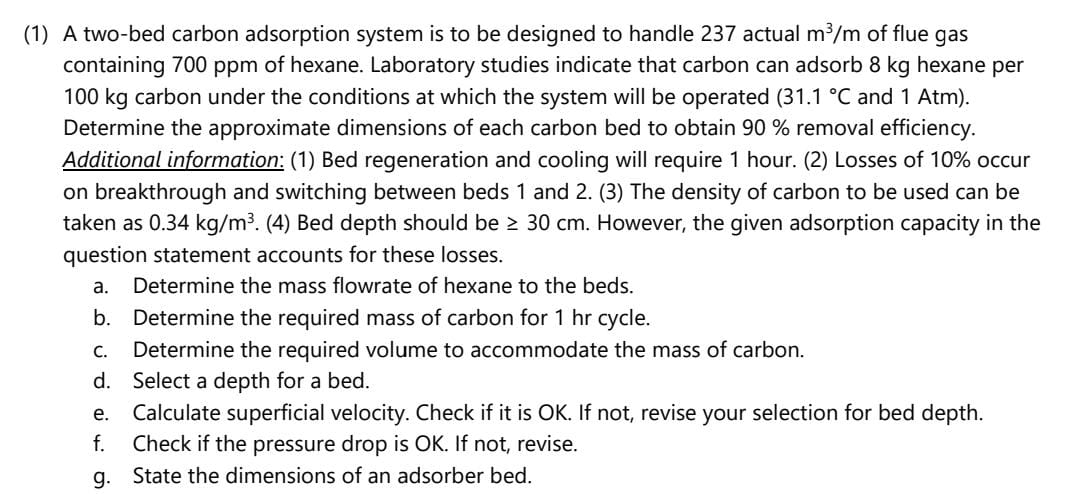
1) A two-bed carbon adsorption system is to be designed to handle 237 actual m3/m of flue gas containing 700ppm of hexane. Laboratory studies indicate that carbon can adsorb 8kg hexane per 100kg carbon under the conditions at which the system will be operated (31.1C and 1Atm). Determine the approximate dimensions of each carbon bed to obtain 90% removal efficiency. Additional information: (1) Bed regeneration and cooling will require 1 hour. (2) Losses of 10% occur on breakthrough and switching between beds 1 and 2. (3) The density of carbon to be used can be taken as 0.34kg/m3. (4) Bed depth should be 30cm. However, the given adsorption capacity in the question statement accounts for these losses. a. Determine the mass flowrate of hexane to the beds. b. Determine the required mass of carbon for 1hr cycle. c. Determine the required volume to accommodate the mass of carbon. d. Select a depth for a bed. e. Calculate superficial velocity. Check if it is OK. If not, revise your selection for bed depth. f. Check if the pressure drop is OK. If not, revise. g. State the dimensions of an adsorber bed. 1) A two-bed carbon adsorption system is to be designed to handle 237 actual m3/m of flue gas containing 700ppm of hexane. Laboratory studies indicate that carbon can adsorb 8kg hexane per 100kg carbon under the conditions at which the system will be operated (31.1C and 1Atm). Determine the approximate dimensions of each carbon bed to obtain 90% removal efficiency. Additional information: (1) Bed regeneration and cooling will require 1 hour. (2) Losses of 10% occur on breakthrough and switching between beds 1 and 2. (3) The density of carbon to be used can be taken as 0.34kg/m3. (4) Bed depth should be 30cm. However, the given adsorption capacity in the question statement accounts for these losses. a. Determine the mass flowrate of hexane to the beds. b. Determine the required mass of carbon for 1hr cycle. c. Determine the required volume to accommodate the mass of carbon. d. Select a depth for a bed. e. Calculate superficial velocity. Check if it is OK. If not, revise your selection for bed depth. f. Check if the pressure drop is OK. If not, revise. g. State the dimensions of an adsorber bed
Step by Step Solution
There are 3 Steps involved in it

Get step-by-step solutions from verified subject matter experts