





Question: 1. A variable that is usually associated with a measurement that can be made to a desired degree of precision and that can take on
1. A variable that is usually associated with a
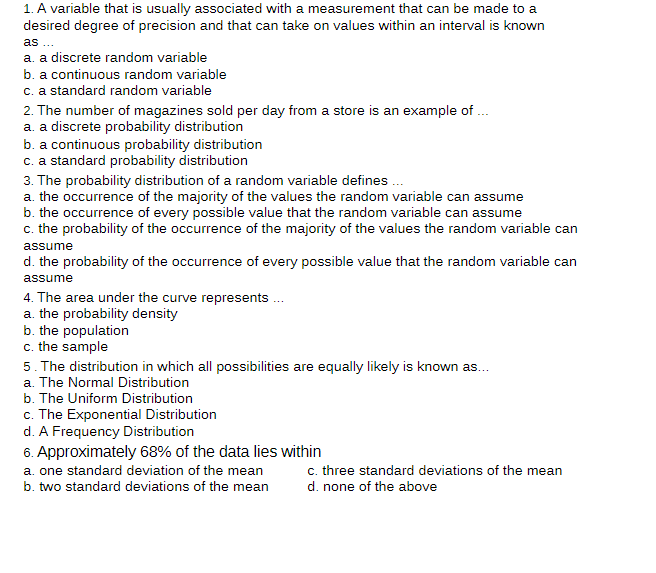
1. A variable that is usually associated with a measurement that can be made to a desired degree of precision and that can take on values within an interval is known as ... a. a discrete random variable b. a continuous random variable c. a standard random variable 2. The number of magazines sold per day from a store is an example of . a. a discrete probability distribution b. a continuous probability distribution c. a standard probability distribution 3. The probability distribution of a random variable defines a. the occurrence of the majority of the values the random variable can assume b. the occurrence of every possible value that the random variable can assume c. the probability of the occurrence of the majority of the values the random variable can assume d. the probability of the occurrence of every possible value that the random variable can assume 4. The area under the curve represents ... a. the probability density b. the population c. the sample 5. The distribution in which all possibilities are equally likely is known as... a. The Normal Distribution b. The Uniform Distribution c. The Exponential Distribution d. A Frequency Distribution 6. Approximately 68% of the data lies within a. one standard deviation of the mean c. three standard deviations of the mean b. two standard deviations of the mean d. none of the above

Step by Step Solution

There are 3 Steps involved in it

1 Expert Approved Answer
Step: 1 Unlock blur-text-image
Question Has Been Solved by an Expert!

Get step-by-step solutions from verified subject matter experts

Step: 2 Unlock
Step: 3 Unlock

Students Have Also Explored These Related Mathematics Questions!