







Question: 1. Add/Subtract a slack/surplus variable to the 3rd constraint * a. 4x1 + 5x2 + 9x3 - S3 90 b. 4x1 + 5x2 + 9x3
1. Add/Subtract a slack/surplus variable to the 3rd constraint * a. 4x1 + 5x2 + 9x3 - S3 90 b. 4x1 + 5x2 + 9x3 + S3 90 c. 4x1 + 5x2 + 9x3 - S3= 90 d. 4x1 + 5x2 + 9x3 + S3 = 90
2. _____ is the "1st entering variable" since it has the ________ which is equal to __________ * a. . X2; most positive coefficient; -9 b. . X2; minimum positive ratio; 9 c. . X3; most negative coefficient; -5 d. X1; minimum positive coefficient; 9
3. __________ is the "1st leaving variable" since it has the/a _________. * a. S2; minimum negative ratio b. S1; minimum positive ratio c. S2; minimum positive ratio d. S3; minimum positive ratio
4. The "new pivot row" of the first iteration is written as: * a. (0.5, 0.75, 1, 0.25, 0, 0, 7) b. (0.5, 75, 1, 0.25, 0, 0, 7) c. (5, 0.75, 1, 0.25, 0, 0, 7) d. (-0.5, 0.75, 1, 0.25, 0, 0, 7)
5. The values of the "2nd basic" variable in the first iteration, is written as: * a. (0.5, 1.25, 0, -1.25, 1, 0, 25) b. (5, 0.25, 0, -1.25, 1, 0, 25) c. (-0.5, 0.25, 0, -1.25, 1, 0, 25) d. (4.5, 0.25, 0, -1.25, 1, 0, 25)
6. The values of the "3rd basic" variable in the first iteration, is written as: * a. (0.5, -1.75, 0, -2.25, 0, 1, 27) b. (5, -1.75, 0, -2.25, 0, 1, 27) c. (-5, -1.75, 0, -2.25, 0, 1, 27) d. (-0.5, -1.75, 0, -2.25, 0, 1, 27)
7. The 2nd entering variable is ______ with a coefficient of______. * a. X2; 0 b. X1; -0.5 c. X3; -0.5 d. X1; -6
8. The 2nd leaving variable is * a. S2 b. X3 c. S1 d. S3
9. The "new pivot row" of the 2nd iteration is written as: * a. (15, 1.5, 2, 0.5, 0, 0, 14) b. (1.5, 0, -2.86, 0, 0.43, 1, 0.6) c. (0.1, 1.5, 2, 0.5, 0, 0, 14) d. (1, 1.5, 2, 0.5, 0, 0, 14)
10. The "New Z-row" of the 2nd iteration is written as: * a. (0.5, 10, 0, 0.17, 0, 2.17, 158.33) b. (0, 1.5, 1, 1.5, 0, 0, 42) c. (5, 0, 0, 0.17, 0, 2.17, 158.33) d. (10, 1.5, 1, 1.5, 0, 0, 42)
11. The values of the "3rd basic" variable in the 2nd iteration, is written as: * a. (10, -1, 1, -2, 0, 1, 34) b. (1, -1, 1, -2, 0, 1, 34) c. (0, -1, 1, -2, 0, 1, 34) d. (10, 1, 1, -2, 0, 1, 34)
12. The optimal values of z, X1, X2, & X3 are respectively: * a. maximum z = 42, 14, 18, 34 b. minimum z = 42, 14, 0, 0 c. maximum z = 42, 14, 0, 0 d. None of the answers.
13. minimum z = 42, 14, 18, 34 The optimal value of X1 in terms of D1, D2, & D3 (Changes in the RHS) is written as: * a. X1= 14 + 0.5D1 b. X1= 14 - 0.5D1 c. X1= 2.47 - 0.21D1 d. X1= 14 - 1.5D1
14. The management decided to add 5 minutes to the time availability of "processing", and decrease 30 minutes from "quality assurance". The value of X1 as a result of the change is * a. 16.5 b. 18 c. 15.6 d. 14
15. The above change is * a. rejected, since one of the basic variables becomes infeasible b. None of the answers. c. accepted, since all basic variables remain feasible d. rejected, since S1& S2 remain feasible
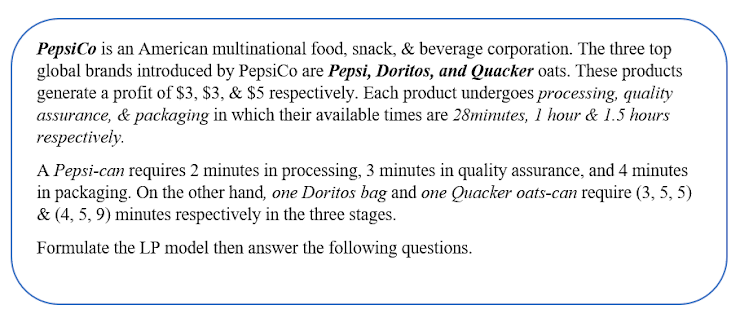
PepsiCo is an American multinational food, snack, & beverage corporation. The three top global brands introduced by PepsiCo are Pepsi, Doritos, and Quacker oats. These products generate a profit of $3, $3, & $5 respectively. Each product undergoes processing, quality assurance, & packaging in which their available times are 28minutes, 1 hour & 1.5 hours respectively. A Pepsi-can requires 2 minutes in processing, 3 minutes in quality assurance, and 4 minutes in packaging. On the other hand, one Doritos bag and one Quacker oats-can require (3, 5, 5) & (4, 5, 9) minutes respectively in the three stages. Formulate the LP model then answer the following questions
Step by Step Solution
There are 3 Steps involved in it

Get step-by-step solutions from verified subject matter experts
 Study Help