







Question: 1. After reading the opening case in chapter 9 The Patent Battle Over CRISPR-Cas9 Gene Editing, (from pg. 199) answer the following questions a. Are
1. After reading the opening case in chapter 9 "The Patent Battle Over CRISPR-Cas9 Gene Editing", (from pg. 199) answer the following questions
a. Are there particular types of innovation activities for which large firms are likely to outperform small firms? Are there types for which small firms are likely to outperform large firms?
b. What are some of the advantages and disadvantages of having formalized procedures for improving the effectiveness or efficiency of innovation?
c. Why is the tension between centralization and decentralization of R&D activities likely to be even greater for multinational firms than firms that compete in one national market?
3. Are there some industries in which a parallel process would not be possible or effective?
4. Is the Stage-Gate process consistent with suggestions that firms adopt parallel processes? What impact do you think using Stage-Gate processes would have on development cycle time and development costs?
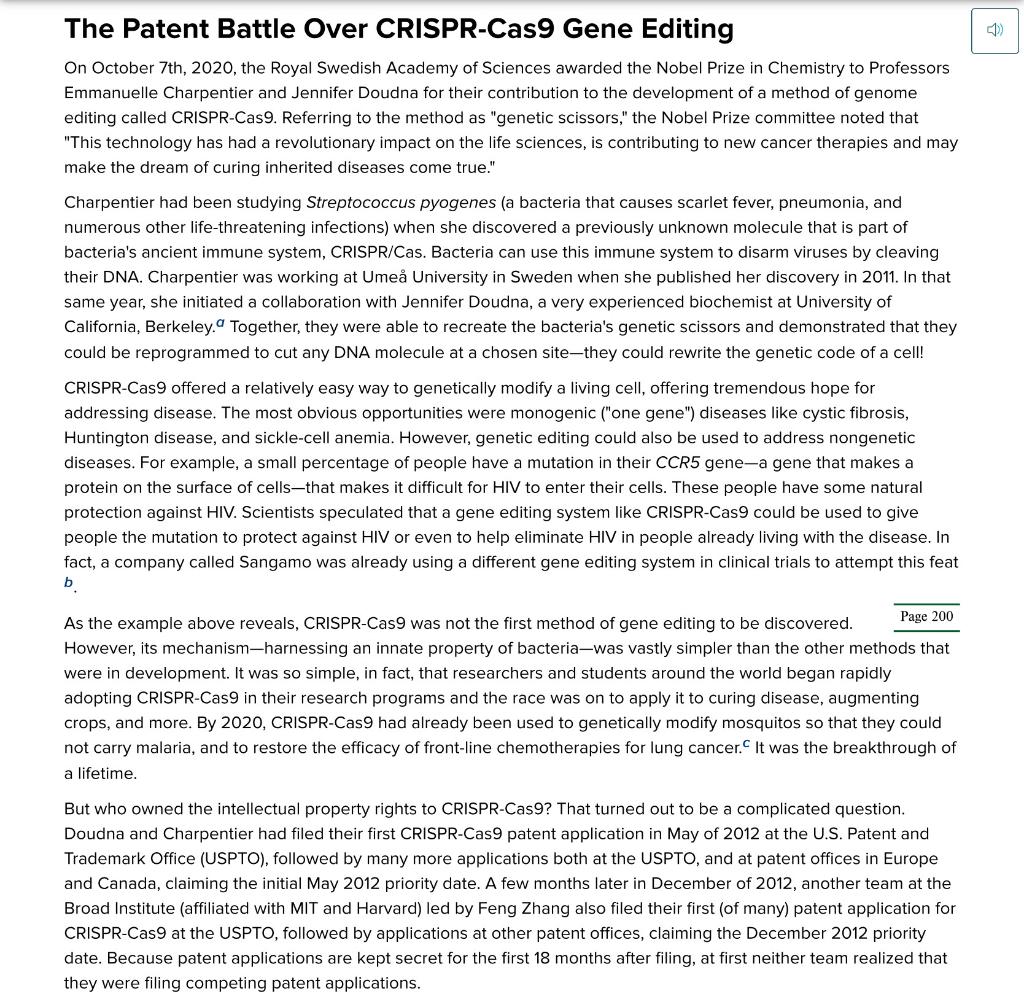
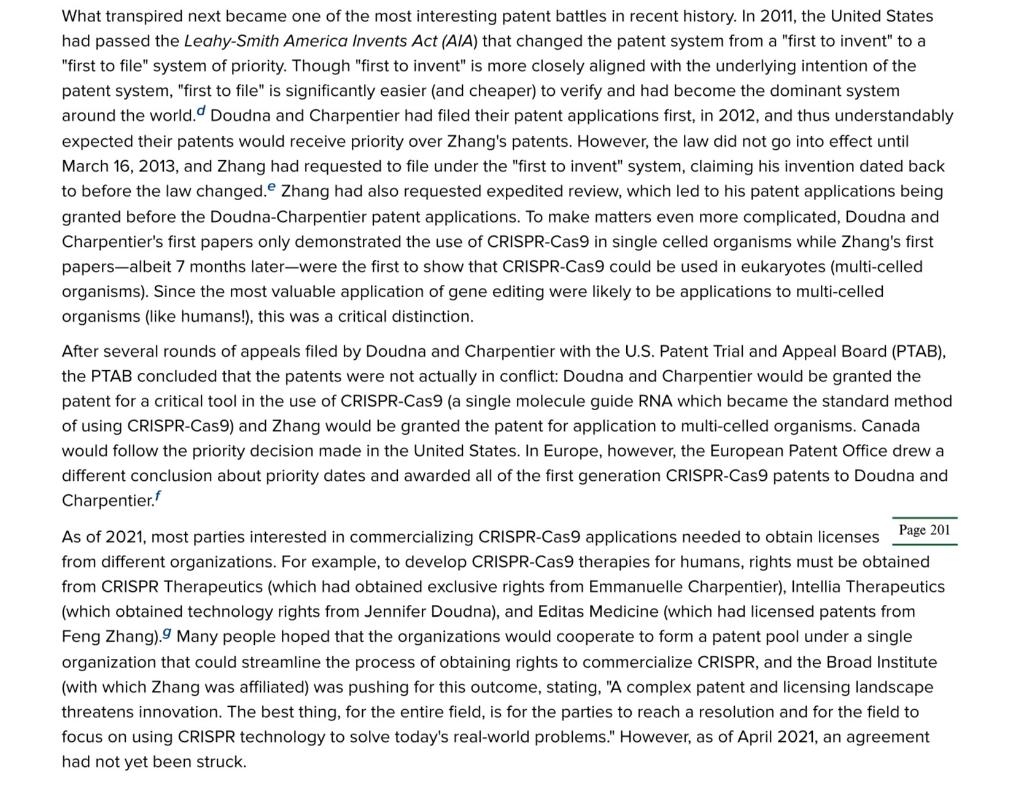
The Patent Battle Over CRISPR-Cas 9 Gene Editing On October 7th, 2020, the Royal Swedish Academy of Sciences awarded the Nobel Prize in Chemistry to Professors Emmanuelle Charpentier and Jennifer Doudna for their contribution to the development of a method of genome editing called CRISPR-Cas9. Referring to the method as "genetic scissors," the Nobel Prize committee noted that "This technology has had a revolutionary impact on the life sciences, is contributing to new cancer therapies and may make the dream of curing inherited diseases come true." Charpentier had been studying Streptococcus pyogenes (a bacteria that causes scarlet fever, pneumonia, and numerous other life-threatening infections) when she discovered a previously unknown molecule that is part of bacteria's ancient immune system, CRISPR/Cas. Bacteria can use this immune system to disarm viruses by cleaving their DNA. Charpentier was working at Ume University in Sweden when she published her discovery in 2011. In that same year, she initiated a collaboration with Jennifer Doudna, a very experienced biochemist at University of California, Berkeley. a Together, they were able to recreate the bacteria's genetic scissors and demonstrated that they could be reprogrammed to cut any DNA molecule at a chosen site-they could rewrite the genetic code of a cell! CRISPR-Cas 9 offered a relatively easy way to genetically modify a living cell, offering tremendous hope for addressing disease. The most obvious opportunities were monogenic ("one gene") diseases like cystic fibrosis, Huntington disease, and sickle-cell anemia. However, genetic editing could also be used to address nongenetic diseases. For example, a small percentage of people have a mutation in their CCR5 gene-a gene that makes a protein on the surface of cells-that makes it difficult for HIV to enter their cells. These people have some natural protection against HIV. Scientists speculated that a gene editing system like CRISPR-Cas 9 could be used to give people the mutation to protect against HIV or even to help eliminate HIV in people already living with the disease. In fact, a company called Sangamo was already using a different gene editing system in clinical trials to attempt this feat b. As the example above reveals, CRISPR-Cas9 was not the first method of gene editing to be discovered. However, its mechanism-harnessing an innate property of bacteria-was vastly simpler than the other methods that were in development. It was so simple, in fact, that researchers and students around the world began rapidly adopting CRISPR-Cas 9 in their research programs and the race was on to apply it to curing disease, augmenting crops, and more. By 2020, CRISPR-Cas 9 had already been used to genetically modify mosquitos so that they could not carry malaria, and to restore the efficacy of front-line chemotherapies for lung cancer. c It was the breakthrough of a lifetime. But who owned the intellectual property rights to CRISPR-Cas9? That turned out to be a complicated question. Doudna and Charpentier had filed their first CRISPR-Cas9 patent application in May of 2012 at the U.S. Patent and Trademark Office (USPTO), followed by many more applications both at the USPTO, and at patent offices in Europe and Canada, claiming the initial May 2012 priority date. A few months later in December of 2012, another team at the Broad Institute (affiliated with MIT and Harvard) led by Feng Zhang also filed their first (of many) patent application for CRISPR-Cas 9 at the USPTO, followed by applications at other patent offices, claiming the December 2012 priority date. Because patent applications are kept secret for the first 18 months after filing, at first neither team realized that they were filing competing patent applications. What transpired next became one of the most interesting patent battles in recent history. In 2011 , the United States had passed the Leahy-Smith America Invents Act (AIA) that changed the patent system from a "first to invent" to a "first to file" system of priority. Though "first to invent" is more closely aligned with the underlying intention of the patent system, "first to file" is significantly easier (and cheaper) to verify and had become the dominant system around the world. d Doudna and Charpentier had filed their patent applications first, in 2012, and thus understandably expected their patents would receive priority over Zhang's patents. However, the law did not go into effect until March 16, 2013, and Zhang had requested to file under the "first to invent" system, claiming his invention dated back to before the law changed. " Zhang had also requested expedited review, which led to his patent applications being granted before the Doudna-Charpentier patent applications. To make matters even more complicated, Doudna and Charpentier's first papers only demonstrated the use of CRISPR-Cas9 in single celled organisms while Zhang's first papers-albeit 7 months later-were the first to show that CRISPR-Cas 9 could be used in eukaryotes (multi-celled organisms). Since the most valuable application of gene editing were likely to be applications to multi-celled organisms (like humans!), this was a critical distinction. After several rounds of appeals filed by Doudna and Charpentier with the U.S. Patent Trial and Appeal Board (PTAB), the PTAB concluded that the patents were not actually in conflict: Doudna and Charpentier would be granted the patent for a critical tool in the use of CRISPR-Cas9 (a single molecule guide RNA which became the standard method of using CRISPR-Cas9) and Zhang would be granted the patent for application to multi-celled organisms. Canada would follow the priority decision made in the United States. In Europe, however, the European Patent Office drew a different conclusion about priority dates and awarded all of the first generation CRISPR-Cas 9 patents to Doudna and Charpentier. f As of 2021, most parties interested in commercializing CRISPR-Cas9 applications needed to obtain licenses 201 from different organizations. For example, to develop CRISPR-Cas9 therapies for humans, rights must be obtained from CRISPR Therapeutics (which had obtained exclusive rights from Emmanuelle Charpentier), Intellia Therapeutics (which obtained technology rights from Jennifer Doudna), and Editas Medicine (which had licensed patents from Feng Zhang). 9 Many people hoped that the organizations would cooperate to form a patent pool under a single organization that could streamline the process of obtaining rights to commercialize CRISPR, and the Broad Institute (with which Zhang was affiliated) was pushing for this outcome, stating, "A complex patent and licensing landscape threatens innovation. The best thing, for the entire field, is for the parties to reach a resolution and for the field to focus on using CRISPR technology to solve today's real-world problems." However, as of April 2021, an agreement had not yet been struck
Step by Step Solution
There are 3 Steps involved in it

Get step-by-step solutions from verified subject matter experts
 Study Help