







Question: 1. An equation representing a function that extends from quadrant 1 to quadrant 3 is a. y = 2x3 C. y = 5x6 b. y=
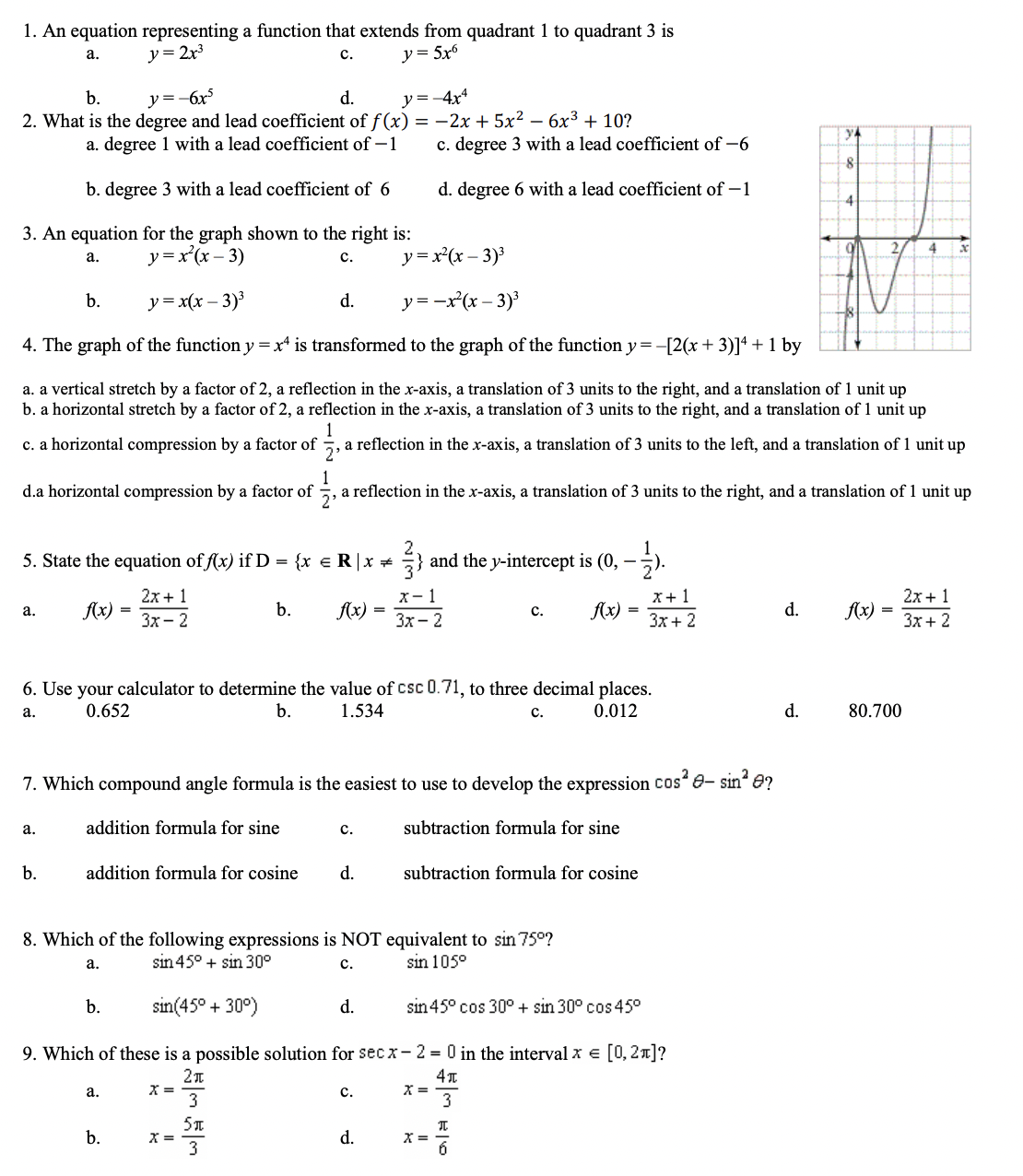
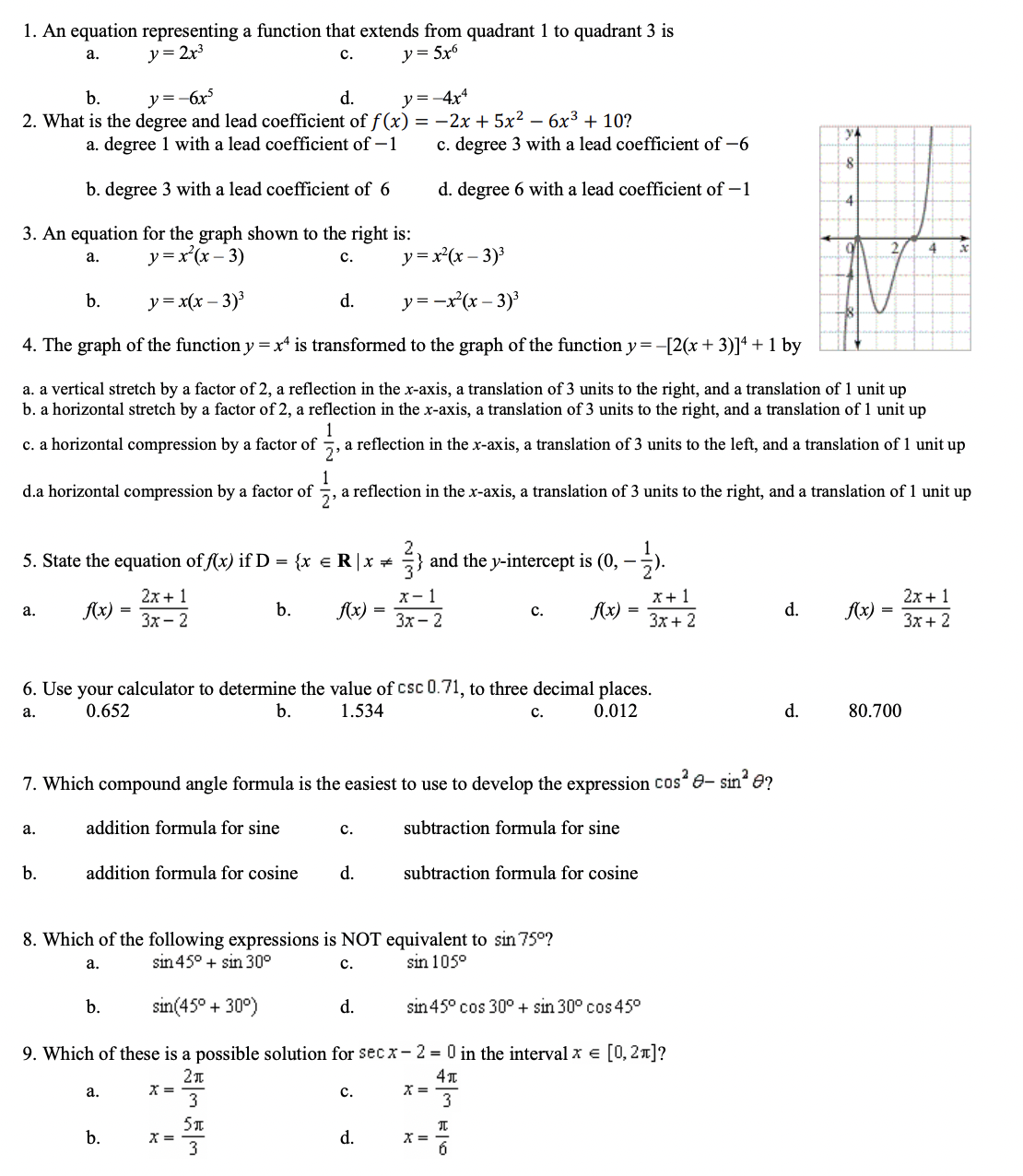
1. An equation representing a function that extends from quadrant 1 to quadrant 3 is a. y = 2x3 C. y = 5x6 b. y= -6x d. y =-4x4 2. What is the degree and lead coefficient of f (x) = -2x + 5x2 - 6x3 + 10? a. degree 1 with a lead coefficient of -1 c. degree 3 with a lead coefficient of -6 b. degree 3 with a lead coefficient of 6 d. degree 6 with a lead coefficient of -1 3. An equation for the graph shown to the right is: a. y= x(x -3) C. y= x2(x- 3)3 b . y = x(x- 3)3 d. y=-x(x-3)3 4. The graph of the function y = x* is transformed to the graph of the function y = -[2(x + 3)]* + 1 by a. a vertical stretch by a factor of 2, a reflection in the x-axis, a translation of 3 units to the right, and a translation of 1 unit up b. a horizontal stretch by a factor of 2, a reflection in the x-axis, a translation of 3 units to the right, and a translation of 1 unit up c. a horizontal compression by a factor of 5, a reflection in the x-axis, a translation of 3 units to the left, and a translation of 1 unit up d.a horizontal compression by a factor of -, a reflection in the x-axis, a translation of 3 units to the right, and a translation of 1 unit up 5. State the equation of f(x) if D = {x e R |x =
Step by Step Solution
There are 3 Steps involved in it

Get step-by-step solutions from verified subject matter experts
 Study Help