







Question: 1. Answer the case following the pattern: Summary, Issues, Recommendation . In the recommendation, in addition to your suggestions to the issue, please specify what
1. Answer the case following the pattern: Summary, Issues, Recommendation. In the recommendation, in addition to your suggestions to the issue, please specify what might could be done from both the parties to improve the situation(intercultural understanding)
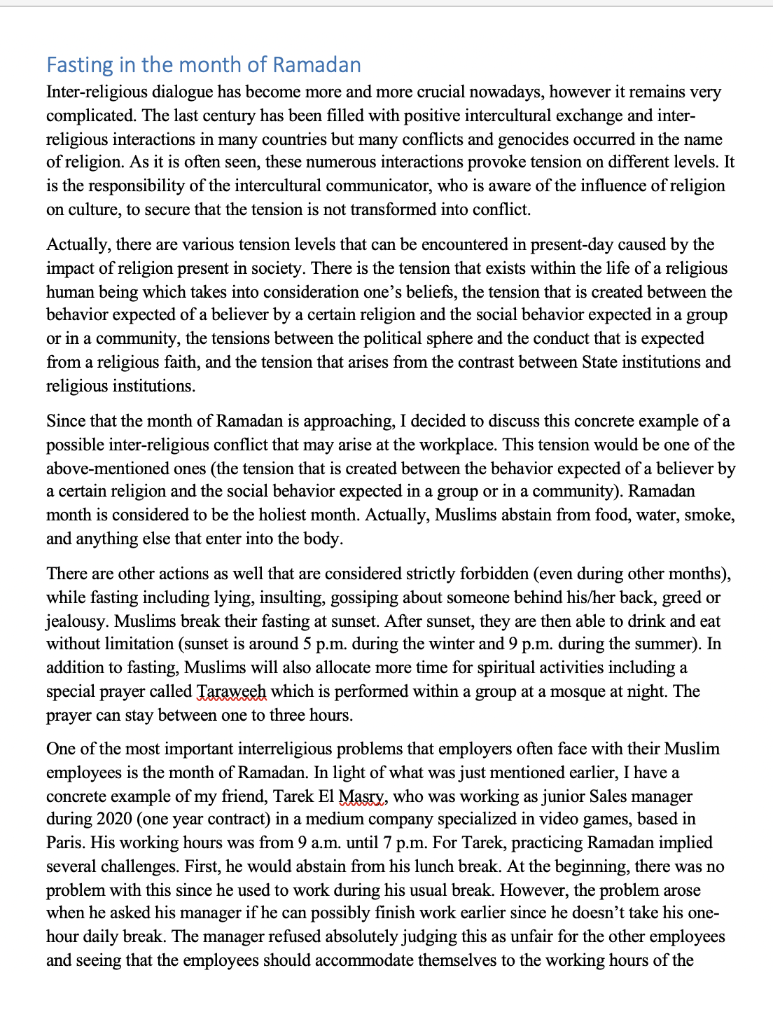
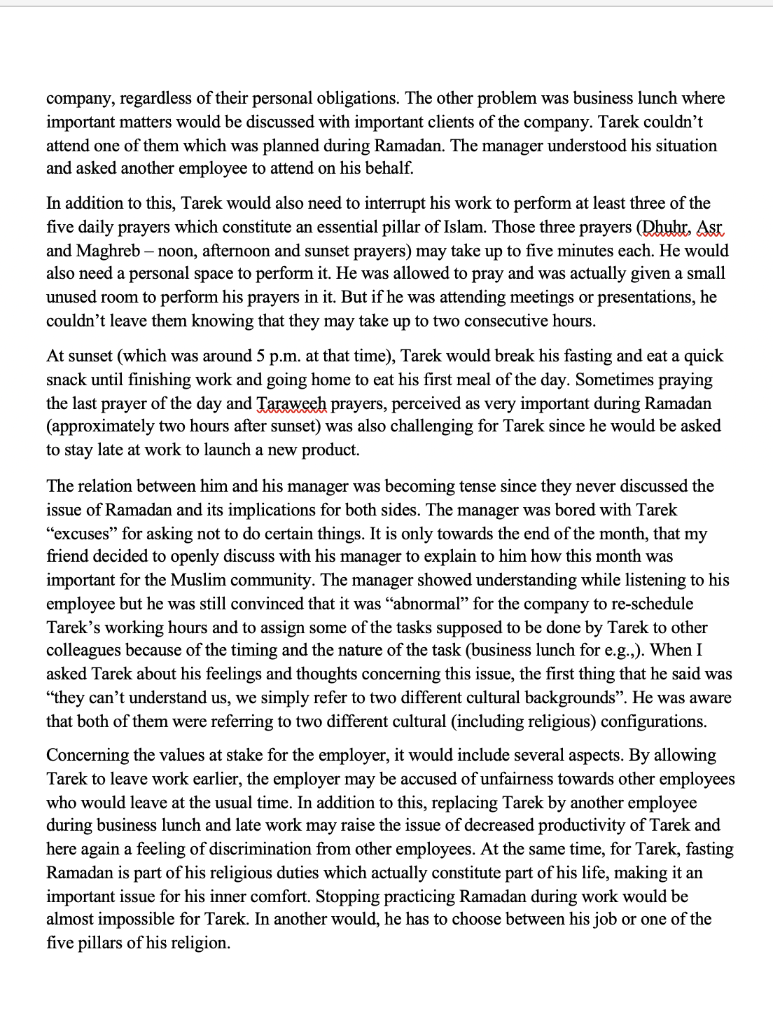
Fasting in the month of Ramadan Inter-religious dialogue has become more and more crucial nowadays, however it remains very complicated. The last century has been filled with positive intercultural exchange and inter- religious interactions in many countries but many conflicts and genocides occurred in the name of religion. As it is often seen, these numerous interactions provoke tension on different levels. It is the responsibility of the intercultural communicator, who is aware of the influence of religion on culture, to secure that the tension is not transformed into conflict. Actually, there are various tension levels that can be encountered in present-day caused by the impact of religion present in society. There is the tension that exists within the life of a religious human being which takes into consideration one's beliefs, the tension that is created between the behavior expected of a believer by a certain religion and the social behavior expected in a group or in a community, the tensions between the political sphere and the conduct that is expected from a religious faith, and the tension that arises from the contrast between State institutions and religious institutions. Since that the month of Ramadan is approaching, I decided to discuss this concrete example of a possible inter-religious conflict that may arise at the workplace. This tension would be one of the above- mentioned ones (the tension that is created between the behavior expected of a believer by a certain religion and the social behavior expected in a group or in a community). Ramadan month is considered to be the holiest month. Actually, Muslims abstain from food, water, smoke, and anything else that enter into the body. There are other actions as well that are considered strictly forbidden (even during other months), while fasting including lying, insulting, gossiping about someone behind his/her back, greed or jealousy. Muslims break their fasting at sunset. After sunset, they are then able to drink and eat without limitation (sunset is around 5 p.m. during the winter and 9 p.m. during the summer). In addition to fasting, Muslims will also allocate more time for spiritual activities including a special prayer called Taraweeh which is performed within a group at a mosque at night. The prayer can stay between one to three hours. One of the most important interreligious problems that employers often face with their Muslim employees is the month of Ramadan. In light of what was just mentioned earlier, I have a concrete example of my friend, Tarek El Masry, who was working as junior Sales manager during 2020 (one year contract) in a medium company specialized in video games, based in Paris. His working hours was from 9 a.m. until 7 p.m. For Tarek, practicing Ramadan implied several challenges. First, he would abstain from his lunch break. At the beginning, there was no problem with this since he used to work during his usual break. However, the problem arose when he asked his manager if he can possibly finish work earlier since he doesn't take his one- hour daily break. The manager refused absolutely judging this as unfair for the other employees and seeing that the employees should accommodate themselves to the working hours of the company, regardless of their personal obligations. The other problem was business lunch where important matters would be discussed with important clients of the company. Tarek couldn't attend one of them which was planned during Ramadan. The manager understood his situation and asked another employee to attend on his behalf. In addition to this, Tarek would also need to interrupt his work to perform at least three of the five daily prayers which constitute an essential pillar of Islam. Those three prayers (Dhuhr, Asr and Maghreb - noon, afternoon and sunset prayers) may take up to five minutes each. He would also need a personal space to perform it. He was allowed to pray and was actually given a small unused room to perform his prayers in it. But if he was attending meetings or presentations, he couldn't leave them knowing that they may take up to two consecutive hours. At sunset (which was around 5 p.m. at that time), Tarek would break his fasting and eat a quick snack until finishing work and going home to eat his first meal of the day. Sometimes praying the last prayer of the day and Taraweeh prayers, perceived as very important during Ramadan (approximately two hours after sunset) was also challenging for Tarek since he would be asked to stay late at work to launch a new product. The relation between him and his manager was becoming tense since they never discussed the issue of Ramadan and its implications for both sides. The manager was bored with Tarek excuses for asking not to do certain things. It is only towards the end of the month, that my friend decided to openly discuss with his manager to explain to him how this month was important for the Muslim community. The manager showed understanding while listening to his employee but he was still convinced that it was abnormal for the company to re-schedule Tarek's working hours and to assign some of the tasks supposed to be done by Tarek to other colleagues because of the timing and the nature of the task (business lunch for e.g.,). When I asked Tarek about his feelings and thoughts concerning this issue, the first thing that he said was "they can't understand us, we simply refer to two different cultural backgrounds. He was aware that both of them were referring to two different cultural (including religious) configurations. Concerning the values at stake for the employer, it would include several aspects. By allowing Tarek to leave work earlier, the employer may be accused of unfairness towards other employees who would leave at the usual time. In addition to this, replacing Tarek by another employee during business lunch and late work may raise the issue of decreased productivity of Tarek and here again a feeling of discrimination from other employees. At the same time, for Tarek, fasting Ramadan is part of his religious duties which actually constitute part of his life, making it an important issue for his inner comfort. Stopping practicing Ramadan during work would be almost impossible for Tarek. In another would, he has to choose between his job or one of the five pillars of his religionStep by Step Solution
There are 3 Steps involved in it
1 Expert Approved Answer
Step: 1 Unlock

Question Has Been Solved by an Expert!
Get step-by-step solutions from verified subject matter experts
Step: 2 Unlock
Step: 3 Unlock
 Study Help