







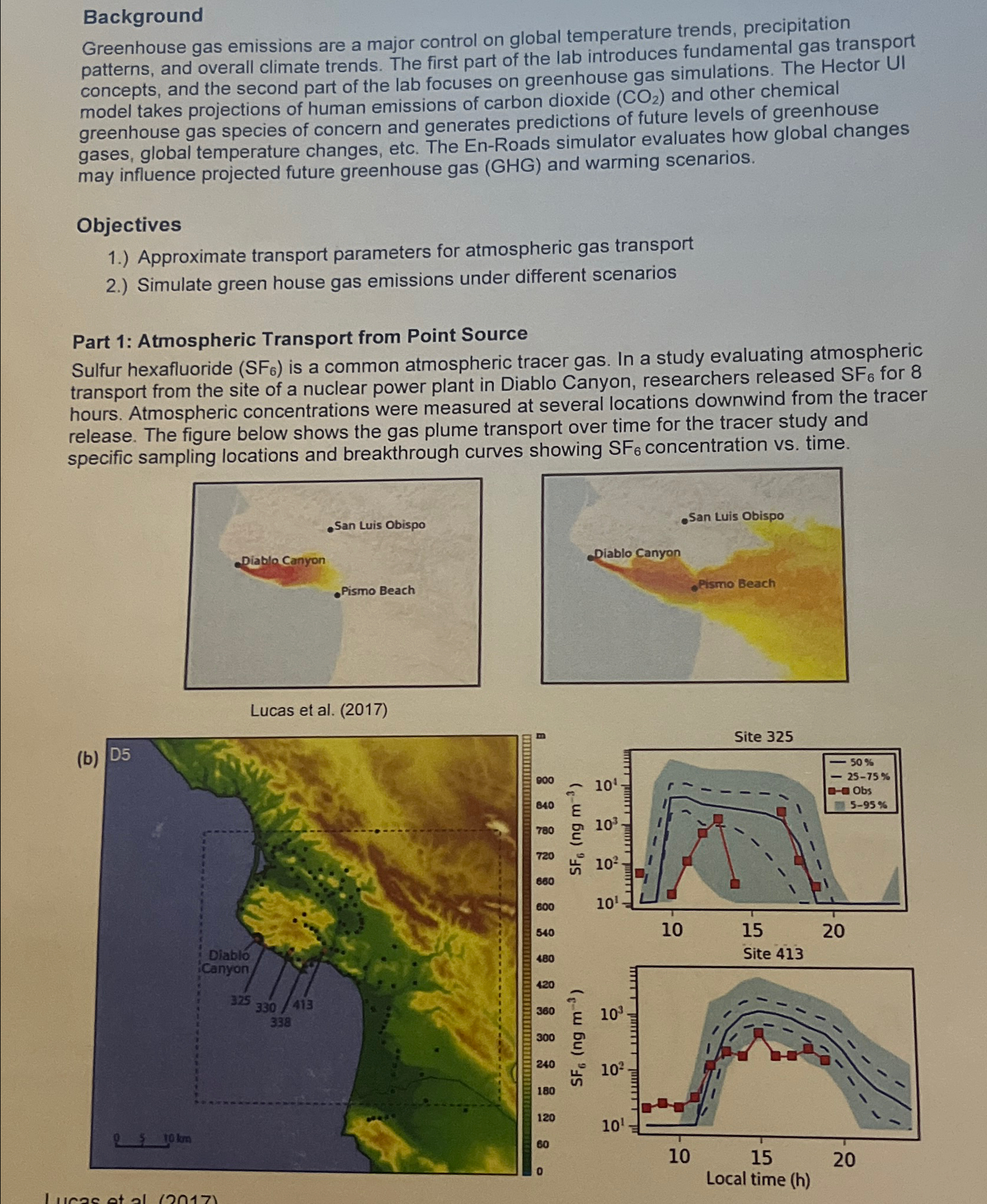
Question: 1 . ) Approximate the possible range of average wind velocities based on the two S F 6 breakthrough curves at Site 3 2 5
Approximate the possible range of average wind velocities based on the two breakthrough curves at Site and Site Hint: Use the model curves for analysis, and state distances from source approximated from figure.
Explain why concentrations at Site are much higher than Site
If the flow rate from the smoke stack is of exhaust gases at a temperature of Outside air temperature is and wind speed is The stack is tall, with a diameter of What is the plume height at the edge of the property downwind?
plume rise
buoyancy flux parameter
downwind distance
wind speed
acceleration due to gravity
stack diameter L
stack gas velocity
absolute stack gas temperature
absolute ambient air temperature
Background
Greenhouse gas emissions are a major control on global temperature trends, precipitation patterns, and overall climate trends. The first part of the lab introduces fundamental gas transport concepts, and the second part of the lab focuses on greenhouse gas simulations. The Hector UI model takes projections of human emissions of carbon dioxide and other chemical greenhouse gas species of concern and generates predictions of future levels of greenhouse gases, global temperature changes, etc. The EnRoads simulator evaluates how global changes may influence projected future greenhouse gas GHG and warming scenarios.
Objectives
Approximate transport parameters for atmospheric gas transport
Simulate green house gas emissions under different scenarios
Part : Atmospheric Transport from Point Source
Sulfur hexafluoride is a common atmospheric tracer gas. In a study evaluating atmospheric transport from the site of a nuclear power plant in Diablo Canyon, researchers released SF for hours. Atmospheric concentrations were measured at several locations downwind from the tracer release. The figure below shows the gas plume transport over time for the tracer study and specific sampling locations and breakthrough curves showing concentration vs time.
b
Step by Step Solution
There are 3 Steps involved in it
1 Expert Approved Answer
Step: 1 Unlock

Question Has Been Solved by an Expert!
Get step-by-step solutions from verified subject matter experts
Step: 2 Unlock
Step: 3 Unlock
 Study Help