







Question: 1) Are these issues relevant and salient based on your assessment of the strengths and weaknesses of the company and the opportunities and threats in
1) Are these issues relevant and salient based on your assessment of the strengths and weaknesses of the company and the opportunities and threats in the environment?
2) Why are they the appropriate issues?
3) What additional rationale and analyses would you provide to support the issues identified?
4) If they are not the appropriate issues, what do you think are the key issues and why?
5) Showcase our teams analysis and thinking here.
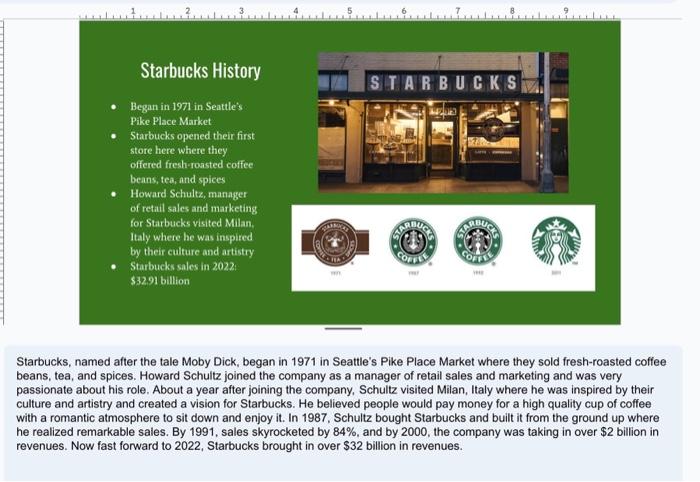
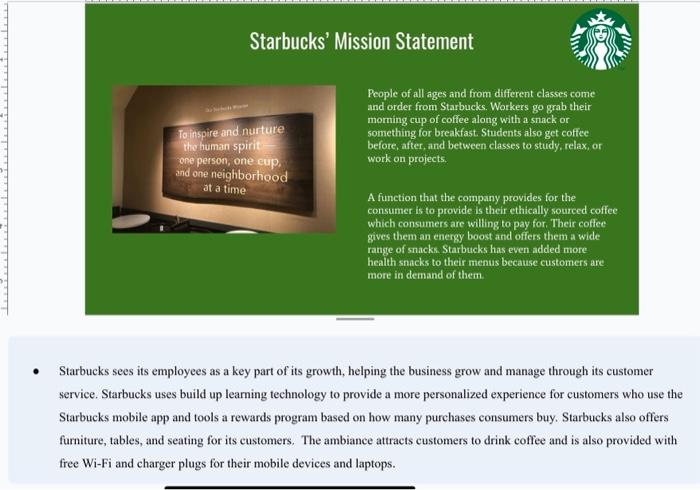
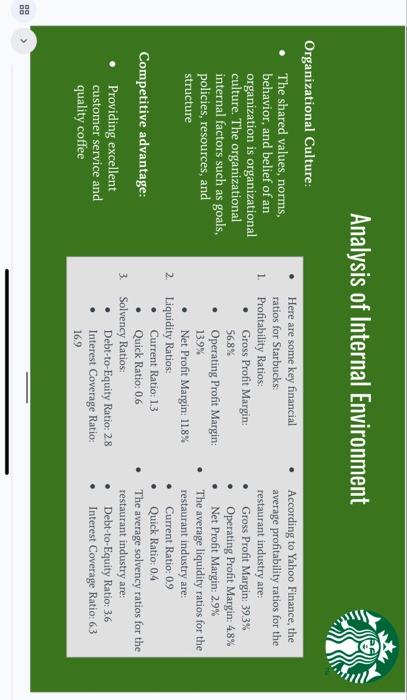
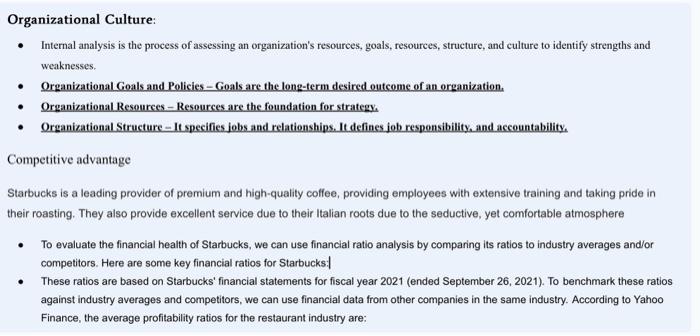
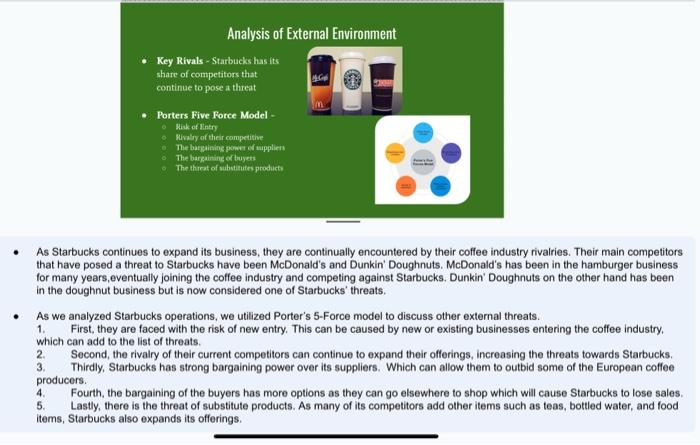
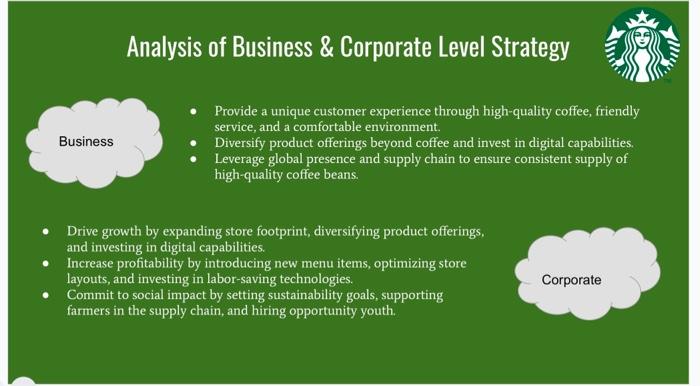
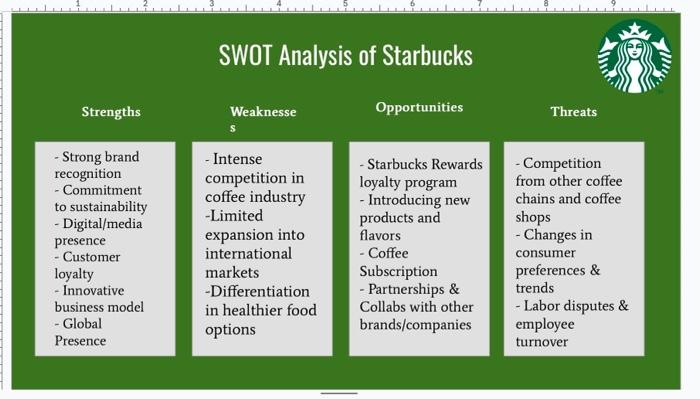
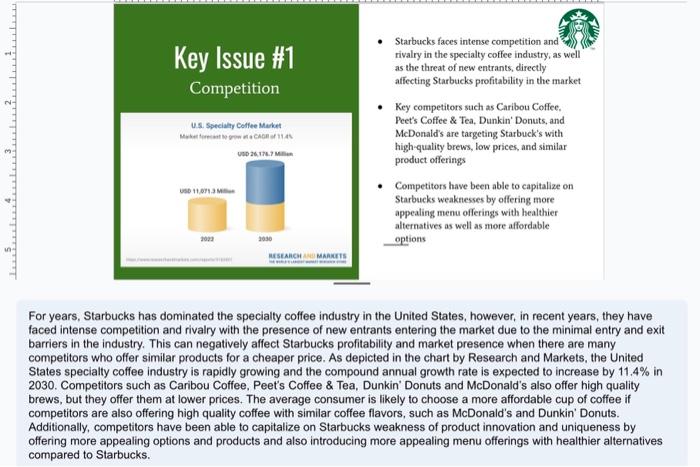
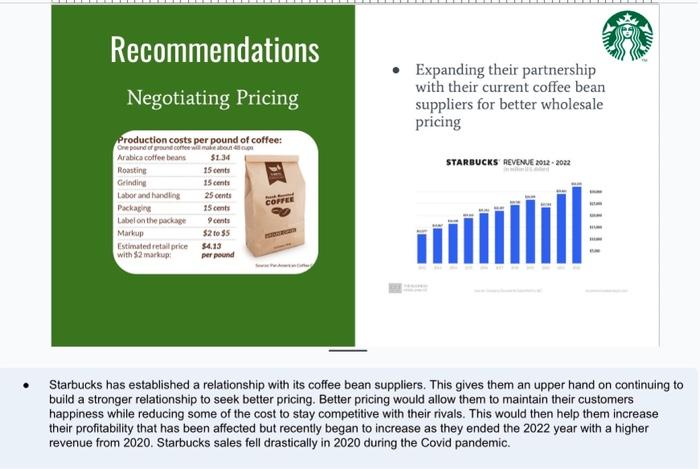
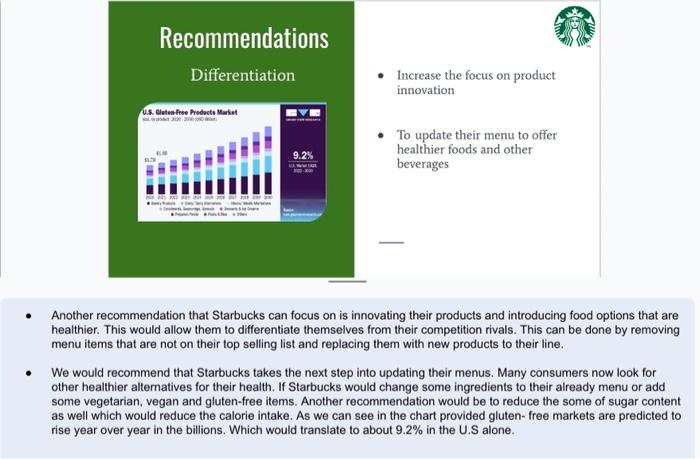
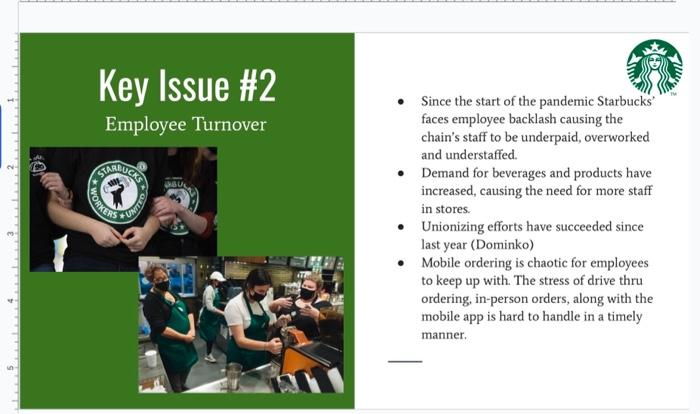
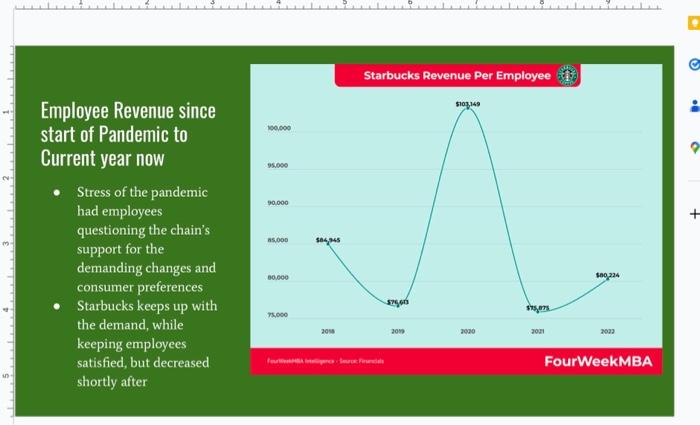
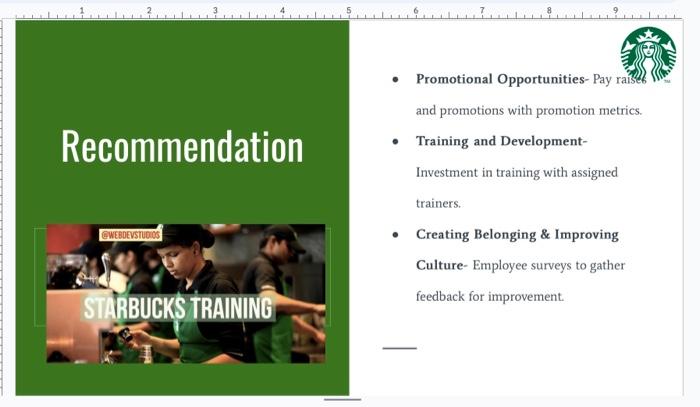
Starbucks, named after the tale Moby Dick, began in 1971 in Seattle's Pike Place Market where they sold fresh-roasted coffee beans, tea, and spices. Howard Schultz joined the company as a manager of retail sales and marketing and was very passionate about his role. About a year after joining the company, Schultz visited Milan, Italy where he was inspired by their culture and artistry and created a vision for Starbucks. He believed people would pay money for a high quality cup of coffee with a romantic atmosphere to sit down and enjoy it. In 1987, Schultz bought Starbucks and built it from the ground up where he realized remarkable sales. By 1991 , sales skyrocketed by 84%, and by 2000 , the company was taking in over $2 billion in revenues. Now fast forward to 2022 , Starbucks brought in over $32 billion in revenues. Starbucks sees its employees as a key part of its growth, helping the business grow and manage through its customer service. Starbucks uses build up learning technology to provide a more personalized experience for customers who use the Starbucks mobile app and tools a rewards program based on how many purchases consumers buy. Starbucks also offers furniture, tables, and seating for its customers. The ambiance attracts customers to drink coffee and is also provided with free Wi-Fi and charger plugs for their mobile devices and laptops. Analysis of Internal Environment - Here are some key financial - According to Yahoo Finance, the ratios for Starbucks: average profitability ratios for the 1. Profitability Ratios: restaurant industry are: - Gross Profit Margin: - Gross Profit Margin: 39.3\% - Operating Profit Margin: 4.8% - Operating Profit Margin: - Net Profit Margin: 29\% 13.9% - The average liquidity ratios for the - Net Profit Margin: 11.8\% restaurant industry are: 2. Liquidity Ratios: - Current Ratio: 0.9 - Current Ratio:13 - Quick Ratio: 0.4 - Quick Ratio: 0.6 - The average solvency ratios for the 3. Solvency Ratios: restaurant industry are: - Debt-to-Equity Ratio: 2.8 - Debt-to-Equity Ratio: 3.6 - Interest Coverage Ratio: - Interest Coverage Ratio: 63 169 Organizational Culture: - Internal analysis is the process of assessing an organization's resources, goals, resources, structure, and culture to identify strengths and weaknesses. - Organizational Goals and Policies - Goals are the long-term desired outcome of an organization. - Organizational Resources - Resources are the foundation for strategy. - Organizational Structure - It specifies jobs and relationships. It defines job responsibility, and accountability. Competitive advantage Starbucks is a leading provider of premium and high-quality coffee, providing employees with extensive training and taking pride in their roasting. They also provide excellent service due to their Italian roots due to the seductive, yet comfortable atmosphere - To evaluate the financial health of Starbucks, we can use financial ratio analysis by comparing its ratios to industry averages and/or competitors. Here are some key financial ratios for Starbucks: - These ratios are based on Starbucks' financial statements for fiscal year 2021 (ended September 26, 2021). To benchmark these ratios against industry averages and competitors, we can use financial data from other companies in the same industry. According to Yahoo Finance, the average profitability ratios for the restaurant industry are: Analysis of External Environment - Key Rivals - Starbucks has its share of competitors that continue to pose a threat - Porters Five Force Model - Misk of lint y Pivaluy of their competithe The batgaiping powers sf atppliere The bargainaing ef truyets The thirat of nubatintes product - As Starbucks continues to expand its business, they are continually encountered by their coffee industry rivalries. Their main competitors that have posed a threat to Starbucks have been McDonald's and Dunkin' Doughnuts. McDonald's has been in the hamburger business for many years,eventually joining the coffee industry and competing against Starbucks. Dunkin' Doughnuts on the other hand has been in the doughnut business but is now considered one of Starbucks' threats. - As we analyzed Starbucks operations, we utilized Porter's 5-Force model to discuss other external threats. 1. First, they are faced with the risk of new entry. This can be caused by new or existing businesses entering the coffee industry, which can add to the list of threats. 2. Second, the rivalry of their current competitors can continue to expand their offerings, increasing the threats towards Starbucks. 3. Thirdly, Starbucks has strong bargaining power over its suppliers. Which can allow them to outbid some of the European coffee producers. 4. Fourth, the bargaining of the buyers has more options as they can go elsewhere to shop which will cause Starbucks to lose sales. 5. Lastly, there is the threat of substitute products. As many of its competitors add other items such as teas, bottled water, and food items, Starbucks also expands its offerings. Analysis of Business \& Corporate Level Strategy - Provide a unique customer experience through high-quality coffee, friendly service, and a comfortable environment. - Diversify product offerings beyond coffee and invest in digital capabilities. Leverage global presence and highality coffee beans. - Drive growth by expanding store footprint, diversifying product offerings, and investing in digital capabilities. - Increase profitability by introducing new menu items, optimizing store - Commit to social impact by setting sustainability goals, supporting farmers in the supply chain, and hiring opportunity youth. Starbucks' business strategy is focused on creating a unique customer experience through a combination of quality coffee, friendly service, and a comfortable environment. The company's core competencies include sourcing high-quality coffee beans, roasting them to perfection, and providing excellent customer service. The company has diversified its product offerings beyond coffee to include teas, pastries, and other food items. Starbucks' success in these areas has been driven by its emphasis on quality, innovation, and sustainability. Starbucks has also invested heavily in its digital capabilities, allowing customers to order ahead and pay for their drinks using its mobile app. Starbucks' business strategy is supported by its extensive global presence. The company has over 31,000 stores in 82 countries, making it one of the world's largest coffeehouse chains. Starbucks has also made significant investments in its supply chain, allowing it to ensure that its stores have a consistent supply of high-quality coffee beans. Corporate Strategy: Starbucks' corporate strategy is focused on three key areas: growth, profitability, and social impact. The company aims to achieve growth by expanding its store footprint, diversifying its product offerings, and expanding its digital capabilities. Starbucks plans to open 600 new stores in the United States alone in 2022, with a focus on drive-thru and pick-up locations. To drive profitability, Starbucks is focused on increasing its average ticket size and improving its operating margins. The company has achieved this by introducing new menu items, optimizing its store layouts, and investing in labor-saving technologies. Finally, Starbucks has a strong commitment to social impact. The company has set ambitious sustainability goals, including a goal to become "resource positive" by 2030 , meaning that it will give more than it takes from the planet. Starbucks has also committed to hiring 100,000 opportunity youth by 2025 and has launched several initiatives to support farmers in its supply chain. Overall, Starbucks' business and corporate strategy have allowed it to become one of the world's most successful and recognized coffee brands. The company's focus on quality, innovation, and sustainability, combined with its extensive global presence and commitment to social impact, should position it well for continued success in the years to come. SWOT Analysis of Starbucks - Starbucks faces intense competition and rivalry in the specialty coffee industry, as well as the threat of new entrants, directly affecting Starbucks profitability in the market - Key competitors such as Caribou Coffee. Peet's Coffee \& Tea, Dunkin' Donuts, and McDonald's are targeting Starbuck's with high-quality brews, low prices, and similar product offerings - Competitors have been able to capitalize on Starbucks weaknesses by offering more appealing menu offerings with healthier alternatives as well as more affordable options For years, Starbucks has dominated the specialty coffee industry in the United States, however, in recent years, they have faced intense competition and rivalry with the presence of new entrants entering the market due to the minimal entry and exit barriers in the industry. This can negatively affect Starbucks profitability and market presence when there are many competitors who offer similar products for a cheaper price. As depicted in the chart by Research and Markets, the United States specialty coffee industry is rapidly growing and the compound annual growth rate is expected to increase by 11.4% in 2030. Competitors such as Caribou Coffee, Peet's Coffee \& Tea, Dunkin' Donuts and McDonald's also offer high quality brews, but they offer them at lower prices. The average consumer is likely to choose a more affordable cup of coffee if competitors are also offering high quality coffee with similar coffee flavors, such as McDonald's and Dunkin' Donuts. Additionally, competitors have been able to capitalize on Starbucks weakness of product innovation and uniqueness by offering more appealing options and products and also introducing more appealing menu offerings with healthier alternatives compared to Starbucks. Recommendations - Expanding their partnership with their current coffee bean suppliers for better wholesale pricing Production costs per pound of coffee: Starbucks has established a relationship with its coffee bean suppliers. This gives them an upper hand on continuing to build a stronger relationship to seek better pricing. Better pricing would allow them to maintain their customers happiness while reducing some of the cost to stay competitive with their rivals. This would then help them increase their profitability that has been affected but recently began to increase as they ended the 2022 year with a higher revenue from 2020. Starbucks sales fell drastically in 2020 during the Covid pandemic. - Increase the focus on product innovation - To update their menu to offer healthier foods and other beverages Another recommendation that Starbucks can focus on is innovating their products and introducing food options that are healthier. This would allow them to differentiate themselves from their competition rivals. This can be done by removing menu items that are not on their top selling list and replacing them with new products to their line. We would recommend that Starbucks takes the next step into updating their menus. Many consumers now look for other healthier alternatives for their health. If Starbucks would change some ingredients to their already menu or add some vegetarian, vegan and gluten-free items. Another recommendation would be to reduce the some of sugar content as well which would reduce the calorie intake. As we can see in the chart provided gluten-free markets are predicted to rise year over year in the billions. Which would translate to about 9.2% in the U.S alone. - Since the start of the pandemic Starbucks' faces employee backlash causing the chain's staff to be underpaid, overworked and understaffed. - Demand for beverages and products have increased, causing the need for more staff in stores. - Unionizing efforts have succeeded since last year (Dominko) - Mobile ordering is chaotic for employees to keep up with. The stress of drive thru ordering, in-person orders, along with the mobile app is hard to handle in a timely manner. Employee Revenue since start of Pandemic to Current year now - Stress of the pandemic had employees questioning the chain's support for the demanding changes and consumer preferences - Starbucks keeps up with the demand, while keeping employees satisfied, but decreased shortly after - Promotional Opportunities-Pay raiseb and promotions with promotion metrics. - Training and Development- Investment in training with assigned trainers. - Creating Belonging \& Improving Culture- Employee surveys to gather feedback for improvement
Step by Step Solution
There are 3 Steps involved in it

Get step-by-step solutions from verified subject matter experts
 Study Help