Question: 1. Assault vs. Battery: When does an assault become a battery? Can battery be a tort, a crime or both? 2. Conversion vs. Trespass to
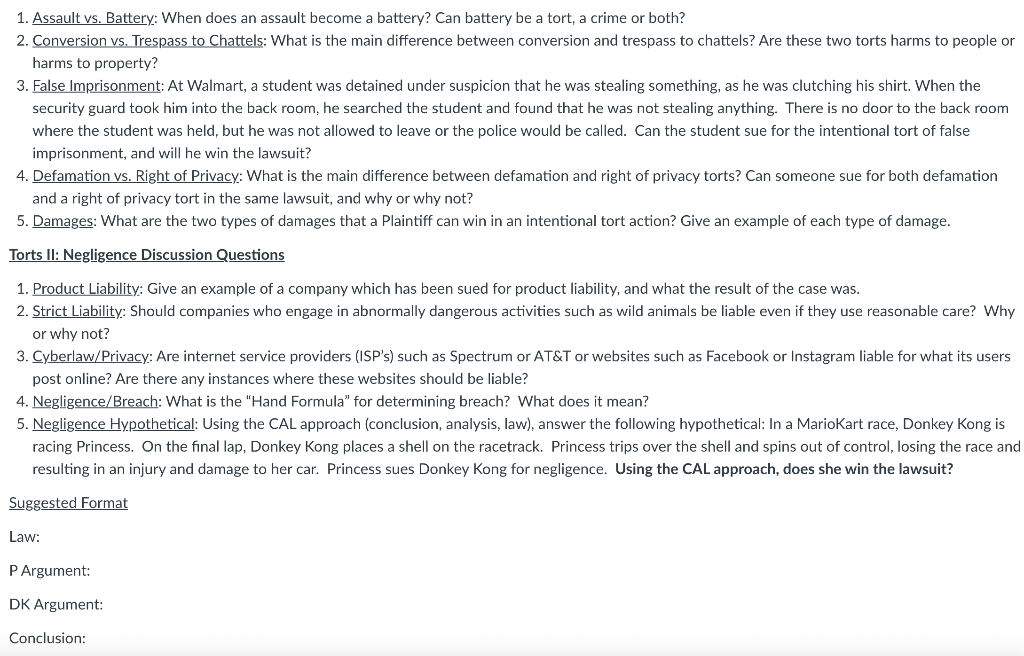
1. Assault vs. Battery: When does an assault become a battery? Can battery be a tort, a crime or both? 2. Conversion vs. Trespass to Chattels: What is the main difference between conversion and trespass to chattels? Are these two torts harms to people or harms to property? 3. False Imprisonment: At Walmart, a student was detained under suspicion that he was stealing something, as he was clutching his shirt. When the security guard took him into the back room, he searched the student and found that he was not stealing anything. There is no door to the back room where the student was held, but he was not allowed to leave or the police would be called. Can the student sue for the intentional tort of false imprisonment, and will he win the lawsuit? 4. Defamation vs. Right of Privacy: What is the main difference between defamation and right of privacy torts? Can someone sue for both defamation and a right of privacy tort in the same lawsuit, and why or why not? 5. Damages: What are the two types of damages that a plaintiff can win in an intentional tort action? Give an example of each type of damage. Torts II: Negligence Discussion Questions 1. Product Liability: Give an example of a company which has been sued for product liability, and what the result of the case was. 2. Strict Liability: Should companies who engage in abnormally dangerous activities such as wild animals be liable even if they use reasonable care? Why or why not? 3. Cyberlaw/Privacy: Are internet service providers (ISP's) such as Spectrum or AT&T or websites such as Facebook or Instagram liable for what its users post online? Are there any instances where these websites should be liable? 4. Negligence/Breach: What is the "Hand Formula" for determining breach? What does it mean? 5. Negligence Hypothetical: Using the CAL approach (conclusion, analysis, law), answer the following hypothetical: In a MarioKart race, Donkey Kong is racing Princess. On the final lap, Donkey Kong places a shell on the racetrack. Princess trips over the shell and spins out of control, losing the race and resulting in an injury and damage to her car. Princess sues Donkey Kong for negligence. Using the CAL approach, does she win the lawsuit? Suggested Format Law: P Argument: DK Argument: Conclusion: 1. Assault vs. Battery: When does an assault become a battery? Can battery be a tort, a crime or both? 2. Conversion vs. Trespass to Chattels: What is the main difference between conversion and trespass to chattels? Are these two torts harms to people or harms to property? 3. False Imprisonment: At Walmart, a student was detained under suspicion that he was stealing something, as he was clutching his shirt. When the security guard took him into the back room, he searched the student and found that he was not stealing anything. There is no door to the back room where the student was held, but he was not allowed to leave or the police would be called. Can the student sue for the intentional tort of false imprisonment, and will he win the lawsuit? 4. Defamation vs. Right of Privacy: What is the main difference between defamation and right of privacy torts? Can someone sue for both defamation and a right of privacy tort in the same lawsuit, and why or why not? 5. Damages: What are the two types of damages that a plaintiff can win in an intentional tort action? Give an example of each type of damage. Torts II: Negligence Discussion Questions 1. Product Liability: Give an example of a company which has been sued for product liability, and what the result of the case was. 2. Strict Liability: Should companies who engage in abnormally dangerous activities such as wild animals be liable even if they use reasonable care? Why or why not? 3. Cyberlaw/Privacy: Are internet service providers (ISP's) such as Spectrum or AT&T or websites such as Facebook or Instagram liable for what its users post online? Are there any instances where these websites should be liable? 4. Negligence/Breach: What is the "Hand Formula" for determining breach? What does it mean? 5. Negligence Hypothetical: Using the CAL approach (conclusion, analysis, law), answer the following hypothetical: In a MarioKart race, Donkey Kong is racing Princess. On the final lap, Donkey Kong places a shell on the racetrack. Princess trips over the shell and spins out of control, losing the race and resulting in an injury and damage to her car. Princess sues Donkey Kong for negligence. Using the CAL approach, does she win the lawsuit? Suggested Format Law: P Argument: DK Argument: Conclusion









 Study Help