







Question: 1. b) Most problems in introductory physics present a situation and ask you to determine what will happen next using ideas that were just introduced.
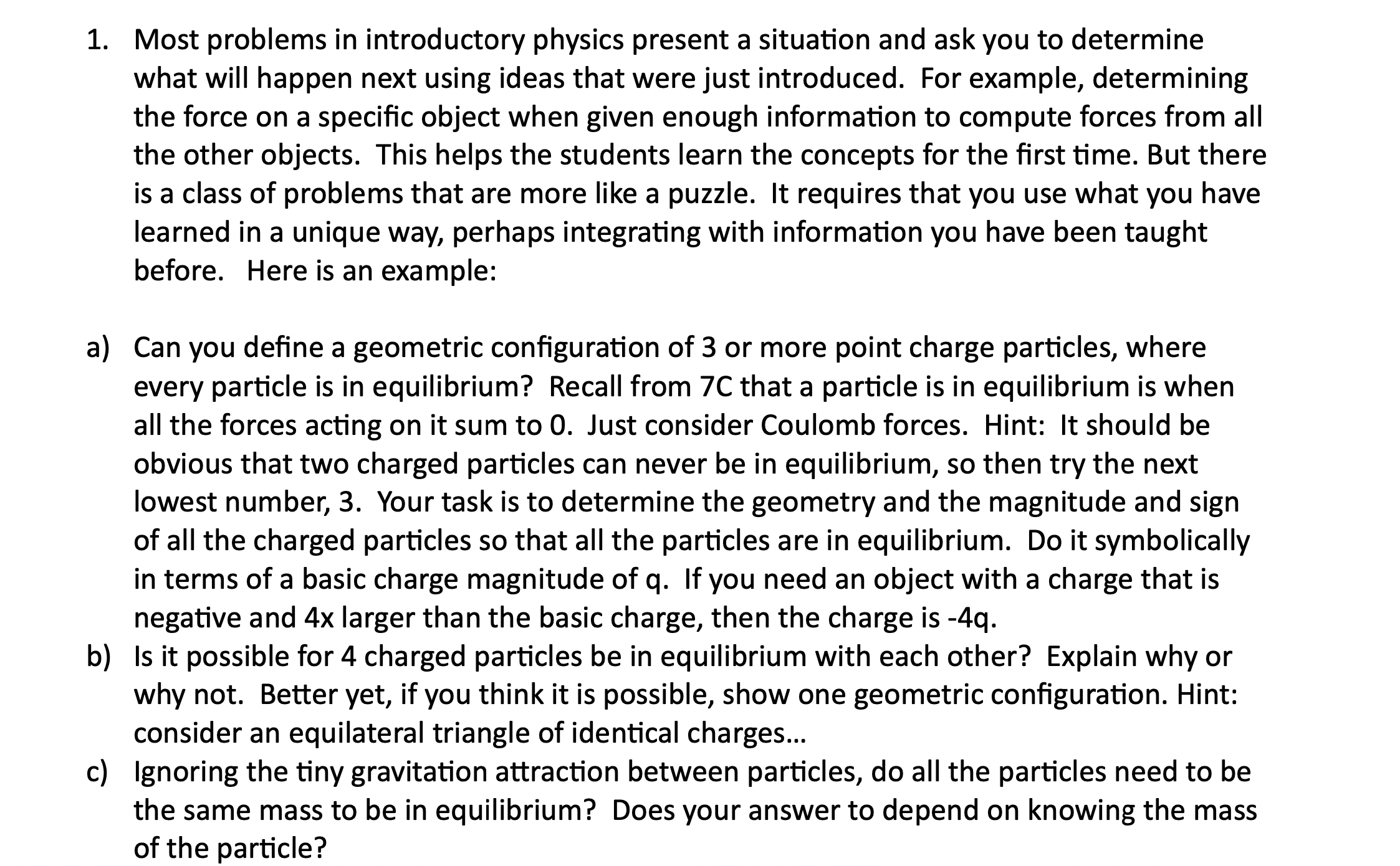
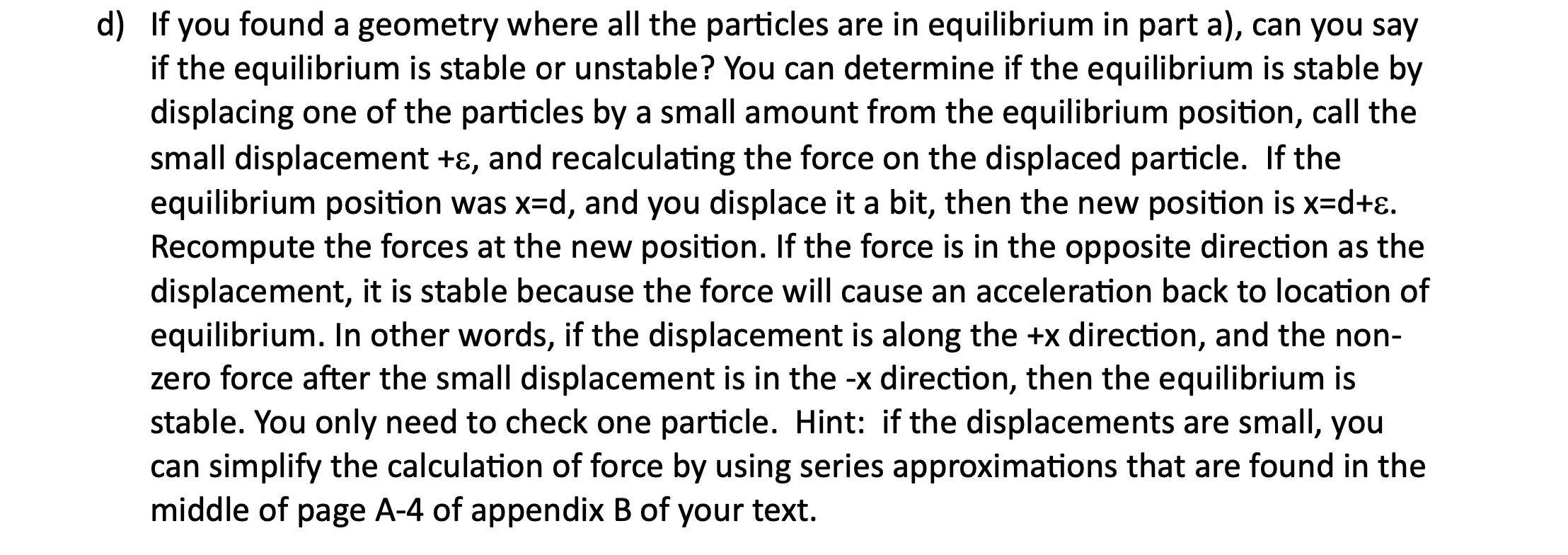
1. b) Most problems in introductory physics present a situation and ask you to determine what will happen next using ideas that were just introduced. For example, determining the force on a specic object when given enough information to compute forces from all the other objects. This helps the students learn the concepts for the rst time. But there is a class of problems that are more like a puzzle. It requires that you use what you have learned in a unique way, perhaps integrating with information you have been taught before. Here is an example: Can you dene a geometric conguration of 3 or more point charge particles, where every particle is in equilibrium? Recall from 7C that a particle is in equilibrium is when all the forces acting on it sum to 0. Just consider Coulomb forces. Hint: It should be obvious that two charged particles can never be in equilibrium, so then try the next lowest number, 3. Your task is to determine the geometry and the magnitude and sign of all the charged particles so that all the particles are in equilibrium. Do it symbolically in terms of a basic charge magnitude of q. If you need an object with a charge that is negative and 4x larger than the basic charge, then the charge is -4q. Is it possible for 4 charged particles be in equilibrium with each other? Explain why or why not. Better yet, if you think it is possible, show one geometric conguration. Hint: consider an equilateral triangle of identical charges... Ignoring the tiny gravitation attraction between particles, do all the particles need to be the same mass to be in equilibrium? Does your answer to depend on knowing the mass of the particle? d) If you found a geometry where all the particles are in equilibrium in part a), can you say if the equilibrium is stable or unstable? You can determine if the equilibrium is stable by displacing one of the particles by a small amount from the equilibrium position, call the small displacement +3, and recalculating the force on the displaced particle. If the equilibrium position was x=d, and you displace it a bit, then the new position is x=d+s. Recompute the forces at the new position. If the force is in the opposite direction as the displacement, it is stable because the force will cause an acceleration back to location of equilibrium. In other words, if the displacement is along the +x direction, and the non- zero force after the small displacement is in the -x direction, then the equilibrium is stable. You only need to check one particle. Hint: if the displacements are small, you can simplify the calculation of force by using series approximations that are found in the middle of page A-4 of appendix B of your text
Step by Step Solution
There are 3 Steps involved in it

Get step-by-step solutions from verified subject matter experts
 Study Help