







Question: 1. Before estimating the regression equation, conduct a preliminary analysis of the relationship between workers' earnings and 1) gender; 2) educational attainment; 3) skill level;
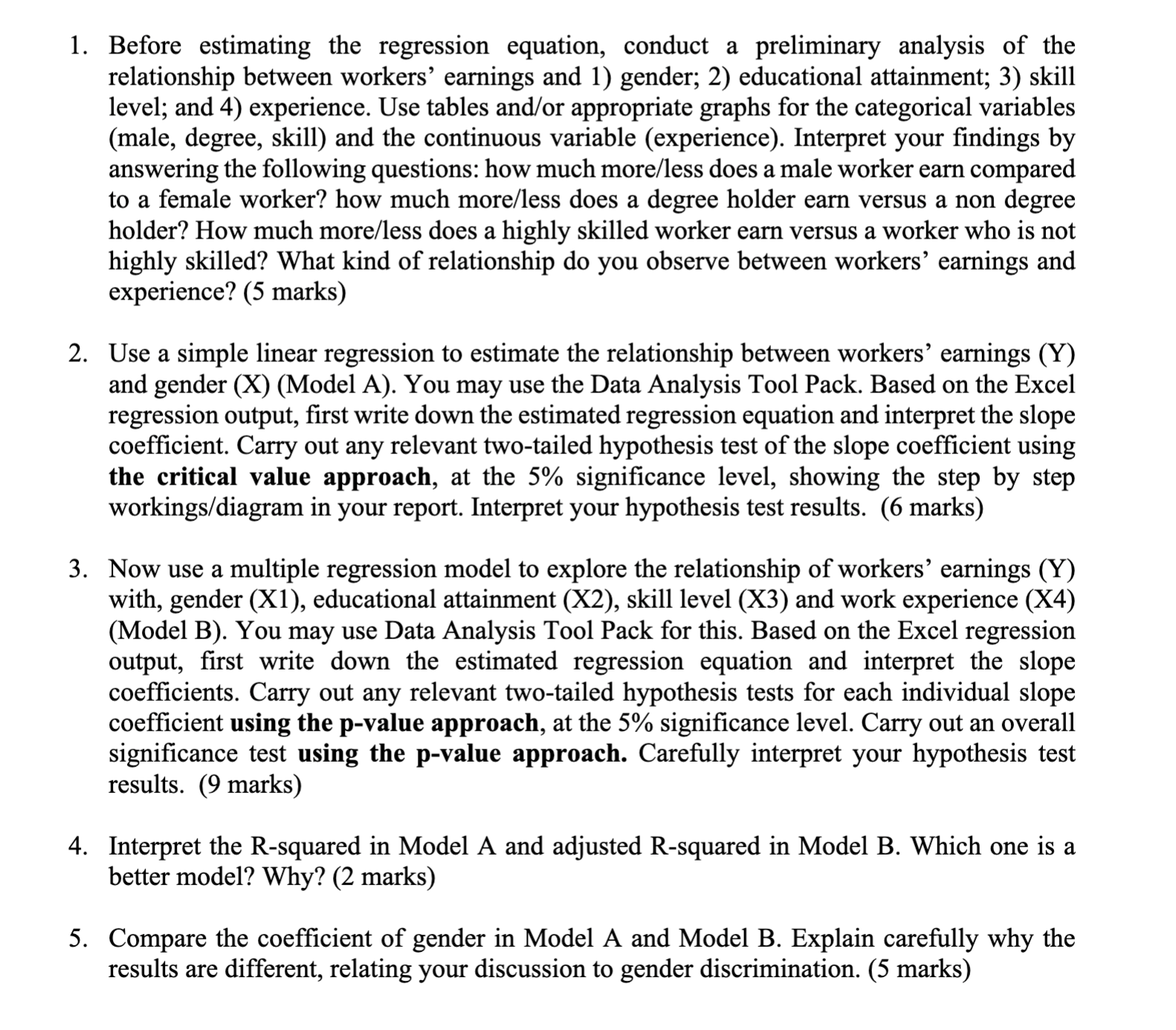
1. Before estimating the regression equation, conduct a preliminary analysis of the relationship between workers' earnings and 1) gender; 2) educational attainment; 3) skill level; and 4) experience. Use tables and/or appropriate graphs for the categorical variables (male, degree, skill) and the continuous variable (experience). Interpret your findings by answering the following questions: how much more/less does a male worker earn compared to a female worker? how much more/less does a degree holder earn versus a non degree holder? How much more/less does a highly skilled worker earn versus a worker who is not highly skilled? What kind of relationship do you observe between workers' earnings and experience? (5 marks) 2. Use a simple linear regression to estimate the relationship between workers' earnings (Y) and gender (X) (Model A). You may use the Data Analysis Tool Pack. Based on the Excel regression output, first write down the estimated regression equation and interpret the slope coefficient. Carry out any relevant two-tailed hypothesis test of the slope coefficient using the critical value approach, at the 5% significance level, showing the step by step workings/diagram in your report. Interpret your hypothesis test results. (6 marks) 3. Now use a multiple regression model to explore the relationship of workers' earnings (Y) with, gender (X1), educational attainment (X2), skill level (X3) and work experience (X4) (Model B). You may use Data Analysis Tool Pack for this. Based on the Excel regression output, first write down the estimated regression equation and interpret the slope coefficients. Carry out any relevant two-tailed hypothesis tests for each individual slope coefficient using the p-value approach, at the 5% significance level. Carry out an overall significance test using the p-value approach. Carefully interpret your hypothesis test results. (9 marks) 4. Interpret the R-squared in Model A and adjusted R-squared in Model B. Which one is a better model? Why? (2 marks) 5. Compare the coefficient of gender in Model A and Model B. Explain carefully why the results are different, relating your discussion to gender discrimination
Step by Step Solution
There are 3 Steps involved in it

Get step-by-step solutions from verified subject matter experts
 Study Help