







Question: 1. Below are the algorithm steps to solve a problem. The G=(V. E) series (graph) consists of V node (node. vertex) and E edge
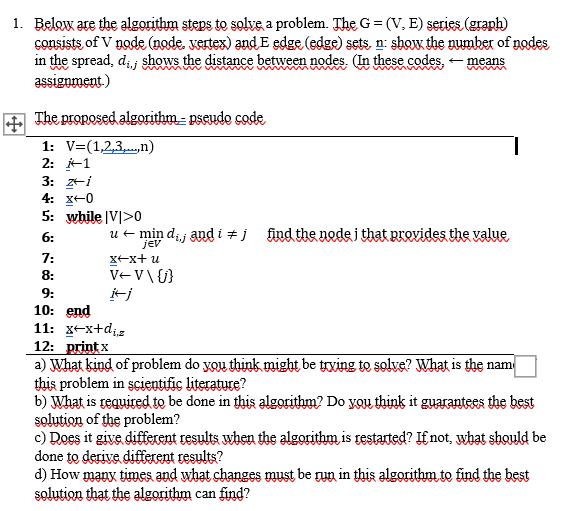
1. Below are the algorithm steps to solve a problem. The G=(V. E) series (graph) consists of V node (node. vertex) and E edge (edge) sets. n: show the number of nodes in the spread, d; shows the distance between nodes. (In these codes, - means assignment.) The proposed algorithm- pseudo code 1: V=(1,2,3,...,n) 2: 1 3: z-i 4: X+0 5: while |V>0 6: 7: 8: u min dij and i j find the node i that provides the value jev x+x+u V-V \ {j} 9: 10: end 11: x+x+diz 12: print x a) What kind of problem do you think might be trying to solve? What is the nam this problem in scientific literature? b) What is required to be done in this algorithm? Do you think it guarantees the best solution of the problem? c) Does it give different results when the algorithm is restarted? If not, what should be done to derive different results? d) How many times and what changes must be run in this algorithm to find the best solution that the algorithm can find?
Step by Step Solution
3.44 Rating (154 Votes )
There are 3 Steps involved in it
a The proposed algorithm seems to be solving a graph problem related to finding the shortest path be... View full answer

Get step-by-step solutions from verified subject matter experts
 Study Help