







Question: 1 Binary genetic algorithm (Python) Here we constructed a binary genetic algorithm based on the evolution of a population of NPOP individuals (or chromosomes), each
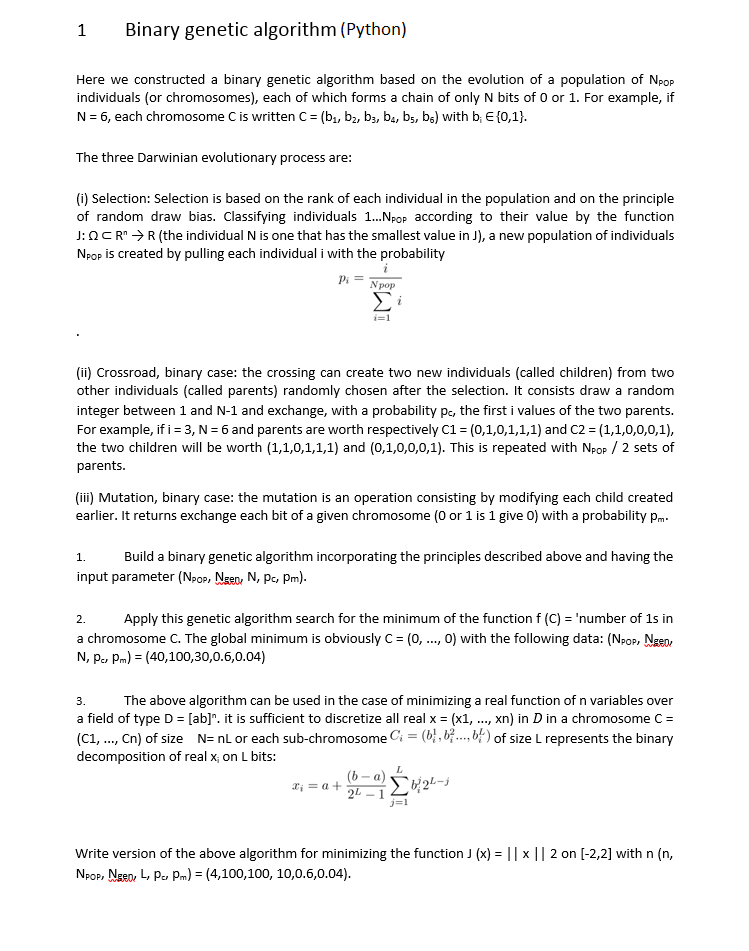
1 Binary genetic algorithm (Python) Here we constructed a binary genetic algorithm based on the evolution of a population of NPOP individuals (or chromosomes), each of which forms a chain of only N bits of 0 or 1. For example, if N = 6, each chromosome C is written C = (bi, bz, bz, ba, bs, b) with b; E{0,1}. The three Darwinian evolutionary process are: (i) Selection: Selection is based on the rank of each individual in the population and on the principle of random draw bias. Classifying individuals 1...Npop according to their value by the function J: O CR" R (the individual N is one that has the smallest value in J), a new population of individuals Npop is created by pulling each individual i with the probability Pi = Npop (ii) Crossroad, binary case: the crossing can create two new individuals (called children) from two other individuals (called parents) randomly chosen after the selection. It consists draw a random integer between 1 and N-1 and exchange, with a probability pc, the first i values of the two parents. For example, if i = 3, N = 6 and parents are worth respectively C1 = (0,1,0,1,1,1) and C2 = (1,1,0,0,0,1), the two children will be worth (1,1,0,1,1,1) and (0,1,0,0,0,1). This is repeated with Npop / 2 sets of parents. (iii) Mutation, binary case: the mutation is an operation consisting by modifying each child created earlier. It returns exchange each bit of a given chromosome (0 or 1 is 1 give 0) with a probability Pm. 1. Build a binary genetic algorithm incorporating the principles described above and having the input parameter (Npop, Ngen, N, P, Pm). 2. Apply this genetic algorithm search for the minimum of the function f(C) = 'number of 1s in a chromosome C. The global minimum is obviously C = (0,...,O) with the following data: (Npop, Nzen, N, P, Pm) = (40,100,30,0.6,0.04) 3. The above algorithm can be used in the case of minimizing a real function of n variables over a field of type D = [ab]". it is sufficient to discretize all real x = (x1, ..., xn) in D in a chromosome C = (C1, ..., Cn) of size N=nL or each sub-chromosome C; = 6,67..., b) of size L represents the binary decomposition of real x on L bits: &i= a + b ual- i=1 Write version of the above algorithm for minimizing the function] (x) = || x || 2 on (-2,2] with n (n, Npop, Ngen L, pa pm) = (4,100,100, 10,0.6,0.04). 1 Binary genetic algorithm (Python) Here we constructed a binary genetic algorithm based on the evolution of a population of NPOP individuals (or chromosomes), each of which forms a chain of only N bits of 0 or 1. For example, if N = 6, each chromosome C is written C = (bi, bz, bz, ba, bs, b) with b; E{0,1}. The three Darwinian evolutionary process are: (i) Selection: Selection is based on the rank of each individual in the population and on the principle of random draw bias. Classifying individuals 1...Npop according to their value by the function J: O CR" R (the individual N is one that has the smallest value in J), a new population of individuals Npop is created by pulling each individual i with the probability Pi = Npop (ii) Crossroad, binary case: the crossing can create two new individuals (called children) from two other individuals (called parents) randomly chosen after the selection. It consists draw a random integer between 1 and N-1 and exchange, with a probability pc, the first i values of the two parents. For example, if i = 3, N = 6 and parents are worth respectively C1 = (0,1,0,1,1,1) and C2 = (1,1,0,0,0,1), the two children will be worth (1,1,0,1,1,1) and (0,1,0,0,0,1). This is repeated with Npop / 2 sets of parents. (iii) Mutation, binary case: the mutation is an operation consisting by modifying each child created earlier. It returns exchange each bit of a given chromosome (0 or 1 is 1 give 0) with a probability Pm. 1. Build a binary genetic algorithm incorporating the principles described above and having the input parameter (Npop, Ngen, N, P, Pm). 2. Apply this genetic algorithm search for the minimum of the function f(C) = 'number of 1s in a chromosome C. The global minimum is obviously C = (0,...,O) with the following data: (Npop, Nzen, N, P, Pm) = (40,100,30,0.6,0.04) 3. The above algorithm can be used in the case of minimizing a real function of n variables over a field of type D = [ab]". it is sufficient to discretize all real x = (x1, ..., xn) in D in a chromosome C = (C1, ..., Cn) of size N=nL or each sub-chromosome C; = 6,67..., b) of size L represents the binary decomposition of real x on L bits: &i= a + b ual- i=1 Write version of the above algorithm for minimizing the function] (x) = || x || 2 on (-2,2] with n (n, Npop, Ngen L, pa pm) = (4,100,100, 10,0.6,0.04)
Step by Step Solution
There are 3 Steps involved in it

Get step-by-step solutions from verified subject matter experts
 Study Help