







Question: 1. BLJ say that cash differs from open-loop and closed-loop payments systems in which of the following ways? (p. 118; Kindle, 2014) (Ch. 6, Introductory
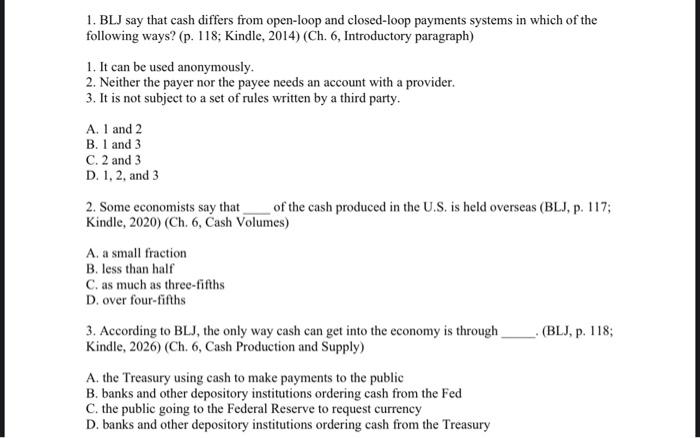
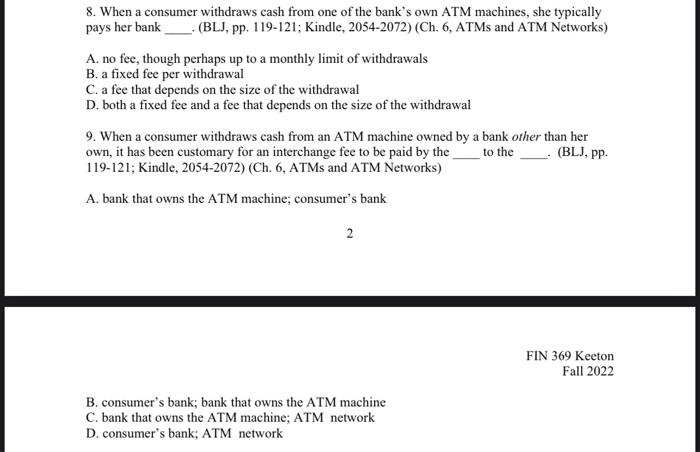
1. BLJ say that cash differs from open-loop and closed-loop payments systems in which of the following ways? (p. 118; Kindle, 2014) (Ch. 6, Introductory paragraph) 1. It can be used anonymously. 2. Neither the payer nor the payee needs an account with a provider. 3 . It is not subject to a set of rules written by a third party. A. 1 and 2 B. 1 and 3 C. 2 and 3 D. 1,2 , and 3 2. Some economists say that of the cash produced in the U.S. is held overseas (BLJ, p. 117; Kindle, 2020) (Ch. 6, Cash Volumes) A. a small fraction B. less than half C. as much as three-fifths D. over four-fifths 3. According to BLJ, the only way cash can get into the economy is through (BLJ, p. 118; Kindle, 2026) (Ch. 6, Cash Production and Supply) A. the Treasury using cash to make payments to the public B. banks and other depository institutions ordering cash from the Fed C. the public going to the Federal Reserve to request currency D. banks and other depository institutions ordering cash from the Treasury 8. When a consumer withdraws cash from one of the bank's own ATM machines, she typically pays her bank ___. (BLJ, pp. 119-121; Kindle, 2054-2072) (Ch. 6, ATMs and ATM Networks) A. no fee, though perhaps up to a monthly limit of withdrawals B. a fixed fee per withdrawal C. a fee that depends on the size of the withdrawal D. both a fixed fee and a fee that depends on the size of the withdrawal 9. When a consumer withdraws cash from an ATM machine owned by a bank other than her own, it has been customary for an interchange fee to be paid by the to the (BLJ, pp. 119-121; Kindle, 2054-2072) (Ch. 6, ATMs and ATM Networks) A. bank that owns the ATM machine; consumer's bank 2 FIN 369 Keeton Fall 2022 B. consumer's bank; bank that owns the ATM machine C. bank that owns the ATM machine; ATM network D. consumer's bank; ATM network 1. BLJ say that cash differs from open-loop and closed-loop payments systems in which of the following ways? (p. 118; Kindle, 2014) (Ch. 6, Introductory paragraph) 1. It can be used anonymously. 2. Neither the payer nor the payee needs an account with a provider. 3 . It is not subject to a set of rules written by a third party. A. 1 and 2 B. 1 and 3 C. 2 and 3 D. 1,2 , and 3 2. Some economists say that of the cash produced in the U.S. is held overseas (BLJ, p. 117; Kindle, 2020) (Ch. 6, Cash Volumes) A. a small fraction B. less than half C. as much as three-fifths D. over four-fifths 3. According to BLJ, the only way cash can get into the economy is through (BLJ, p. 118; Kindle, 2026) (Ch. 6, Cash Production and Supply) A. the Treasury using cash to make payments to the public B. banks and other depository institutions ordering cash from the Fed C. the public going to the Federal Reserve to request currency D. banks and other depository institutions ordering cash from the Treasury 8. When a consumer withdraws cash from one of the bank's own ATM machines, she typically pays her bank ___. (BLJ, pp. 119-121; Kindle, 2054-2072) (Ch. 6, ATMs and ATM Networks) A. no fee, though perhaps up to a monthly limit of withdrawals B. a fixed fee per withdrawal C. a fee that depends on the size of the withdrawal D. both a fixed fee and a fee that depends on the size of the withdrawal 9. When a consumer withdraws cash from an ATM machine owned by a bank other than her own, it has been customary for an interchange fee to be paid by the to the (BLJ, pp. 119-121; Kindle, 2054-2072) (Ch. 6, ATMs and ATM Networks) A. bank that owns the ATM machine; consumer's bank 2 FIN 369 Keeton Fall 2022 B. consumer's bank; bank that owns the ATM machine C. bank that owns the ATM machine; ATM network D. consumer's bank; ATM network
Step by Step Solution
There are 3 Steps involved in it

Get step-by-step solutions from verified subject matter experts
 Study Help