







Question: 1. Bob's preferences are characterized by the utility function 730.39) 2 leaf'3 where 0 1. Bob's preferences are characterized by the utility function = kgl
1. Bob's preferences are characterized by the utility function 730.39) 2 leaf'3 where 0
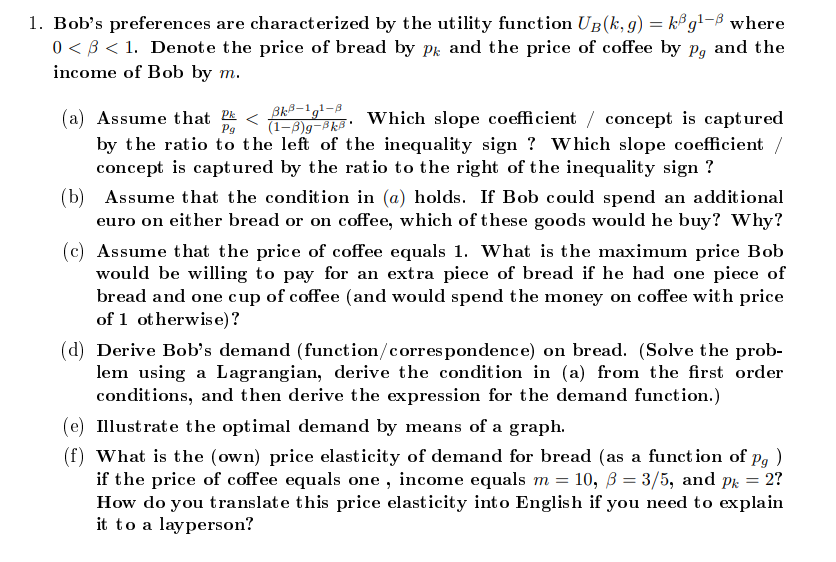
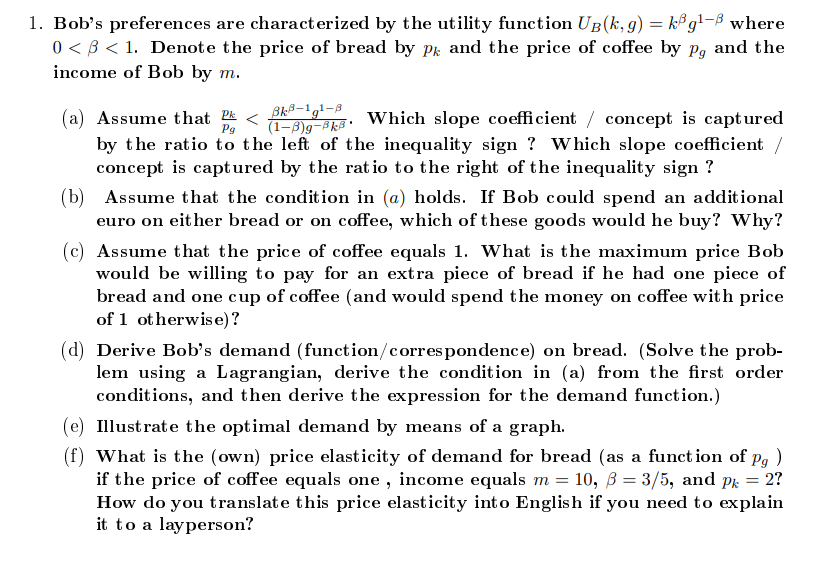
1. Bob's preferences are characterized by the utility function = kgl where Denote the price of bread by pk and the price of coffee by pg and the income of Bob by (a) Assume that < Which slope coefficient / concept is captured (1-)g-k3 by the ratio to the left of the inequality sign ? Which slope coefficient / concept is captured by the ratio to the right of the inequality sign . (b) Assume that the condition in holds. If Bob could spend an additional euro on either bread or on coffee, which of these goods would he buy? Why? (c) Assume that the price of coffee equals 1. What is the maximum price Bob would be willing to pay for an extra piece of bread if he had one piece of bread and one cup of coffee (and would spend the money on coffee with price of 1 otherwise)? (d) Derive Bob's demand (function correspondence) on bread. (Solve the prob- lem using a Lagrangian, derive the condition in (a) from the first order conditions, and then derive the expression for the demand function.) (e) Illustrate the optimal demand by means of a graph. (f) What is the (own) price elasticity of demand for bread (as a funct ion of pg ) if the price of coffee equals one , income equals m = 10, = 3/5, and pk = 2? How do you translate this price elasticity into English if you need to explain it to a layperson?
Step by Step Solution
There are 3 Steps involved in it

Get step-by-step solutions from verified subject matter experts
 Study Help