







Question: 1) Can work be done on a system if there is no motion? ( ) Yes, if an outside force is provided. ( )
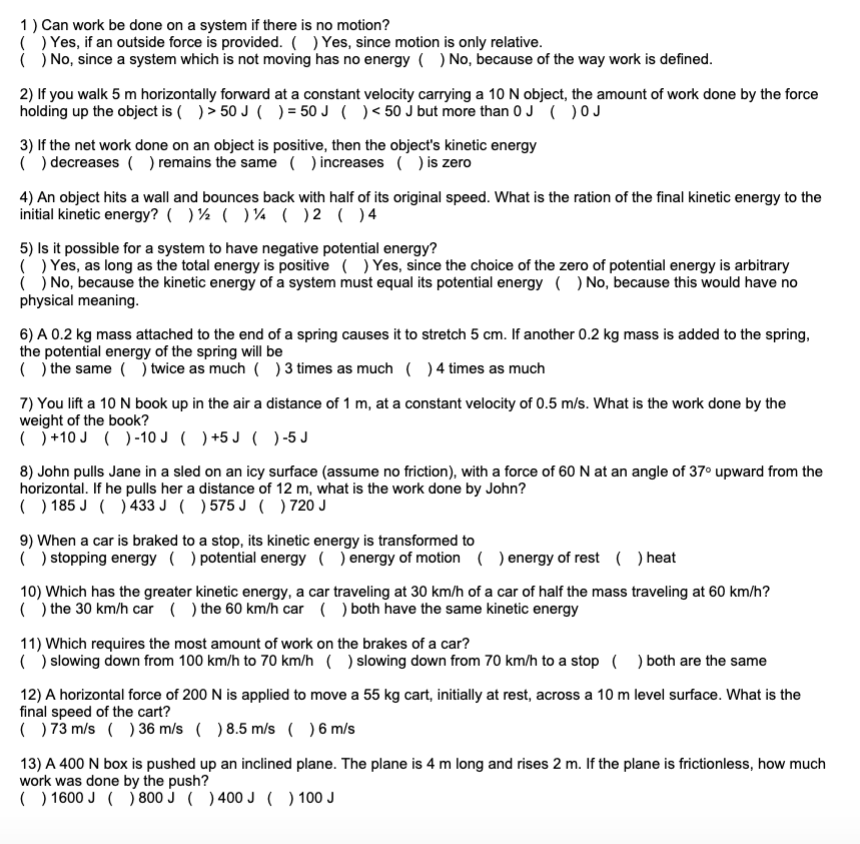
1) Can work be done on a system if there is no motion? ( ) Yes, if an outside force is provided. ( ) Yes, since motion is only relative. ( ) No, since a system which is not moving has no energy ( ) No, because of the way work is defined. 2) If you walk 5 m horizontally forward at a constant velocity carrying a 10 N object, the amount of work done by the force holding up the object is ( ) > 50 J ( ) = 50 J ( ) < 50 J but more than 0 J ( )OJ 3) If the net work done on an object is positive, then the object's kinetic energy () decreases ( ) remains the same () increases () is zero 4) An object hits a wall and bounces back with half of its original speed. What is the ration of the final kinetic energy to the initial kinetic energy? ( ) ( ) ( ) ( )4 5) Is it possible for a system to have negative potential energy? ( ) Yes, as long as the total energy is positive ( ) Yes, since the choice of the zero of potential energy is arbitrary (No, because the kinetic energy of a system must equal its potential energy ( ) No, because this would have no physical meaning. 6) A 0.2 kg mass attached to the end of a spring causes it to stretch 5 cm. If another 0.2 kg mass is added to the spring, the potential energy of the spring will be ( ) the same ( ) twice as much ( ) 3 times as much ( ) 4 times as much 7) You lift a 10 N book up in the air a distance of 1 m, at a constant velocity of 0.5 m/s. What is the work done by the weight of the book? ( ) +10 J ()-10 J ()+5J ()-5 J 8) John pulls Jane in a sled on an icy surface (assume no friction), with a force of 60 N at an angle of 37 upward from the horizontal. If he pulls her a distance of 12 m, what is the work done by John? ( ) 185 J ( ) 433 J ( )575J () 720 J 9) When a car is braked to a stop, its kinetic energy is transformed to () stopping energy ( ) potential energy ( ) energy of motion ( ) energy of rest ( ) heat 10) Which has the greater kinetic energy, a car traveling at 30 km/h of a car of half the mass traveling at 60 km/h? ( ) the 30 km/h car () the 60 km/h car () both have the same kinetic energy 11) Which requires the most amount of work on the brakes of a car? () slowing down from 100 km/h to 70 km/h () slowing down from 70 km/h to a stop ( ) both are the same 12) A horizontal force of 200 N is applied to move a 55 kg cart, initially at rest, across a 10 m level surface. What is the final speed of the cart? ( ) 73 m/s ( ) 36 m/s ( ) 8.5 m/s ( ) 6 m/s 13) A 400 N box is pushed up an inclined plane. The plane is 4 m long and rises 2 m. If the plane is frictionless, how much work was done by the push? ( ) 1600 J ( ) 800 J ( ) 400 J ( ) 100 J
Step by Step Solution
3.50 Rating (160 Votes )
There are 3 Steps involved in it
The detailed answer for the above question is provided below 1 No because of the way work is defined Work is defined as the amount of energy transferred from one object to another when a force is appl... View full answer

Get step-by-step solutions from verified subject matter experts
 Study Help