Question: 1. Case Brief the case using the provided format. 2. Answer questions at the end of the case. PEOPLE v. DILLARD California Court of Appeal
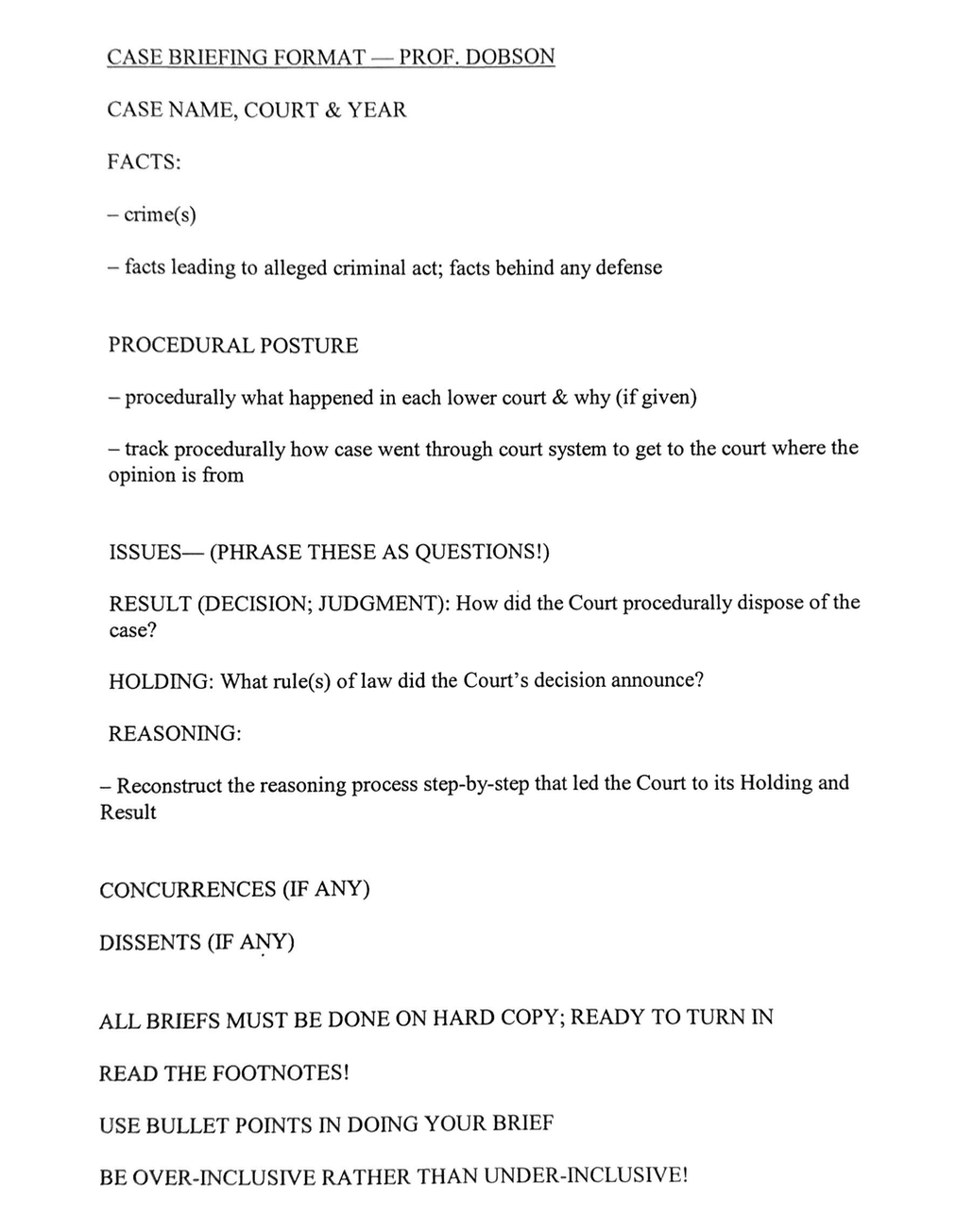
1. Case Brief the case using the provided format.
2. Answer questions at the end of the case.
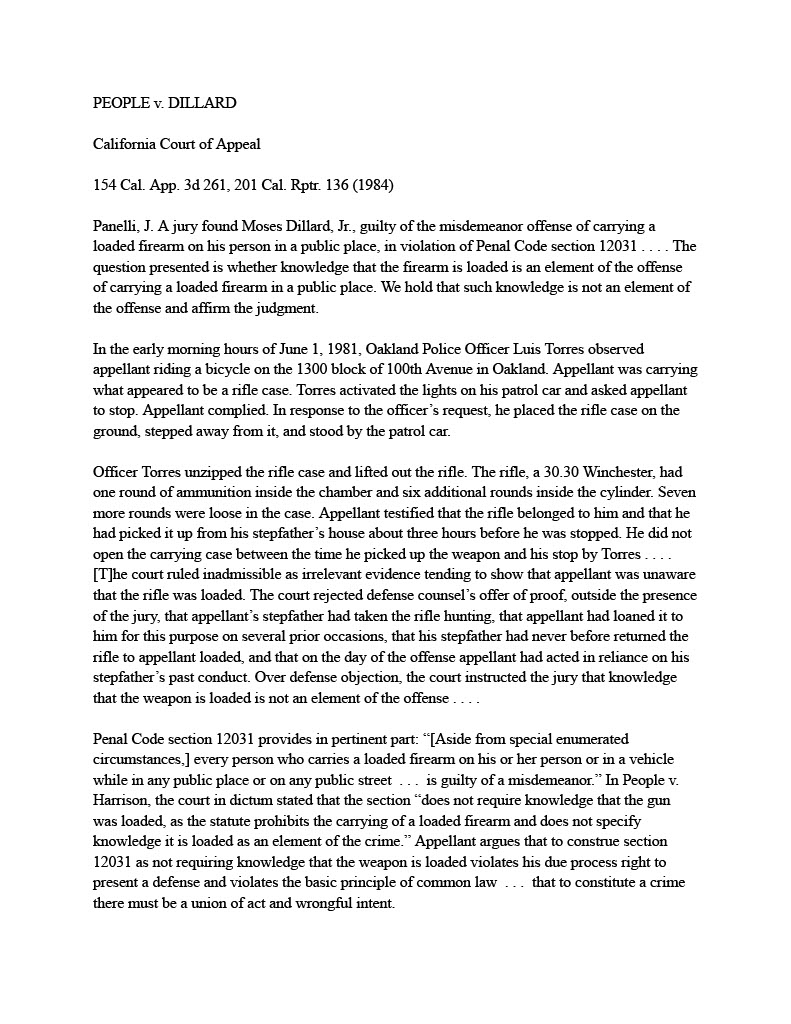
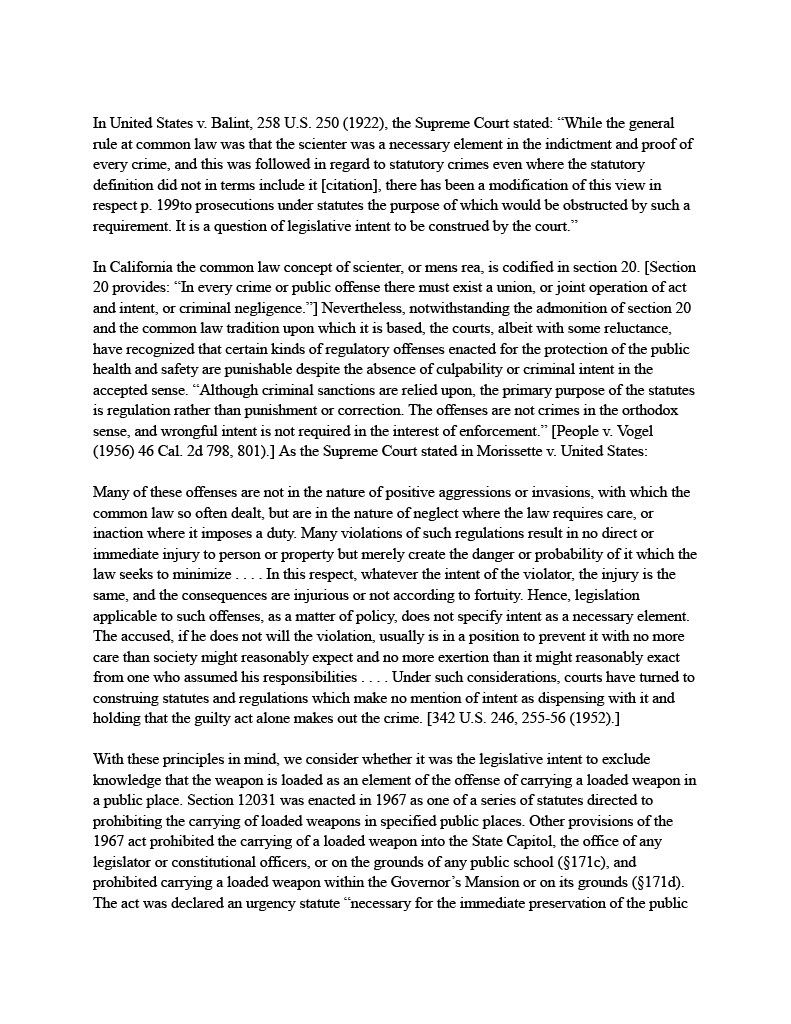
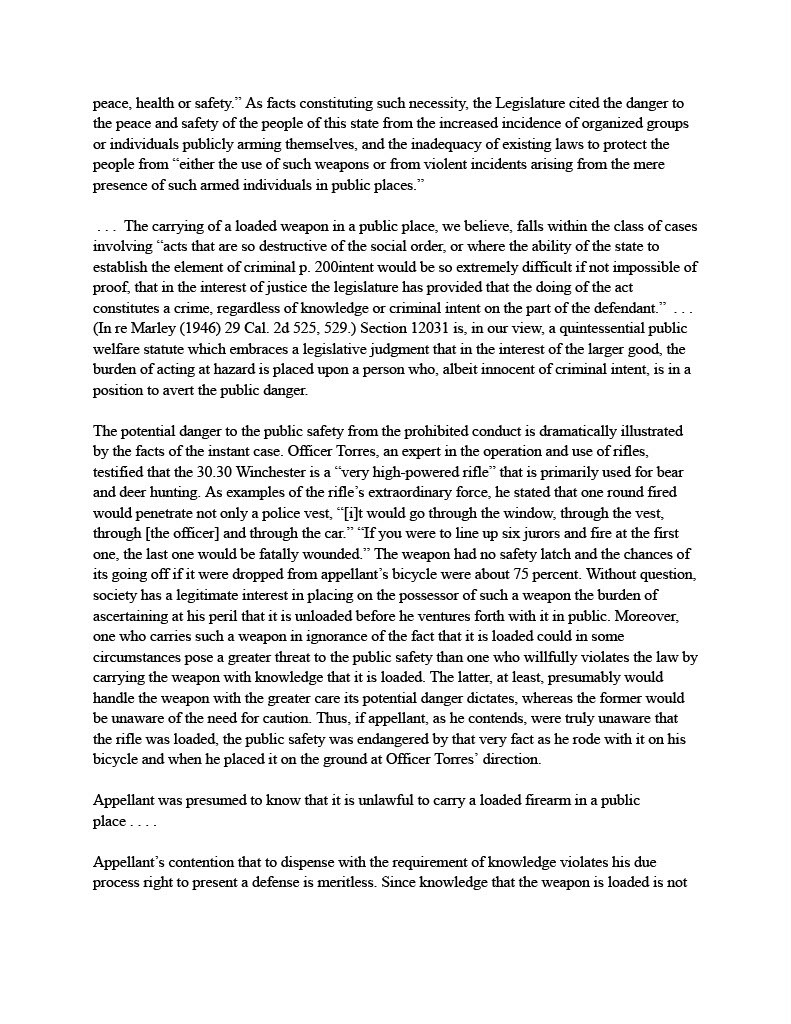
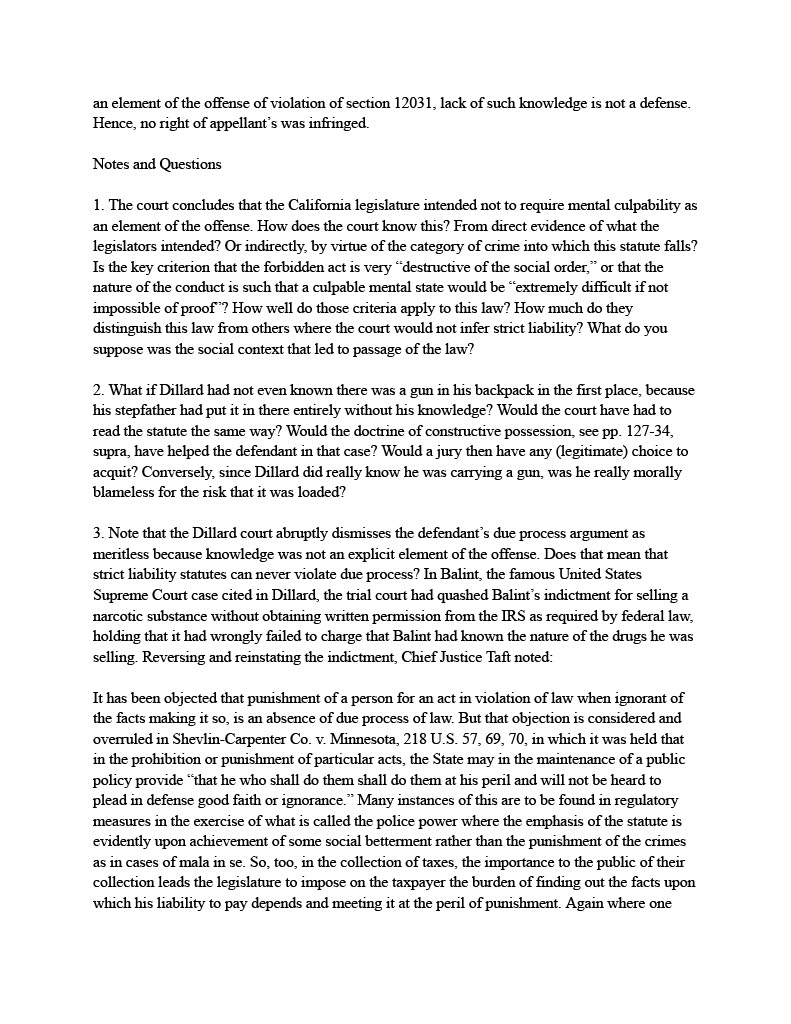
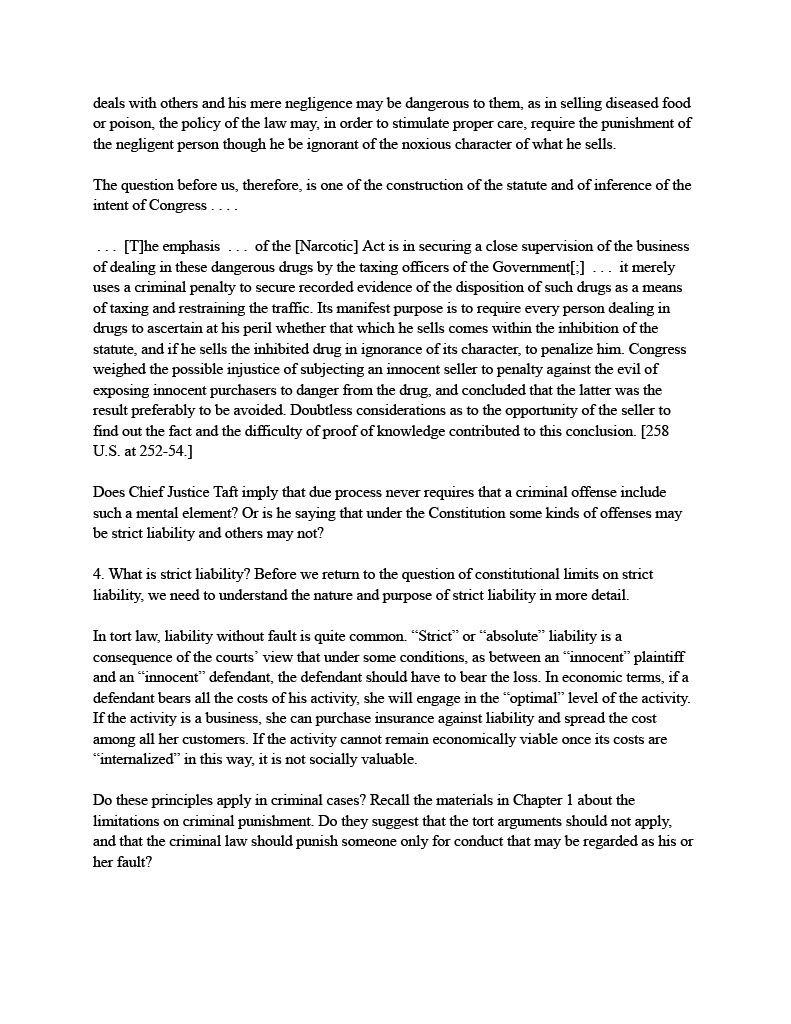
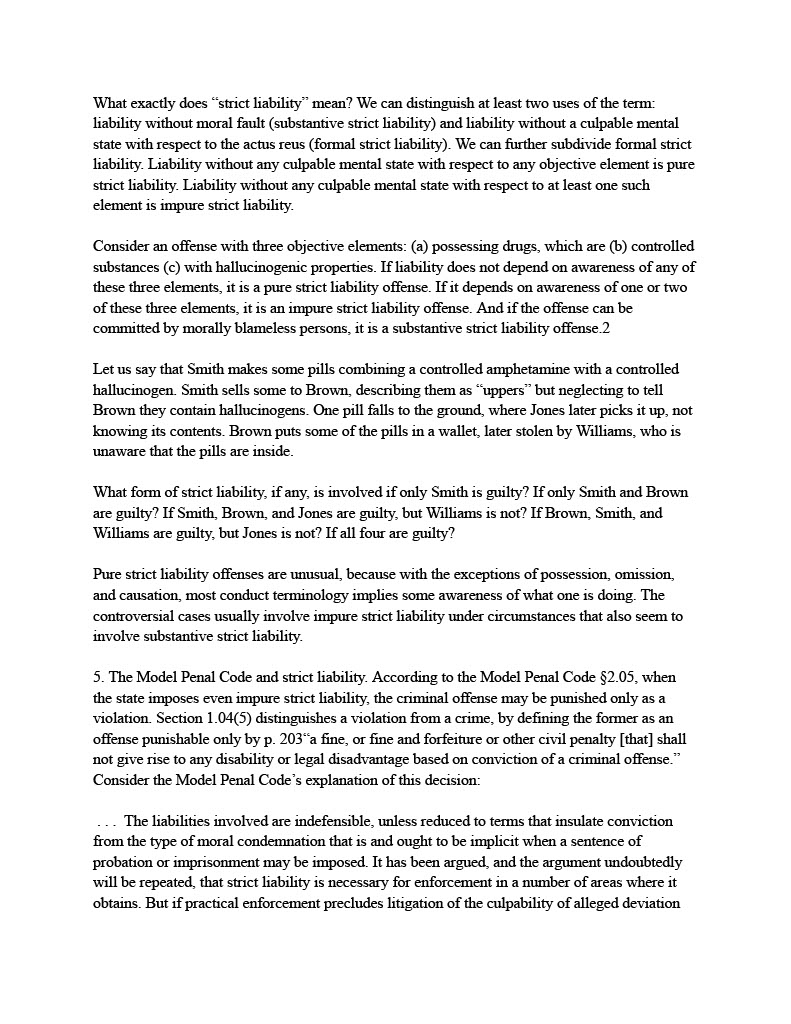
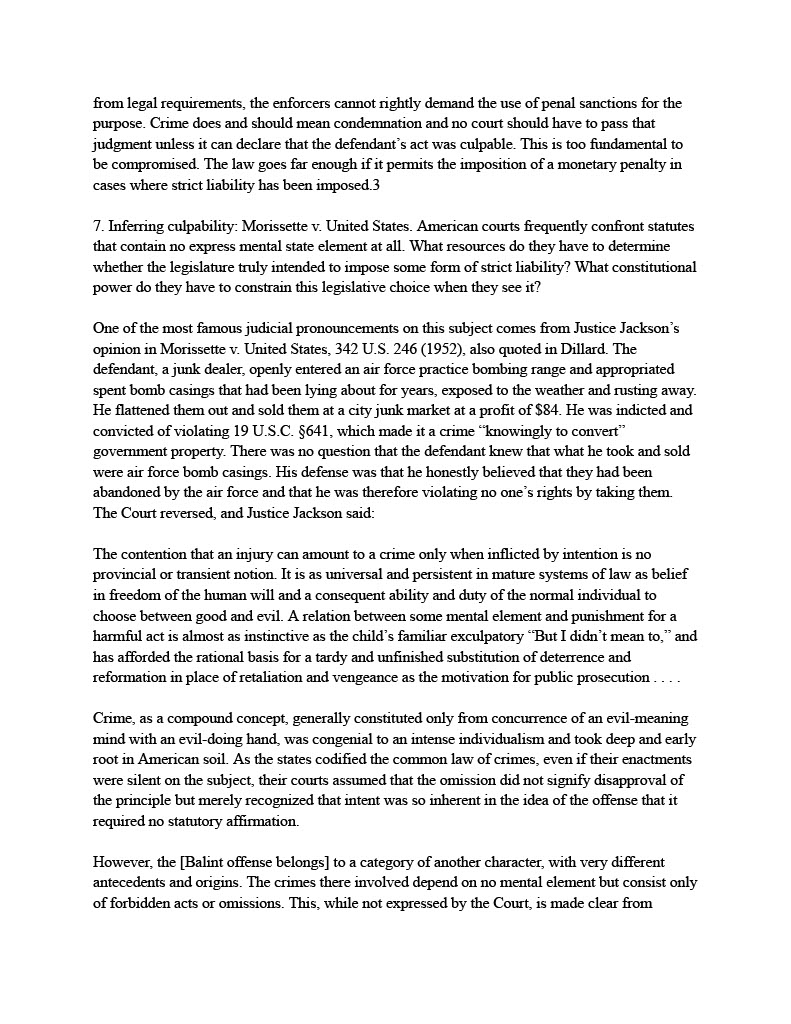
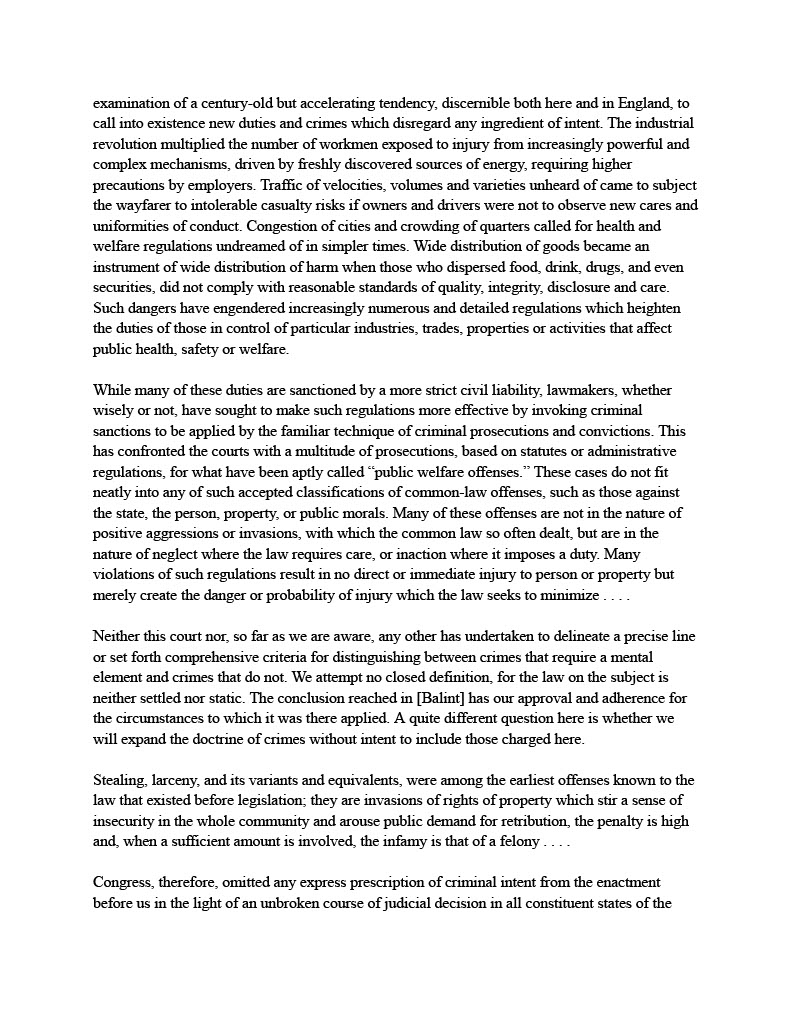
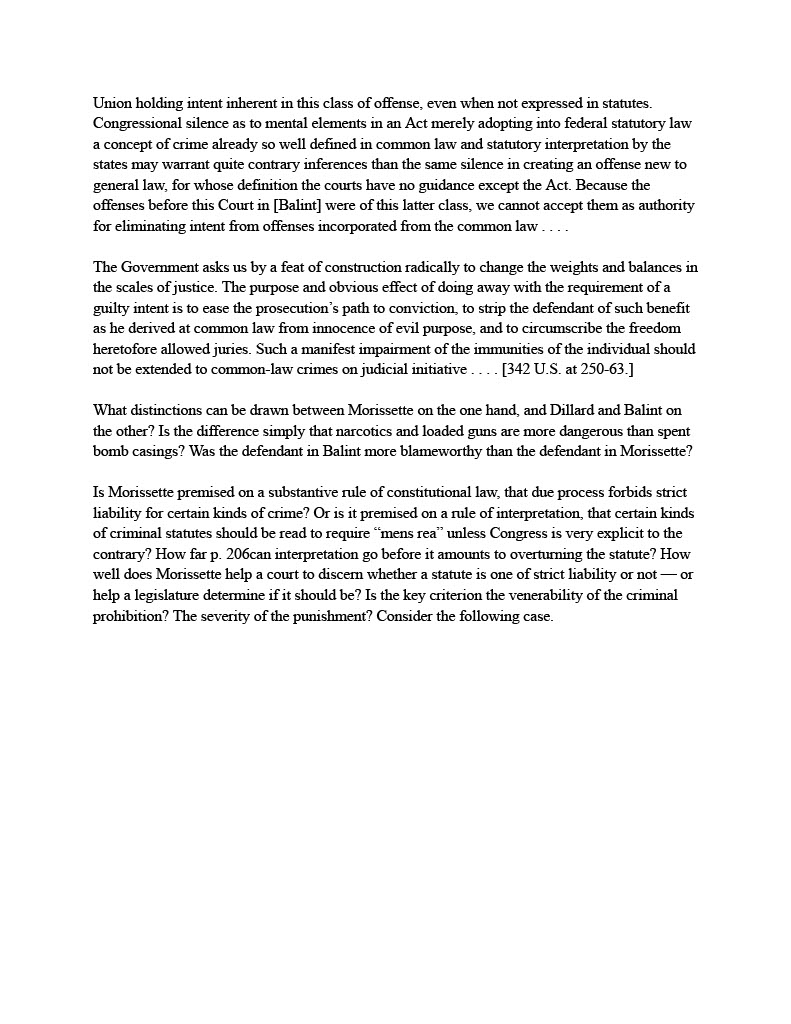
PEOPLE v. DILLARD California Court of Appeal 154 Cal. App. 3d 261, 201 Cal. Rptr. 136 (1984) Panelli, J. A jury found Moses Dillard, Jr., guilty of the misdemeanor offense of carrying a loaded firearm on his person in a public place, in violation of Penal Code section 12031 . .. . The question presented is whether knowledge that the firearm is loaded is an element of the offense of carrying a loaded firearm in a public place. We hold that such knowledge is not an element of the offense and affirm the judgment. In the early morning hours of June 1, 1981, Oakland Police Officer Luis Torres observed appellant riding a bicycle on the 1300 block of 100th Avenue in Oakland. Appellant was carrying what appeared to be a rifle case. Torres activated the lights on his patrol car and asked appellant to stop. Appellant complied. In response to the officer's request, he placed the rifle case on the ground, stepped away from it, and stood by the patrol car. Officer Torres unzipped the rifle case and lifted out the rifle. The rifle, a 30.30 Winchester, had one round of ammunition inside the chamber and six additional rounds inside the cylinder. Seven more rounds were loose in the case. Appellant testified that the rifle belonged to him and that he had picked it up from his stepfather's house about three hours before he was stopped. He did not open the carrying case between the time he picked up the weapon and his stop by Torres . [The court ruled inadmissible as irrelevant evidence tending to show that appellant was unaware that the rifle was loaded. The court rejected defense counsel's offer of proof, outside the presence of the jury, that appellant's stepfather had taken the rifle hunting, that appellant had loaned it to him for this purpose on several prior occasions, that his stepfather had never before returned the rifle to appellant loaded, and that on the day of the offense appellant had acted in reliance on his stepfather's past conduct. Over defense objection, the court instructed the jury that knowledge that the weapon is loaded is not an element of the offense . Penal Code section 12031 provides in pertinent part: "[Aside from special enumerated circumstances,] every person who carries a loaded firearm on his or her person or in a vehicle while in any public place or on any public street . . . is guilty of a misdemeanor." In People v. Harrison, the court in dictum stated that the section "does not require knowledge that the gun was loaded, as the statute prohibits the carrying of a loaded firearm and does not specify knowledge it is loaded as an element of the crime." Appellant argues that to construe section 12031 as not requiring knowledge that the weapon is loaded violates his due process right to present a defense and violates the basic principle of common law . . . that to constitute a crime there must be a union of act and wrongful intent.In United States v. Balint, 258 U.S. 250 (1922), the Supreme Court stated: "While the general rule at common law was that the scienter was a necessary element in the indictment and proof of every crime, and this was followed in regard to statutory crimes even where the statutory definition did not in terms include it [citation], there has been a modification of this view in respect p. 199to prosecutions under statutes the purpose of which would be obstructed by such a requirement. It is a question of legislative intent to be construed by the court. In California the common law concept of scienter, or mens rea, is codified in section 20. [Section 20 provides: "In every crime or public offense there must exist a union, or joint operation of act and intent, or criminal negligence."] Nevertheless, notwithstanding the admonition of section 20 and the common law tradition upon which it is based, the courts, albeit with some reluctance. have recognized that certain kinds of regulatory offenses enacted for the protection of the public health and safety are punishable despite the absence of culpability or criminal intent in the accepted sense. "Although criminal sanctions are relied upon, the primary purpose of the statutes is regulation rather than punishment or correction. The offenses are not crimes in the orthodox sense, and wrongful intent is not required in the interest of enforcement." [People v. Vogel (1956) 46 Cal. 2d 798, 801).] As the Supreme Court stated in Morissette v. United States: Many of these offenses are not in the nature of positive aggressions or invasions, with which the common law so often dealt, but are in the nature of neglect where the law requires care, or inaction where it imposes a duty. Many violations of such regulations result in no direct or immediate injury to person or property but merely create the danger or probability of it which the law seeks to minimize . . . In this respect, whatever the intent of the violator, the injury is the same, and the consequences are injurious or not according to fortuity. Hence, legislation applicable to such offenses, as a matter of policy, does not specify intent as a necessary element. The accused, if he does not will the violation, usually is in a position to prevent it with no more care than society might reasonably expect and no more exertion than it might reasonably exact from one who assumed his responsibilities . . . . Under such considerations, courts have turned to construing statutes and regulations which make no mention of intent as dispensing with it and holding that the guilty act alone makes out the crime. [342 U.S. 246, 255-56 (1952).] With these principles in mind, we consider whether it was the legislative intent to exclude knowledge that the weapon is loaded as an element of the offense of carrying a loaded weapon in a public place. Section 12031 was enacted in 1967 as one of a series of statutes directed to prohibiting the carrying of loaded weapons in specified public places. Other provisions of the 1967 act prohibited the carrying of a loaded weapon into the State Capitol, the office of any legislator or constitutional officers, or on the grounds of any public school ($171c), and prohibited carrying a loaded weapon within the Governor's Mansion or on its grounds ($171d). The act was declared an urgency statute "necessary for the immediate preservation of the publicpeace, health or safety." As facts constituting such necessity, the Legislature cited the danger to the peace and safety of the people of this state from the increased incidence of organized groups or individuals publicly arming themselves, and the inadequacy of existing laws to protect the people from "either the use of such weapons or from violent incidents arising from the mere presence of such armed individuals in public places." . . . The carrying of a loaded weapon in a public place, we believe, falls within the class of cases involving "acts that are so destructive of the social order, or where the ability of the state to establish the element of criminal p. 200intent would be so extremely difficult if not impossible of proof, that in the interest of justice the legislature has provided that the doing of the act constitutes a crime, regardless of knowledge or criminal intent on the part of the defendant." ... (In re Marley (1946) 29 Cal. 2d 525, 529.) Section 12031 is, in our view, a quintessential public welfare statute which embraces a legislative judgment that in the interest of the larger good, the burden of acting at hazard is placed upon a person who, albeit innocent of criminal intent, is in a position to avert the public danger. The potential danger to the public safety from the prohibited conduct is dramatically illustrated by the facts of the instant case. Officer Torres, an expert in the operation and use of rifles, testified that the 30.30 Winchester is a "very high-powered rifle" that is primarily used for bear and deer hunting. As examples of the rifle's extraordinary force, he stated that one round fired would penetrate not only a police vest, "[ijt would go through the window, through the vest, through [the officer] and through the car." "If you were to line up six jurors and fire at the first one, the last one would be fatally wounded." The weapon had no safety latch and the chances of its going off if it were dropped from appellant's bicycle were about 75 percent. Without question, society has a legitimate interest in placing on the possessor of such a weapon the burden of ascertaining at his peril that it is unloaded before he ventures forth with it in public. Moreover, one who carries such a weapon in ignorance of the fact that it is loaded could in some circumstances pose a greater threat to the public safety than one who willfully violates the law by carrying the weapon with knowledge that it is loaded. The latter, at least, presumably would handle the weapon with the greater care its potential danger dictates, whereas the former would be unaware of the need for caution. Thus, if appellant, as he contends, were truly unaware that the rifle was loaded, the public safety was endangered by that very fact as he rode with it on his bicycle and when he placed it on the ground at Officer Torres' direction. Appellant was presumed to know that it is unlawful to carry a loaded firearm in a public place . .. Appellant's contention that to dispense with the requirement of knowledge violates his due process right to present a defense is meritless. Since knowledge that the weapon is loaded is notan element of the offense of violation of section 12031, lack of such knowledge is not a defense. Hence, no right of appellant's was infringed. Notes and Questions 1. The court concludes that the California legislature intended not to require mental culpability as an element of the offense. How does the court know this? From direct evidence of what the legislators intended? Or indirectly, by virtue of the category of crime into which this statute falls? Is the key criterion that the forbidden act is very "destructive of the social order," or that the nature of the conduct is such that a culpable mental state would be "extremely difficult if not impossible of proof? How well do those criteria apply to this law? How much do they distinguish this law from others where the court would not infer strict liability? What do you suppose was the social context that led to passage of the law? 2. What if Dillard had not even known there was a gun in his backpack in the first place, because his stepfather had put it in there entirely without his knowledge? Would the court have had to read the statute the same way? Would the doctrine of constructive possession, see pp. 127-34, supra, have helped the defendant in that case? Would a jury then have any (legitimate) choice to acquit? Conversely, since Dillard did really know he was carrying a gun, was he really morally blameless for the risk that it was loaded? 3. Note that the Dillard court abruptly dismisses the defendant's due process argument as meritless because knowledge was not an explicit element of the offense. Does that mean that strict liability statutes can never violate due process? In Balint, the famous United States Supreme Court case cited in Dillard, the trial court had quashed Balint's indictment for selling a narcotic substance without obtaining written permission from the IRS as required by federal law, holding that it had wrongly failed to charge that Balint had known the nature of the drugs he was selling. Reversing and reinstating the indictment, Chief Justice Taft noted: It has been objected that punishment of a person for an act in violation of law when ignorant of the facts making it so, is an absence of due process of law. But that objection is considered and overruled in Shevlin-Carpenter Co. v. Minnesota, 218 U.S. 57, 69, 70, in which it was held that in the prohibition or punishment of particular acts, the State may in the maintenance of a public policy provide "that he who shall do them shall do them at his peril and will not be heard to plead in defense good faith or ignorance." Many instances of this are to be found in regulatory measures in the exercise of what is called the police power where the emphasis of the statute is evidently upon achievement of some social betterment rather than the punishment of the crimes as in cases of mala in se. So, too, in the collection of taxes, the importance to the public of their collection leads the legislature to impose on the taxpayer the burden of finding out the facts upon which his liability to pay depends and meeting it at the peril of punishment. Again where onedeals with others and his mere negligence may be dangerous to them, as in selling diseased food or poison, the policy of the law may, in order to stimulate proper care, require the punishment of the negligent person though he be ignorant of the noxious character of what he sells. The question before us, therefore, is one of the construction of the statute and of inference of the intent of Congress . . . .. [T]he emphasis . . . of the [Narcotic] Act is in securing a close supervision of the business of dealing in these dangerous drugs by the taxing officers of the Government[;] .. . it merely uses a criminal penalty to secure recorded evidence of the disposition of such drugs as a means of taxing and restraining the traffic. Its manifest purpose is to require every person dealing in drugs to ascertain at his peril whether that which he sells comes within the inhibition of the statute, and if he sells the inhibited drug in ignorance of its character, to penalize him. Congress weighed the possible injustice of subjecting an innocent seller to penalty against the evil of exposing innocent purchasers to danger from the drug, and concluded that the latter was the result preferably to be avoided. Doubtless considerations as to the opportunity of the seller to find out the fact and the difficulty of proof of knowledge contributed to this conclusion. [258 U.S. at 252-54.] Does Chief Justice Taft imply that due process never requires that a criminal offense include such a mental element? Or is he saying that under the Constitution some kinds of offenses may be strict liability and others may not? 4. What is strict liability? Before we return to the question of constitutional limits on strict liability, we need to understand the nature and purpose of strict liability in more detail. In tort law, liability without fault is quite common. "Strict" or "absolute" liability is a consequence of the courts' view that under some conditions, as between an "innocent" plaintiff and an "innocent" defendant, the defendant should have to bear the loss. In economic terms, if a defendant bears all the costs of his activity, she will engage in the "optimal" level of the activity. If the activity is a business, she can purchase insurance against liability and spread the cost among all her customers. If the activity cannot remain economically viable once its costs are "internalized" in this way, it is not socially valuable. Do these principles apply in criminal cases? Recall the materials in Chapter 1 about the limitations on criminal punishment. Do they suggest that the tort arguments should not apply, and that the criminal law should punish someone only for conduct that may be regarded as his or her fault?What exactly does "strict liability" mean? We can distinguish at least two uses of the term: liability without moral fault (substantive strict liability) and liability without a culpable mental state with respect to the actus reus (formal strict liability). We can further subdivide formal strict liability. Liability without any culpable mental state with respect to any objective element is pure strict liability. Liability without any culpable mental state with respect to at least one such element is impure strict liability. Consider an offense with three objective elements: (a) possessing drugs, which are (b) controlled substances (c) with hallucinogenic properties. If liability does not depend on awareness of any of these three elements, it is a pure strict liability offense. If it depends on awareness of one or two of these three elements, it is an impure strict liability offense. And if the offense can be committed by morally blameless persons, it is a substantive strict liability offense.2 Let us say that Smith makes some pills combining a controlled amphetamine with a controlled hallucinogen. Smith sells some to Brown, describing them as "uppers" but neglecting to tell Brown they contain hallucinogens. One pill falls to the ground, where Jones later picks it up, not knowing its contents. Brown puts some of the pills in a wallet, later stolen by Williams, who is unaware that the pills are inside. What form of strict liability, if any, is involved if only Smith is guilty? If only Smith and Brown are guilty? If Smith, Brown, and Jones are guilty, but Williams is not? If Brown, Smith, and Williams are guilty, but Jones is not? If all four are guilty? Pure strict liability offenses are unusual, because with the exceptions of possession, omission, and causation, most conduct terminology implies some awareness of what one is doing. The controversial cases usually involve impure strict liability under circumstances that also seem to involve substantive strict liability. 5. The Model Penal Code and strict liability. According to the Model Penal Code $2.05, when the state imposes even impure strict liability, the criminal offense may be punished only as a violation. Section 1.04(5) distinguishes a violation from a crime, by defining the former as an offense punishable only by p. 203"a fine, or fine and forfeiture or other civil penalty [that] shall not give rise to any disability or legal disadvantage based on conviction of a criminal offense." Consider the Model Penal Code's explanation of this decision: .. . The liabilities involved are indefensible, unless reduced to terms that insulate conviction from the type of moral condemnation that is and ought to be implicit when a sentence of probation or imprisonment may be imposed. It has been argued, and the argument undoubtedly will be repeated, that strict liability is necessary for enforcement in a number of areas where it obtains. But if practical enforcement precludes litigation of the culpability of alleged deviationfrom legal requirements, the enforcers cannot rightly demand the use of penal sanctions for the purpose. Crime does and should mean condemnation and no court should have to pass that judgment unless it can declare that the defendant's act was culpable. This is too fundamental to be compromised. The law goes far enough if it permits the imposition of a monetary penalty in cases where strict liability has been imposed.3 7. Inferring culpability: Morissette v. United States. American courts frequently confront statutes that contain no express mental state element at all. What resources do they have to determine whether the legislature truly intended to impose some form of strict liability? What constitutional power do they have to constrain this legislative choice when they see it? One of the most famous judicial pronouncements on this subject comes from Justice Jackson's opinion in Morissette v. United States, 342 U.S. 246 (1952), also quoted in Dillard. The defendant, a junk dealer, openly entered an air force practice bombing range and appropriated spent bomb casings that had been lying about for years, exposed to the weather and rusting away. He flattened them out and sold them at a city junk market at a profit of $84. He was indicted and convicted of violating 19 U.S.C. $641, which made it a crime "knowingly to convert" government property. There was no question that the defendant knew that what he took and sold were air force bomb casings. His defense was that he honestly believed that they had been abandoned by the air force and that he was therefore violating no one's rights by taking them. The Court reversed, and Justice Jackson said: The contention that an injury can amount to a crime only when inflicted by intention is no provincial or transient notion. It is as universal and persistent in mature systems of law as belief in freedom of the human will and a consequent ability and duty of the normal individual to choose between good and evil. A relation between some mental element and punishment for a harmful act is almost as instinctive as the child's familiar exculpatory "But I didn't mean to," and has afforded the rational basis for a tardy and unfinished substitution of deterrence and reformation in place of retaliation and vengeance as the motivation for public prosecution .. Crime, as a compound concept, generally constituted only from concurrence of an evil-meaning mind with an evil-doing hand, was congenial to an intense individualism and took deep and early root in American soil. As the states codified the common law of crimes, even if their enactments were silent on the subject, their courts assumed that the omission did not signify disapproval of the principle but merely recognized that intent was so inherent in the idea of the offense that it required no statutory affirmation. However, the [Balint offense belongs] to a category of another character, with very different antecedents and origins. The crimes there involved depend on no mental element but consist only of forbidden acts or omissions. This, while not expressed by the Court, is made clear fromexamination of a century-old but accelerating tendency, discernible both here and in England, to call into existence new duties and crimes which disregard any ingredient of intent. The industrial revolution multiplied the number of workmen exposed to injury from increasingly powerful and complex mechanisms, driven by freshly discovered sources of energy, requiring higher precautions by employers. Traffic of velocities, volumes and varieties unheard of came to subject the wayfarer to intolerable casualty risks if owners and drivers were not to observe new cares and uniformities of conduct. Congestion of cities and crowding of quarters called for health and welfare regulations undreamed of in simpler times. Wide distribution of goods became an instrument of wide distribution of harm when those who dispersed food, drink, drugs, and even securities, did not comply with reasonable standards of quality, integrity, disclosure and care. Such dangers have engendered increasingly numerous and detailed regulations which heighten the duties of those in control of particular industries, trades, properties or activities that affect public health, safety or welfare. While many of these duties are sanctioned by a more strict civil liability, lawmakers, whether wisely or not, have sought to make such regulations more effective by invoking criminal sanctions to be applied by the familiar technique of criminal prosecutions and convictions. This has confronted the courts with a multitude of prosecutions, based on statutes or administrative regulations, for what have been aptly called "public welfare offenses." These cases do not fit neatly into any of such accepted classifications of common-law offenses, such as those against the state, the person, property, or public morals. Many of these offenses are not in the nature of positive aggressions or invasions, with which the common law so often dealt, but are in the nature of neglect where the law requires care, or inaction where it imposes a duty. Many violations of such regulations result in no direct or immediate injury to person or property but merely create the danger or probability of injury which the law seeks to minimize . Neither this court nor, so far as we are aware, any other has undertaken to delineate a precise line or set forth comprehensive criteria for distinguishing between crimes that require a mental element and crimes that do not. We attempt no closed definition, for the law on the subject is neither settled nor static. The conclusion reached in [Balint] has our approval and adherence for the circumstances to which it was there applied. A quite different question here is whether we will expand the doctrine of crimes without intent to include those charged here. Stealing, larceny, and its variants and equivalents, were among the earliest offenses known to the law that existed before legislation; they are invasions of rights of property which stir a sense of insecurity in the whole community and arouse public demand for retribution, the penalty is high and, when a sufficient amount is involved, the infamy is that of a felony . . . . Congress, therefore, omitted any express prescription of criminal intent from the enactment before us in the light of an unbroken course of judicial decision in all constituent states of theUnion holding intent inherent in this class of offense, even when not expressed in statutes. Congressional silence as to mental elements in an Act merely adopting into federal statutory law a concept of crime already so well defined in common law and statutory interpretation by the states may warrant quite contrary inferences than the same silence in creating an offense new to general law, for whose definition the courts have no guidance except the Act. Because the offenses before this Court in [Balint] were of this latter class, we cannot accept them as authority for eliminating intent from offenses incorporated from the common law . . . . The Government asks us by a feat of construction radically to change the weights and balances in the scales of justice. The purpose and obvious effect of doing away with the requirement of a guilty intent is to ease the prosecution's path to conviction, to strip the defendant of such benefit as he derived at common law from innocence of evil purpose, and to circumscribe the freedom heretofore allowed juries. Such a manifest impairment of the immunities of the individual should not be extended to common-law crimes on judicial initiative . . . . [342 U.S. at 250-63.] What distinctions can be drawn between Morissette on the one hand, and Dillard and Balint on the other? Is the difference simply that narcotics and loaded guns are more dangerous than spent bomb casings? Was the defendant in Balint more blameworthy than the defendant in Morissette? Is Morissette premised on a substantive rule of constitutional law, that due process forbids strict liability for certain kinds of crime? Or is it premised on a rule of interpretation, that certain kinds of criminal statutes should be read to require "mens rea" unless Congress is very explicit to the contrary? How far p. 206can interpretation go before it amounts to overturning the statute? How well does Morissette help a court to discern whether a statute is one of strict liability or not - or help a legislature determine if it should be? Is the key criterion the venerability of the criminal prohibition? The severity of the punishment? Consider the following case.CASE BRIEFING FORMAT PROF. DOBSON CASE NAME, COURT & YEAR FACTS: crime(s) facts leading to alleged criminal act; facts behind any defense PROCEDURAL POSTURE procedurally what happened in each lower court & why (if given) track procedurally how case went through court system to get to the court where the opinion is from ISSUES (PHRASE THESE AS QUESTIONS!) RESULT (DECISION; JUDGMENT): How did the Court procedurally dispose of the case? HOLDING: What rule(s) of law did the Court's decision announce? REASONING: Reconstruct the reasoning process step-by-step that led the Court to its Holding and Result CONCURRENCES (IF ANY) DISSENTS (IF ANY) ALL BRIEFS MUST BE DONE ON HARD COPY; READY TO TURN IN READ THE FOOTNOTES! USE BULLET POINTS IN DOING YOUR BRIEF BE OVER-INCLUSIVE RATHER THAN UNDER-INCLUSIVE
Step by Step Solution
There are 3 Steps involved in it
1 Expert Approved Answer
Step: 1 Unlock
Question Has Been Solved by an Expert!
Get step-by-step solutions from verified subject matter experts
Step: 2 Unlock
Step: 3 Unlock
Students Have Also Explored These Related Law Questions!









 Study Help