Question: 1. Comment on the statement that exporting maximizes the benefits of selling from countries with weak currencies. 2. Based on the information provided, what is
1. Comment on the statement that exporting maximizes the benefits of
selling from countries with weak currencies.
2. Based on the information provided, what is your advice to the govern-
ment of Rwanda to increase exports?
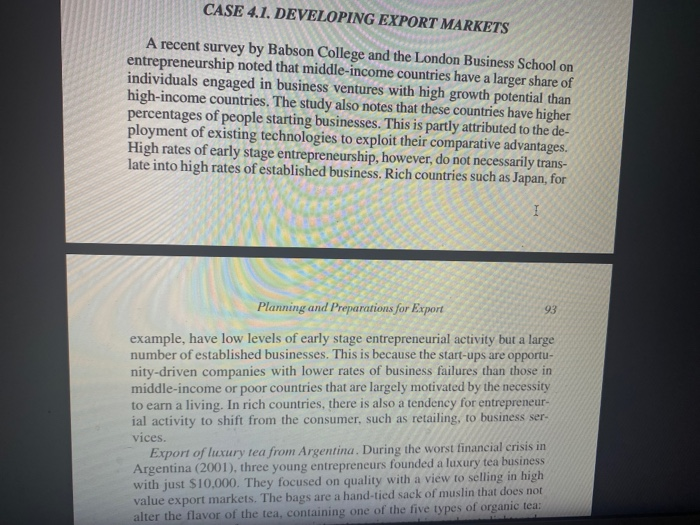
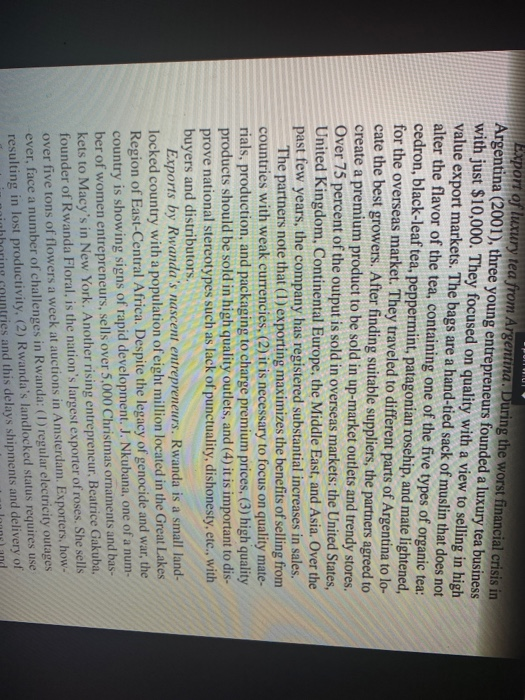
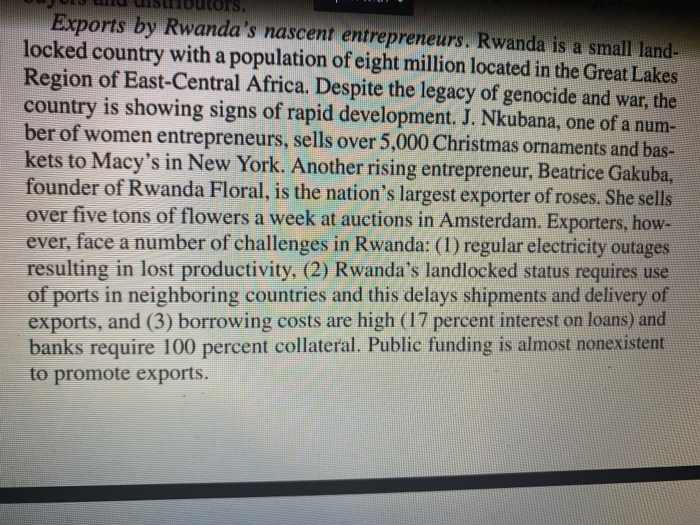
CASE 4.1. DEVELOPING EXPORT MARKETS A recent survey by Babson College and the London Business School on entrepreneurship noted that middle-income countries have a larger share of individuals engaged in business ventures with high growth potential than high-income countries. The study also notes that these countries have higher percentages of people starting businesses. This is partly attributed to the de- ployment of existing technologies to exploit their comparative advantages. High rates of early stage entrepreneurship, however, do not necessarily trans- late into high rates of established business. Rich countries such as Japan, for I Planning and Preparations for Export 93 example, have low levels of early stage entrepreneurial activity but a large number of established businesses. This is because the start-ups are opportu- nity-driven companies with lower rates of business failures than those in middle-income or poor countries that are largely motivated by the necessity to earn a living. In rich countries, there is also a tendency for entrepreneur ial activity to shift from the consumer, such as retailing, to business ser- vices. Export of luxury tea from Argentina. During the worst financial crisis in Argentina (2001), three young entrepreneurs founded a luxury tea business with just $10,000. They focused on quality with a view to selling in high value export markets. The bags are a hand-tied sack of muslin that does not alter the flavor of the tea, containing one of the five types of organic tea: UIT Export of luxury tea from Argentina. During the worst financial crisis in Argentina (2001), three young entrepreneurs founded a luxury tea business with just $10,000. They focused on quality with a view to selling in high value export markets. The bags are a hand-tied sack of muslin that does not alter the flavor of the tea, containing one of the five types of organic tea: cedron, black-leaf tea, peppermint, patagonian rosehip, and mate lightened, for the overseas market. They traveled to different parts of Argentina to lo- cate the best growers. After finding suitable suppliers, the partners agreed to create a premium product to be sold in up-market outlets and trendy stores. Over 75 percent of the output is sold in overseas markets: the United States, United Kingdom, Continental Europe, the Middle East, and Asia. Over the past few years, the company has registered substantial increases in sales. The partners note that (1) exporting maximizes the benefits of selling from countries with weak currencies, (2) it is necessary to focus on quality mate- rials, production, and packaging to charge premium prices, (3) high quality products should be sold in high quality outlets, and (4) it is important to dis- prove national stereotypes such as lack of punctuality, dishonesty, etc., with buyers and distributors. Exports by Rwanda's nascent entrepreneurs. Rwanda is a small land- locked country with a population of eight million located in the Great Lakes Region of East-Central Africa. Despite the legacy of genocide and war, the country is showing signs of rapid development. J. Nkubana, one of a num- ber of women entrepreneurs, sells over 5,000 Christmas ornaments and bas- kets to Macy's in New York. Another rising entrepreneur, Beatrice Gakuba. founder of Rwanda Floral, is the nation's largest exporter of roses. She sells over five tons of flowers a week at auctions in Amsterdam. Exporters, how- ever, face a number of challenges in Rwanda: (1) regular electricity outages resulting in lost productivity. (2) Rwanda's landlocked status requires use untries and this delays shipments and delivery of Exports by Rwanda's nascent entrepreneurs. Rwanda is a small land- locked country with a population of eight million located in the Great Lakes Region of East-Central Africa. Despite the legacy of genocide and war, the country is showing signs of rapid development. J. Nkubana, one of a num- ber of women entrepreneurs, sells over 5,000 Christmas ornaments and bas- kets to Macy's in New York. Another rising entrepreneur, Beatrice Gakuba, founder of Rwanda Floral, is the nation's largest exporter of roses. She sells over five tons of flowers a week at auctions in Amsterdam. Exporters, how- ever, face a number of challenges in Rwanda: (1) regular electricity outages resulting in lost productivity, (2) Rwanda's landlocked status requires use of ports in neighboring countries and this delays shipments and delivery of exports, and (3) borrowing costs are high (17 percent interest on loans) and banks require 100 percent collateral. Public funding is almost nonexistent to promote exports









 Study Help