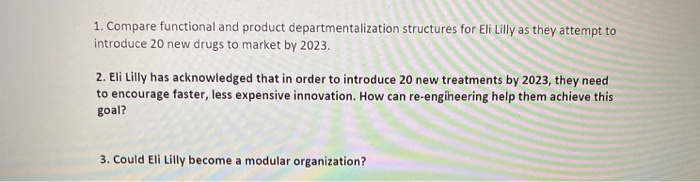
Question: 1. Compare functional and product departmentalization structures for Eli Lilly as they attempt to introduce 20 new drugs to market by 2023. 2. Eli Lilly
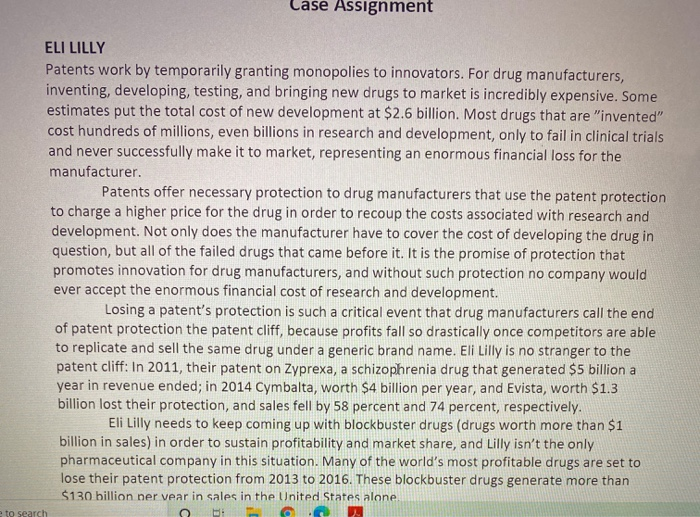
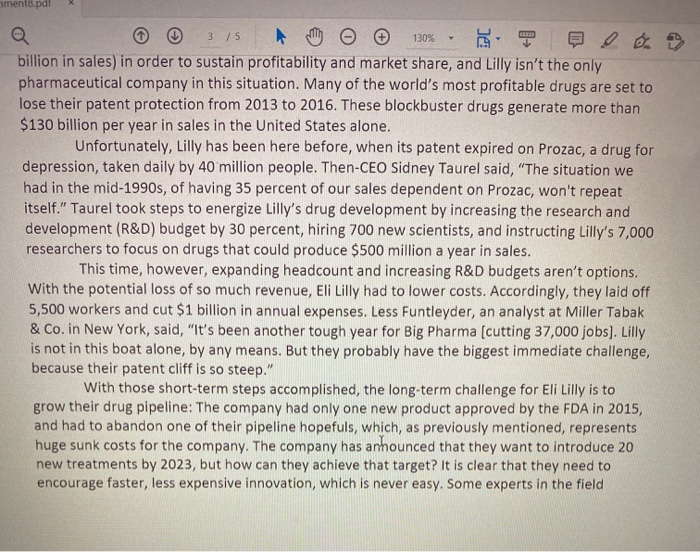
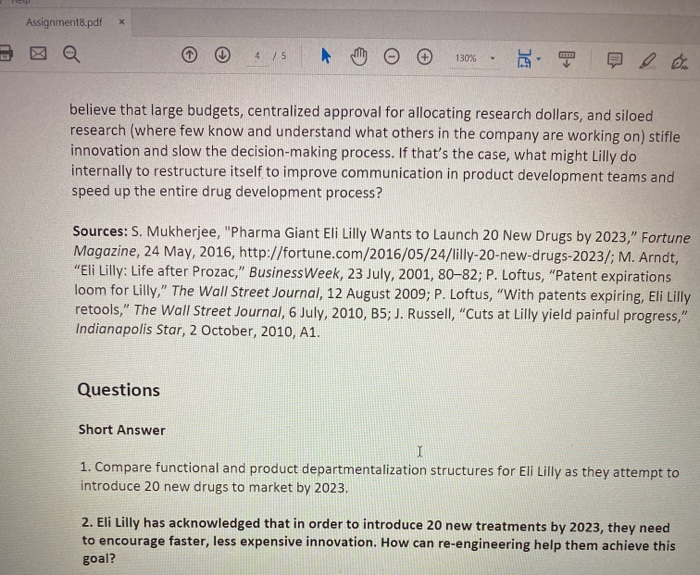
1. Compare functional and product departmentalization structures for Eli Lilly as they attempt to introduce 20 new drugs to market by 2023. 2. Eli Lilly has acknowledged that in order to introduce 20 new treatments by 2023, they need to encourage faster, less expensive innovation. How can re-engineering help them achieve this goal? 3. Could Eli Lilly become a modular organization? Case Assignment ELI LILLY Patents work by temporarily granting monopolies to innovators. For drug manufacturers, inventing, developing, testing, and bringing new drugs to market is incredibly expensive. Some estimates put the total cost of new development at $2.6 billion. Most drugs that are "invented" cost hundreds of millions, even billions in research and development, only to fail in clinical trials and never successfully make it to market, representing an enormous financial loss for the manufacturer. Patents offer necessary protection to drug manufacturers that use the patent protection to charge a higher price for the drug in order to recoup the costs associated with research and development. Not only does the manufacturer have to cover the cost of developing the drug in question, but all of the failed drugs that came before it. It is the promise of protection that promotes innovation for drug manufacturers, and without such protection no company would ever accept the enormous financial cost of research and development. Losing a patent's protection is such a critical event that drug manufacturers call the end of patent protection the patent cliff, because profits fall so drastically once competitors are able to replicate and sell the same drug under a generic brand name. Eli Lilly is no stranger to the patent cliff: In 2011, their patent on Zyprexa, a schizophrenia drug that generated $5 billion a year in revenue ended; in 2014 Cymbalta, worth $4 billion per year, and Evista, worth $1.3 billion lost their protection, and sales fell by 58 percent and 74 percent, respectively. Eli Lilly needs to keep coming up with blockbuster drugs (drugs worth more than $1 billion in sales) in order to sustain profitability and market share, and Lilly isn't the only pharmaceutical company in this situation. Many of the world's most profitable drugs are set to lose their patent protection from 2013 to 2016. These blockbuster drugs generate more than $130 billion per vear in sales in the United States alone to search H: amenta.pdf 3 / 5 130% billion in sales) in order to sustain profitability and market share, and Lilly isn't the only pharmaceutical company in this situation. Many of the world's most profitable drugs are set to lose their patent protection from 2013 to 2016. These blockbuster drugs generate more than $130 billion per year in sales in the United States alone. Unfortunately, Lilly has been here before, when its patent expired on Prozac, a drug for depression, taken daily by 40 million people. Then-CEO Sidney Taurel said, "The situation we had in the mid-1990s, of having 35 percent of our sales dependent on Prozac, won't repeat itself." Taurel took steps to energize Lilly's drug development by increasing the research and development (R&D) budget by 30 percent, hiring 700 new scientists, and instructing Lilly's 7,000 researchers to focus on drugs that could produce $500 million a year in sales. This time, however, expanding headcount and increasing R&D budgets aren't options. With the potential loss of so much revenue, Eli Lilly had to lower costs. Accordingly, they laid off 5,500 workers and cut $1 billion in annual expenses. Less Funtleyder, an analyst at Miller Tabak & Co. in New York, said, "It's been another tough year for Big Pharma (cutting 37,000 jobs). Lilly is not in this boat alone, by any means. But they probably have the biggest immediate challenge, because their patent cliff is so steep." With those short-term steps accomplished, the long-term challenge for Eli Lilly is to grow their drug pipeline: The company had only one new product approved by the FDA in 2015, and had to abandon one of their pipeline hopefuls, which, as previously mentioned, represents huge sunk costs for the company. The company has anhounced that they want to introduce 20 new treatments by 2023, but how can they achieve that target? It is clear that they need to encourage faster, less expensive innovation, which is never easy. Some experts in the field Assignment.pdf X Q 4 / 5 130% believe that large budgets, centralized approval for allocating research dollars, and siloed research (where few know and understand what others in the company are working on) stifle innovation and slow the decision-making process. If that's the case, what might Lilly do internally to restructure itself to improve communication in product development teams and speed up the entire drug development process? Sources: S. Mukherjee, "Pharma Giant Eli Lilly Wants to Launch 20 New Drugs by 2023," Fortune Magazine, 24 May, 2016, http://fortune.com/2016/05/24/lilly-20-new-drugs-2023/; M. Arndt, "Eli Lilly: Life after Prozac," Business Week, 23 July, 2001, 80-82; P. Loftus, "Patent expirations loom for Lilly," The Wall Street Journal, 12 August 2009; P. Loftus, "With patents expiring, Eli Lilly retools." The Wall Street Journal, 6 July, 2010, B5; J. Russell, "Cuts at Lilly yield painful progress," Indianapolis Star, 2 October, 2010, A1. Questions Short Answer I 1. Compare functional and product departmentalization structures for Eli Lilly as they attempt to introduce 20 new drugs to market by 2023. 2. Eli Lilly has acknowledged that in order to introduce 20 new treatments by 2023, they need to encourage faster, less expensive innovation. How can re-engineering help them achieve this goal









 Study Help