



Question: 1. Compare the two bonds below. If yields unexpectedly rise 3%, which bond has more interest rate risk? What is the percentage decline in each
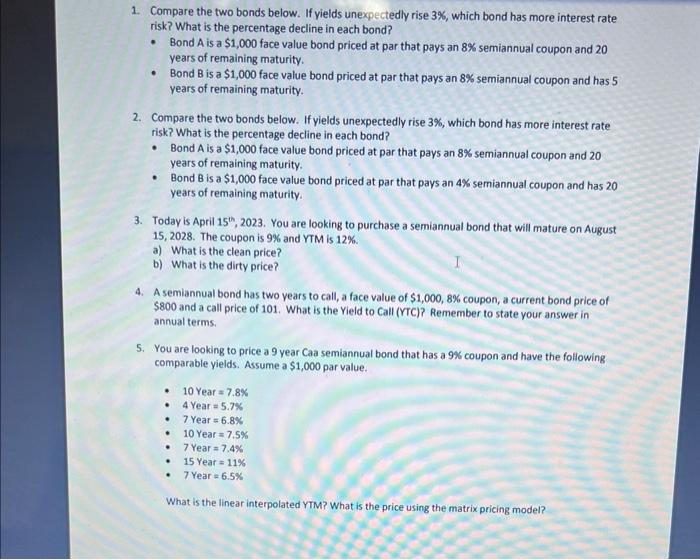
1. Compare the two bonds below. If yields unexpectedly rise 3%, which bond has more interest rate risk? What is the percentage decline in each bond? - Bond A is a $1,000 face value bond priced at par that pays an 8% semiannual coupon and 20 years of remaining maturity. - Bond B is a $1,000 face value bond priced at par that pays an 8% semiannual coupon and has 5 years of remaining maturity. 2. Compare the two bonds below. If yields unexpectedly rise 3%, which bond has more interest rate risk? What is the percentage decline in each bond? - Bond A is a $1,000 face value bond priced at par that pays an 8% semiannual coupon and 20 years of remaining maturity. - Bond B is a $1,000 face value bond priced at par that pays an 4% semiannual coupon and has 20 years of remaining maturity. 3. Today is April 15th, 2023. You are looking to purchase a semiannual bond that will mature on August 15, 2028. The coupon is 9% and YTM is 12%. a) What is the clean price? b) What is the dirty price? 4. A semiannual bond has two years to call, a face value of $1,000,8% coupon, a current bond price of $800 and a call price of 101 . What is the Yield to Call (YTC)? Remember to state your answer in annual terms. 5. You are looking to price a 9 year Caa semiannual bond that has a 9% coupon and have the following comparable yields. Assume a $1,000 par value. - 10 Year =7.8% - 4 Year =5.7% - 7 Year =6.8% - 10 Year =7.5% - 7 Year =7.4% - 15 Year =11% - 7 Year =6.5% What is the linear interpolated YTM? What is the price using the matrix pricing model
Step by Step Solution
There are 3 Steps involved in it

Get step-by-step solutions from verified subject matter experts