



Question: 1. Complete each statement. a) The addition of two vectors always results in another b) A vector can be resolved into two vectors whose sum
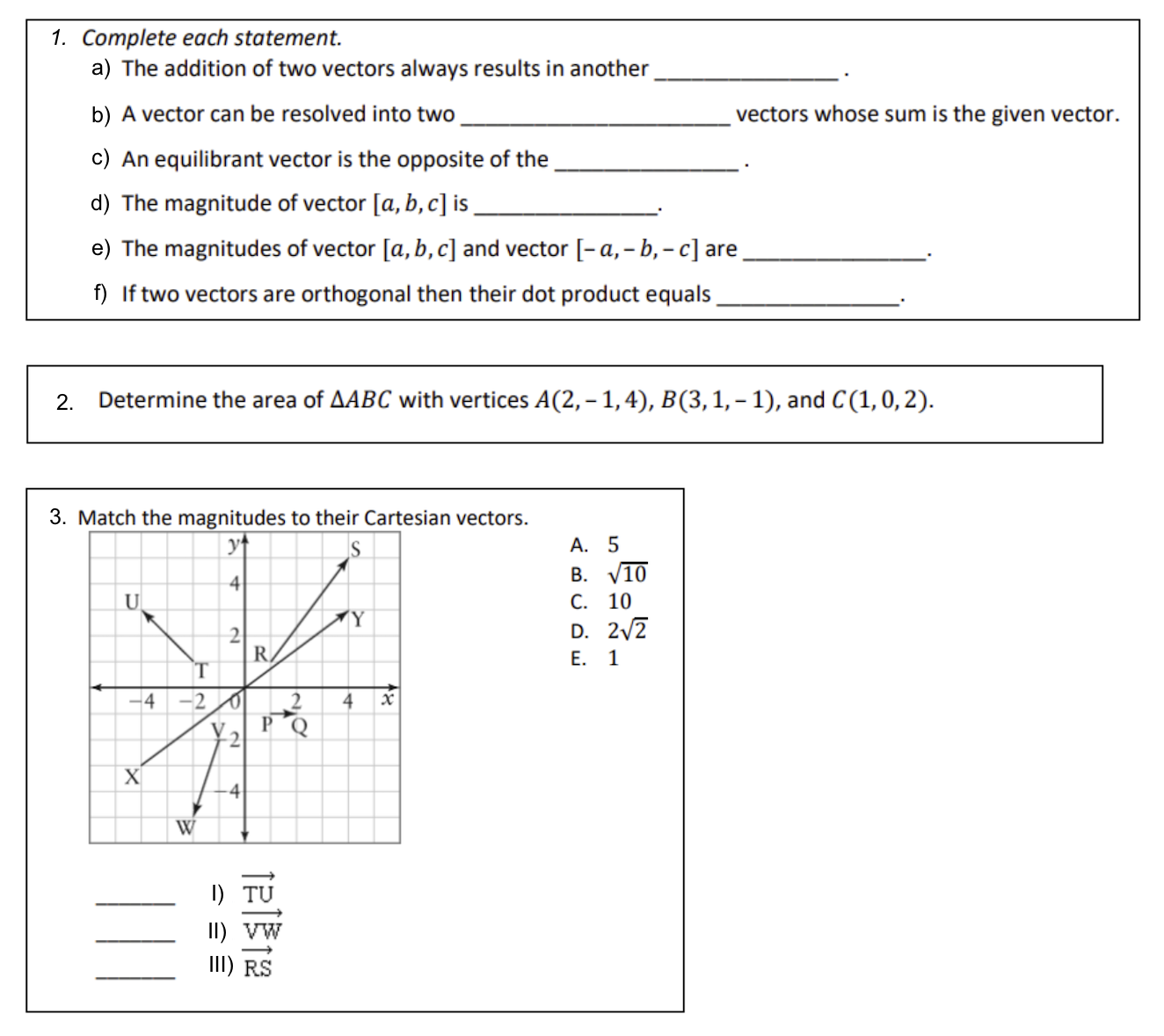
1. Complete each statement. a) The addition of two vectors always results in another b) A vector can be resolved into two vectors whose sum is the given vector. 0) An equilibrant vector is the opposite of the d) The magnitude of vector [(1, b, c] is e) The magnitudes of vector [(1. b, c] and vector [ a, b, c] are f) If two vectors are orthogonal then their dot product equals 2. Determine the area of MBC with vertices A(2. 1,4), 8(3, 1, 1), and C(1, 0,2). 3. Match the magnitudes to their Cartesian vectors
Step by Step Solution
There are 3 Steps involved in it
1 Expert Approved Answer
Step: 1 Unlock

Question Has Been Solved by an Expert!
Get step-by-step solutions from verified subject matter experts
Step: 2 Unlock
Step: 3 Unlock