







Question: 1. Complete reading and viewing all the learning resources specified for this module. 2. Review the Group Project Demo that walks through the normalization
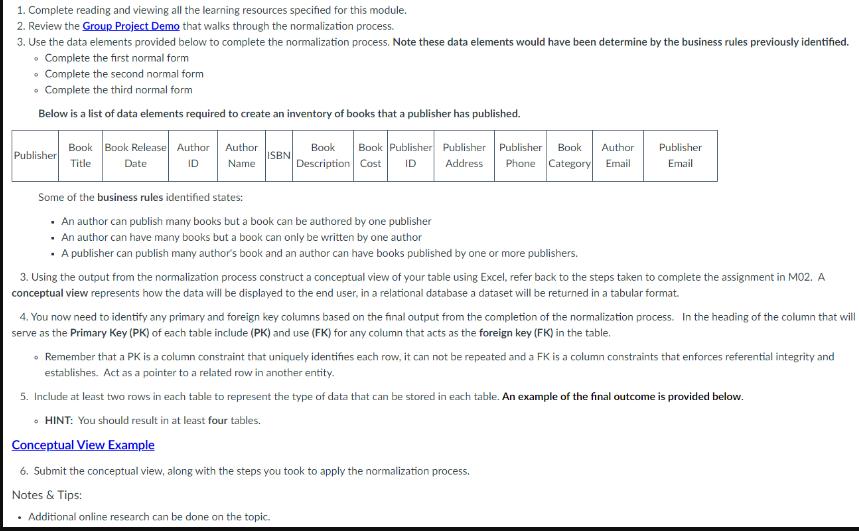
1. Complete reading and viewing all the learning resources specified for this module. 2. Review the Group Project Demo that walks through the normalization process. 3. Use the data elements provided below to complete the normalization process. Note these data elements would have been determine by the business rules previously identified. Complete the first normal form Complete the second normal form Complete the third normal form Below is a list of data elements required to create an inventory of books that a publisher has published. Publisher Book Book Release Author Author Title Date Name ID ISBN Book Book Publisher Publisher Publisher Book Author Description Cost ID Address Phone Category Email Some of the business rules identified states: An author can publish many books but a book can be authored by one publisher An author can have many books but a book can only be written by one author A publisher can publish many author's book and an author can have books published by one or more publishers. Publisher Email 3. Using the output from the normalization process construct a conceptual view of your table using Excel, refer back to the steps taken to complete the assignment in M02. A conceptual view represents how the data will be displayed to the end user, in a relational database a dataset will be returned in a tabular format. 4. You now need to identify any primary and foreign key columns based on the final output from the completion of the normalization process. In the heading of the column that will serve as the Primary Key (PK) of each table include (PK) and use (FK) for any column that acts as the foreign key (FK) in the table. Remember that a PK is a column constraint that uniquely identifies each row, it can not be repeated and a FK is a column constraints that enforces referential integrity and establishes. Act as a pointer to a related row in another entity. 5. Include at least two rows in each table to represent the type of data that can be stored in each table. An example of the final outcome is provided below. HINT: You should result in at least four tables. Conceptual View Example 6. Submit the conceptual view, along with the steps you took to apply the normalization process. Notes & Tips: Additional online research can be done on the topic.
Step by Step Solution
3.46 Rating (159 Votes )
There are 3 Steps involved in it
As there are two database given in the question First case There are two entities 1 Student entity w... View full answer

Get step-by-step solutions from verified subject matter experts
 Study Help