







Question: 1. Compute Midwests direct labor quantity variance (this variance is also called the labor usage variance or the labor efficiency variance). 2. By what amount
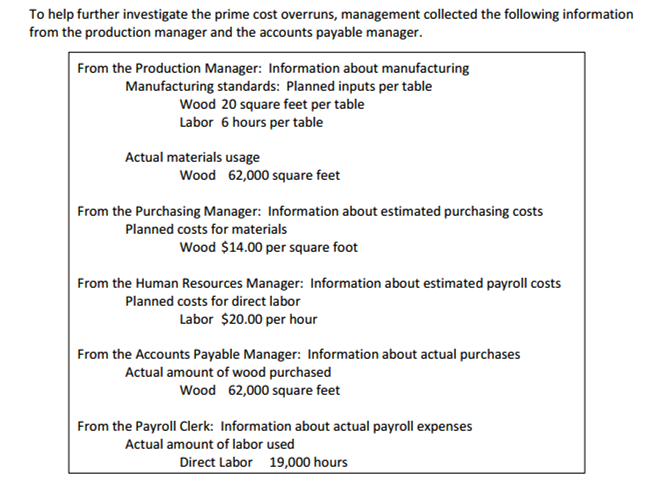
1. Compute Midwests direct labor quantity variance (this variance is also called the labor usage variance or the labor efficiency variance).
2. By what amount did profit change because Midwest used too much or too little direct labor in its tables? How is this answer related to the variance you calculated in question 1?
3. Based on the variance you computed in this activity and in Midwest A, what is the most likely explanation of what went wrong at Midwest in October? Remember, a good explanation is parsimonious it requires the fewest independent causes.
Has your answer changed from the answer you gave in Midwest Crafts A? Why or why not?
What would you investigate to determine whether you explanation is correct?
What corrections to processes or estimates would you recommend to help avoid the variances in the future?
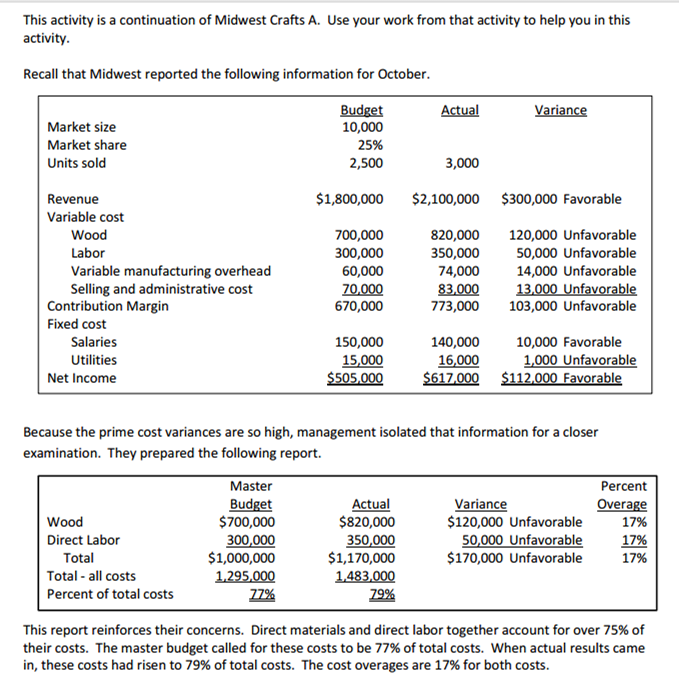
This activity is a continuation of Midwest Crafts A. Use your work from that activity to help you in this activity Recall that Midwest reported the following information for October Budget 10,000 25% 2,500 Actual Variance Market size Market share Units sold 3,000 $1,800,000 $2,100,000 $300,000 Favorable Revenue Variable cost Wood Labor Variable manufacturing overhead Selling and administrative cost 700,000 300,000 60,000 70,000 670,000 820,000 120,000 Unfavorable 0,000 Unfavorable 4,000 14,000 Unfavorable 83000 13000 Unfavorable 773,000 103,000 Unfavorable 350,000 5 Contribution Margin Fixed cost Salaries Utilities Net Income 150,000 15,000 40,000 10,000 Favorable 16,000 1,000 Unfavorable Because the prime cost variances are so high, management isolated that information for a closer examination. They prepared the following report. Master Budget $700,000 300,000 $1,000,000 Actual $820,000 350,000 $1,170,000 483,000 Percent Overage 17% 17% 17% Variance Wood Direct Labor $120,000 Unfavorable 0,000 Unfavorable $170,000 Unfavorable Total - all costs Percent of total costs 11% This report reinforces their concerns. Direct materials and direct labor together account for over 75% of their costs. The master budget called for these costs to be 77% of total costs, when actual results came in, these costs had risen to 79% of total costs. The cost overages are 17% for both costs
Step by Step Solution
There are 3 Steps involved in it

Get step-by-step solutions from verified subject matter experts
 Study Help