







Question: 1. Compute repeat unit molecular weights for the following: (a) poly(vinyl chloride), (b) poly(vinyl chloride) and (c) polycarbonate 2. Compare thermoplastic and thermosetting polymers (a)
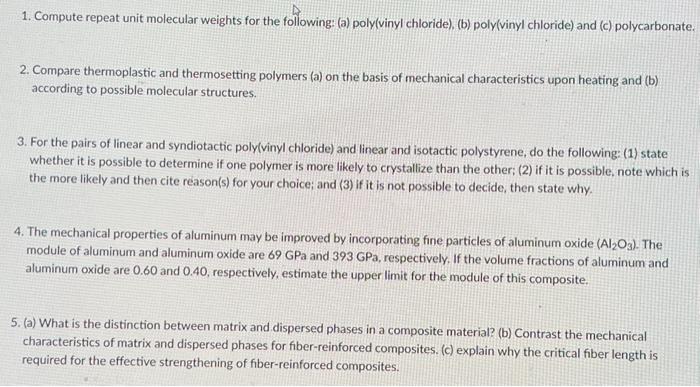
1. Compute repeat unit molecular weights for the following: (a) poly(vinyl chloride), (b) poly(vinyl chloride) and (c) polycarbonate 2. Compare thermoplastic and thermosetting polymers (a) on the basis of mechanical characteristics upon heating and (b) according to possible molecular structures. 3. For the pairs of linear and syndiotactic poly(vinyl chloride) and linear and isotactic polystyrene, do the following: (1) state whether it is possible to determine if one polymer is more likely to crystallize than the other; (2) if it is possible, note which is the more likely and then cite reason(s) for your choice; and (3) if it is not possible to decide, then state why. 4. The mechanical properties of aluminum may be improved by incorporating fine particles of aluminum oxide (Al2O3). The2 module of aluminum and aluminum oxide are 69GPa and 393GPa, respectively. If the volume fractions of aluminum and aluminum oxide are 0.60 and 0.40 , respectively, estimate the upper limit for the module of this composite. 5. (a) What is the distinction between matrix and dispersed phases in a composite material? (b) Contrast the mechanical characteristics of matrix and dispersed phases for fiber-reinforced composites. (c) explain why the critical fiber length is required for the effective strengthening of fiber-reinforced composites
Step by Step Solution
There are 3 Steps involved in it

Get step-by-step solutions from verified subject matter experts
 Study Help