







Question: 1. Computer Graphics - Section 2.'7 (a) Consider the triangle S in R2 with vertices (0, 1), (-2,-1), and (2,-1). Determine homoge- neous coordinates for
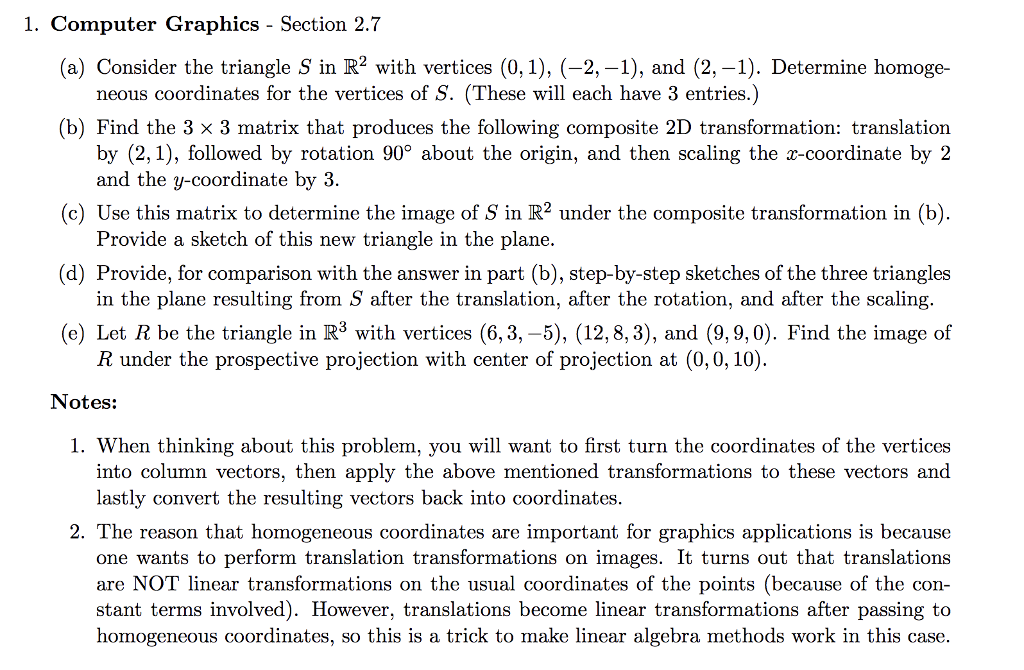
1. Computer Graphics - Section 2.'7 (a) Consider the triangle S in R2 with vertices (0, 1), (-2,-1), and (2,-1). Determine homoge- neous coordinates for the vertices of S. (These will each have 3 entries.) (b) Find the 3 x 3 matrix that produces the following composite 2D transformation: translation by (2,1), followed by rotation 90 about the origin, and then scaling the x-coordinate by 2 and the y-coordinate bv 3 (c) Use this matrix to determine the image of S in R2 under the composite transformation in (b) (d) Provide, for comparison with the answer in part (b), step-by-step sketches of the three triangles (e) Let R be the triangle in R3 with vertices (6,3,-5), (12, 8,3), and (9,9,0). Find the image of Provide a sketch of this new triangle in the plane. in the plane resulting from S after the translation, after the rotation, and after the scaling. R under the prospective projection with center of projection at (0,0, 10) Notes: 1. When thinking about this problem, you will want to first turn the coordinates of the vertices into column vectors, then apply the above mentioned transformations to these vectors and lastly convert the resulting vectors back into coordinates 2. The reason that homogeneous coordinates are important for graphics applications is because one wants to perform translation transformations on images. It turns out that translations are NOT linear transformations on the usual coordinates of the points (because of the con- stant terms involved). However, translations become linear transformations after passing to homogeneous coordinates, so this is a trick to make linear algebra methods work in this case. 1. Computer Graphics - Section 2.'7 (a) Consider the triangle S in R2 with vertices (0, 1), (-2,-1), and (2,-1). Determine homoge- neous coordinates for the vertices of S. (These will each have 3 entries.) (b) Find the 3 x 3 matrix that produces the following composite 2D transformation: translation by (2,1), followed by rotation 90 about the origin, and then scaling the x-coordinate by 2 and the y-coordinate bv 3 (c) Use this matrix to determine the image of S in R2 under the composite transformation in (b) (d) Provide, for comparison with the answer in part (b), step-by-step sketches of the three triangles (e) Let R be the triangle in R3 with vertices (6,3,-5), (12, 8,3), and (9,9,0). Find the image of Provide a sketch of this new triangle in the plane. in the plane resulting from S after the translation, after the rotation, and after the scaling. R under the prospective projection with center of projection at (0,0, 10) Notes: 1. When thinking about this problem, you will want to first turn the coordinates of the vertices into column vectors, then apply the above mentioned transformations to these vectors and lastly convert the resulting vectors back into coordinates 2. The reason that homogeneous coordinates are important for graphics applications is because one wants to perform translation transformations on images. It turns out that translations are NOT linear transformations on the usual coordinates of the points (because of the con- stant terms involved). However, translations become linear transformations after passing to homogeneous coordinates, so this is a trick to make linear algebra methods work in this case
Step by Step Solution
There are 3 Steps involved in it

Get step-by-step solutions from verified subject matter experts
 Study Help