







Question: 1. Consider a baseball that is thrown vertically upwards at a speed of v0 m/s. So the initial condition is v(t=0)= +v0, where the positive
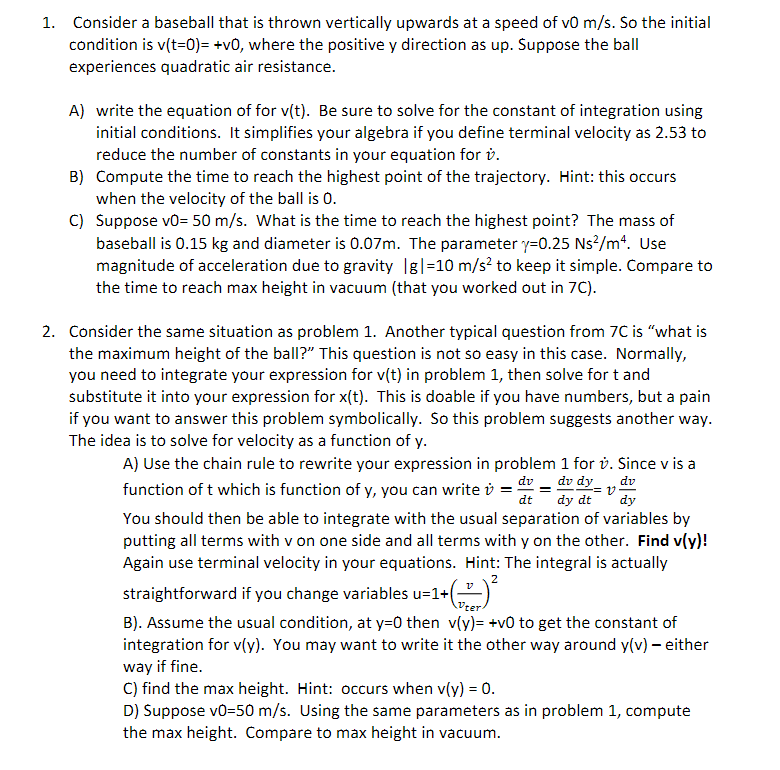
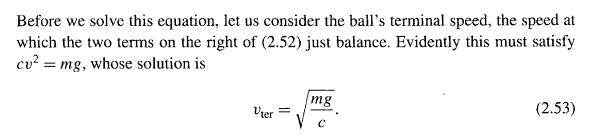
1. Consider a baseball that is thrown vertically upwards at a speed of v0 m/s. So the initial condition is v(t=0)= +v0, where the positive y direction as up. Suppose the ball experiences quadratic air resistance. A) write the equation of for v(t). Be sure to solve for the constant of integration using initial conditions. It simplifies your algebra if you define terminal velocity as 2.53 to reduce the number of constants in your equation for v. B) Compute the time to reach the highest point of the trajectory. Hint: this occurs when the velocity of the ball is 0. C) Suppose v0= 50 m/s. What is the time to reach the highest point? The mass of baseball is 0.15 kg and diameter is 0.07m. The parameter y=0.25 Ns'/m. Use magnitude of acceleration due to gravity |g|=10 m/s' to keep it simple. Compare to the time to reach max height in vacuum (that you worked out in 7C). 2. Consider the same situation as problem 1. Another typical question from 7C is "what is the maximum height of the ball?" This question is not so easy in this case. Normally, you need to integrate your expression for v(t) in problem 1, then solve for t and substitute it into your expression for x(t). This is doable if you have numbers, but a pain if you want to answer this problem symbolically. So this problem suggests another way. The idea is to solve for velocity as a function of y. A) Use the chain rule to rewrite your expression in problem 1 for v. Since v is a function of t which is function of y, you can write b = at _ du dy dv dt dy dt dy You should then be able to integrate with the usual separation of variables by putting all terms with v on one side and all terms with y on the other. Find v(y)! Again use terminal velocity in your equations. Hint: The integral is actually straightforward if you change variables u=1+(" B). Assume the usual condition, at y=0 then v(y)= +v0 to get the constant of integration for v(y). You may want to write it the other way around y(v) - either way if fine. C) find the max height. Hint: occurs when v(y) = 0. D) Suppose v0=50 m/s. Using the same parameters as in problem 1, compute the max height. Compare to max height in vacuum.Before we solve this equation, let us consider the ball's terminal speed, the speed at which the two terms on the right of (2.52) just balance. Evidently this must satisfy cuz = mg, whose solution is mg Uter = (2.53)
Step by Step Solution
There are 3 Steps involved in it

Get step-by-step solutions from verified subject matter experts
 Study Help