







Question: 1. Consider a car being road tested going around a bend in the road as fast as it can. The bend has a constant R
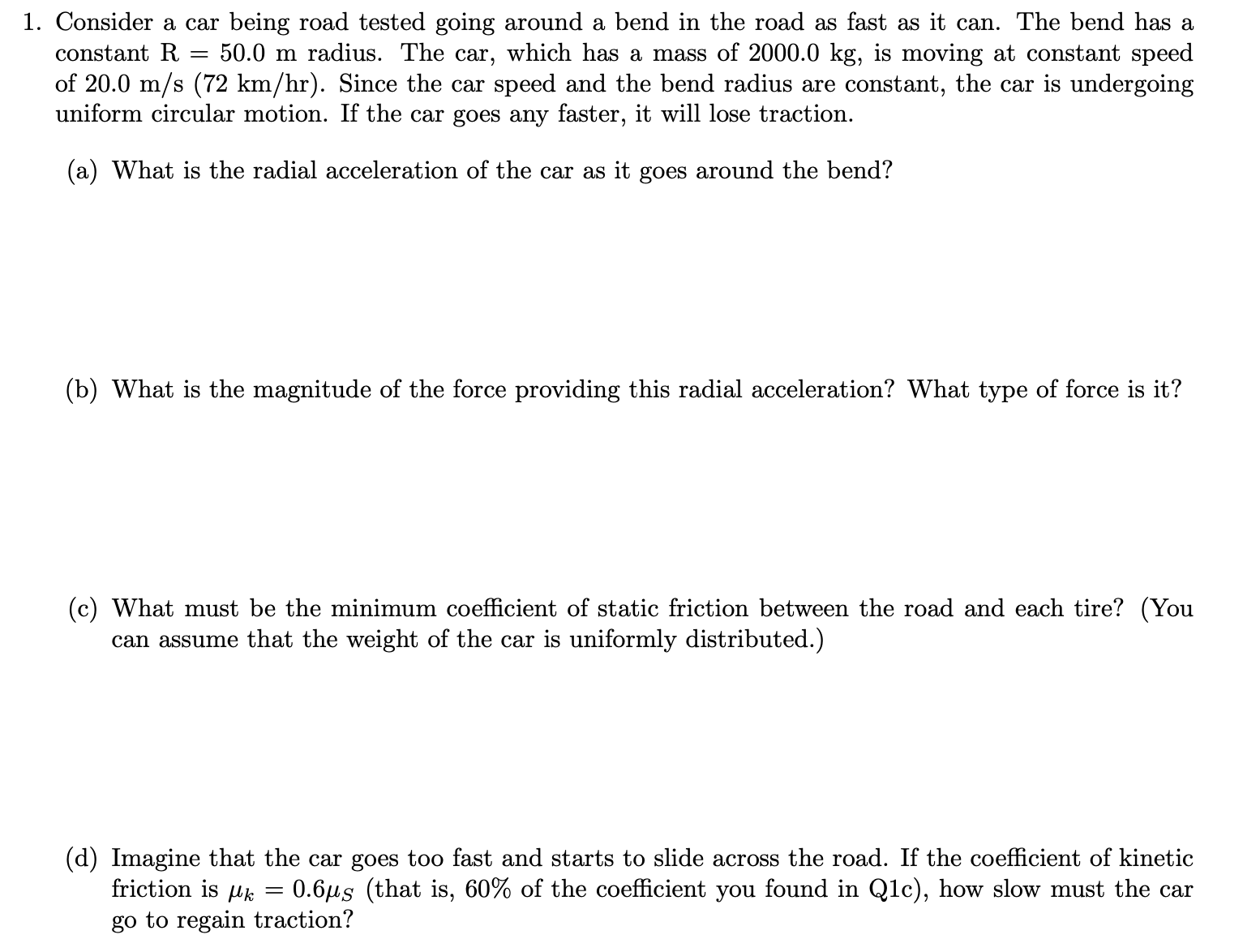
1. Consider a car being road tested going around a bend in the road as fast as it can. The bend has a constant R = 50.0 m radius. The car, which has a mass of 2000.0 kg, is moving at constant speed of 20.0 m/s (72 km/hr). Since the car speed and the bend radius are constant, the car is undergoing uniform circular motion. If the car goes any faster, it will lose traction. (a) What is the radial acceleration of the car as it goes around the bend? (b) What is the magnitude of the force providing this radial acceleration? What type of force is it? (c) What must be the minimum coefficient of static friction between the road and each tire? (You can assume that the weight of the car is uniformly distributed.) (d) Imagine that the car goes too fast and starts to slide across the road. If the coefficient of kinetic friction is /k = 0.6us (that is, 60% of the coefficient you found in Qlc), how slow must the car go to regain traction
Step by Step Solution
There are 3 Steps involved in it

Get step-by-step solutions from verified subject matter experts
 Study Help