



Question: 1. Consider a consumer that is choosing between three bundles, each comprising two goods .1: and y. The bundles are: a. = (2, 2), b
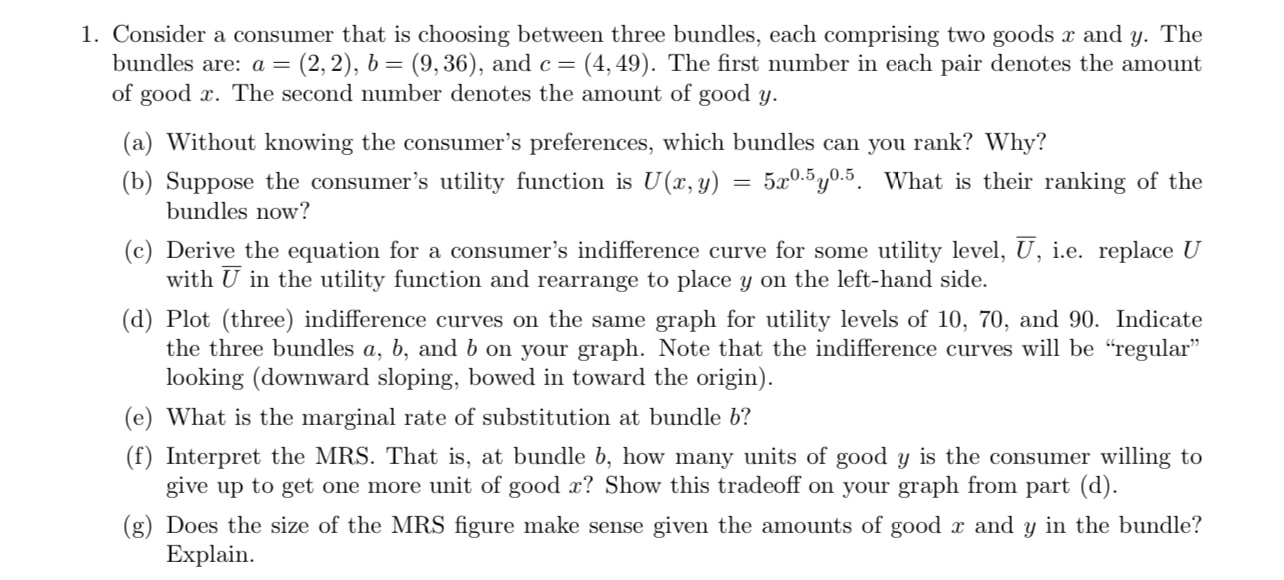
1. Consider a consumer that is choosing between three bundles, each comprising two goods .1: and y. The bundles are: a. = (2, 2), b = (9, 36), and c = (4,49). The rst number in each pair denotes the amount of good 2:. The second number denotes the amount of good y. (a) Without knowing the consumer's preferences, which bundles can you rank? Why? (b) Suppose the consumer's utility function is U(:r, y) = 510'5y0'5. What is their ranking of the bundles now? (c) Derive the equation for a consumer's indifference curve for some utility level, U, i.e. replace U with U in the utility function and rearrange to place y on the lefthand side. ((1) Plot (three) mdierence curves on the same graph for utility levels of 10, 70, and 90. Indicate the three bundles a, b, and b on your graph. Note that the indifference curves will be \"regular\" looking (downward sloping, bowed in toward the origin). (e) What is the marginal rate of substitution at bundle I)? (f) Interpret the MRS. That is, at bundle b, howr many units of good 3; is the consumer willing to give up to get one more unit of good 1:? Show this tradeoff on your graph from part ((1). (g) Does the size of the MRS gure make sense given the amounts of good :1: and y in the bundle? Explain
Step by Step Solution
There are 3 Steps involved in it

Get step-by-step solutions from verified subject matter experts