







Question: 1. Consider a consumer with utility function u(x1,*2) = Inx1 + x2. Assume that p1 = p2 = 1. Determine the optimal bundle for m
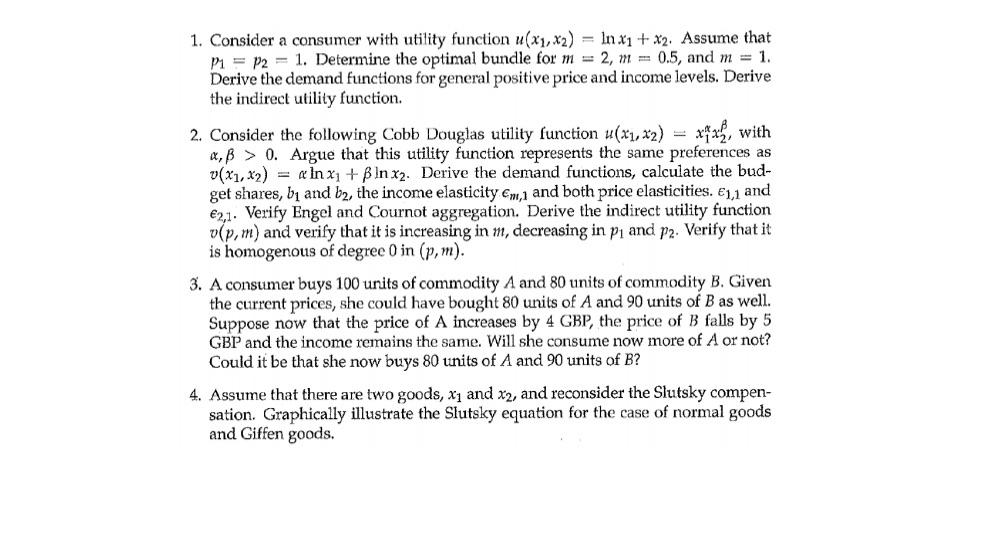
1. Consider a consumer with utility function u(x1,*2) = Inx1 + x2. Assume that p1 = p2 = 1. Determine the optimal bundle for m = 2, m = 0.5, and m = 1. Derive the demand functions for general positive price and income levels. Derive the indirect utility function. 2. Consider the following Cobb Douglas utility function #(x1, x2) = xx5, with a, B > 0. Argue that this utility function represents the same preferences as D(X1,12) = aInx, + plnx2. Derive the demand functions, calculate the bud- get shares, bj and b2, the income elasticity m,, and both price elasticities. 61,1 and 62,1. Verify Engel and Cournot aggregation. Derive the indirect utility function v(p, m) and verify that it is increasing in m, decreasing in p, and p2. Verify that it is homogenous of degree 0 in (p, m). 3. A consumer buys 100 units of commodity A and 80 units of commodity B. Given the current prices, she could have bought 80 units of A and 90 units of B as well. Suppose now that the price of A increases by 4 GBP, the price of B falls by 5 GBP and the income remains the same. Will she consume now more of A or not? Could it be that she now buys 80 units of A and 90 units of B? 4. Assume that there are two goods, x, and x2, and reconsider the Slutsky compen- sation. Graphically illustrate the Slutsky equation for the case of normal goods and Giffen goods
Step by Step Solution
There are 3 Steps involved in it

Get step-by-step solutions from verified subject matter experts
 Study Help