



Question: 1. Consider a modied version of the Solow Growth Model in which there is a represen- tative laborer (L), a representative nancier (F), and a
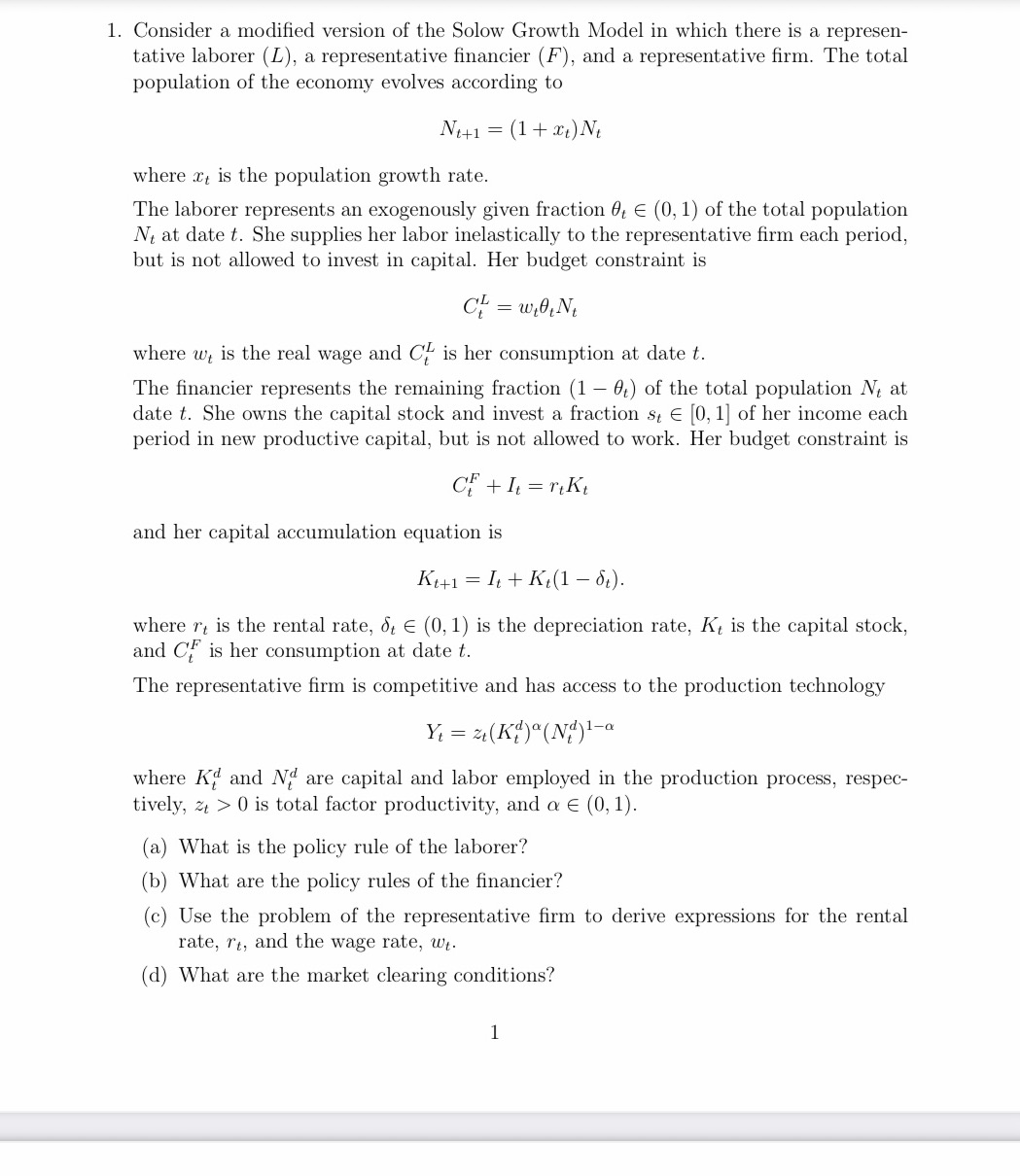
1. Consider a modied version of the Solow Growth Model in which there is a represen- tative laborer (L), a representative nancier (F), and a representative rm. The total population of the economy evolves according to Nc+1 = (1+ miiNr where .131 is the population growth rate. The laborer represents an exogenously given fraction 91 E (0, 1) of the total population N: at date t. She supplies her labor inelastically to the representative rm each period, but is not allowed to invest in capital. Her budget constraint is of : wtatNt where w, is the real wage and Cf\" is her consumption at date t. The nancier represents the remaining fraction (1 6;) of the total population N; at date t. She owns the capital stock and invest a fraction 3; E [0, 1] of her income each period in new productive capital, but is not allowed to work. Her budget constraint is Cf + I; Z TgK: and her capital accumulation equation is Kc+1 = I: + Kc\" 52)- where r, is the rental rate, 6; E (U, 1) is the depreciation rate, If; is the capital stock, and Cf is her consumption at date t. The representative rm is competitive and has access to the production technology Y: = z:(Kf)\"(N:')'\" where K3 and NE are capital and labor employed in the production process, respec- tively, z, > O is total factor productivity, and a E (U, 1). (a) What is the policy rule of the laborer? (b) What are the policy rules of the financier? (c) Use the problem of the representative rm to derive expressions for the rental rate, rt, and the wage rate, \"wt. (d) What are the market clearing conditions
Step by Step Solution
There are 3 Steps involved in it

Get step-by-step solutions from verified subject matter experts