Question: 1. Consider a quantum mechanical system with three states. At each step a particular particle transitions from one state to a different state. Empirical data

1.
1. Consider a quantum mechanical system with1. Consider a quantum mechanical system with1. Consider a quantum mechanical system with
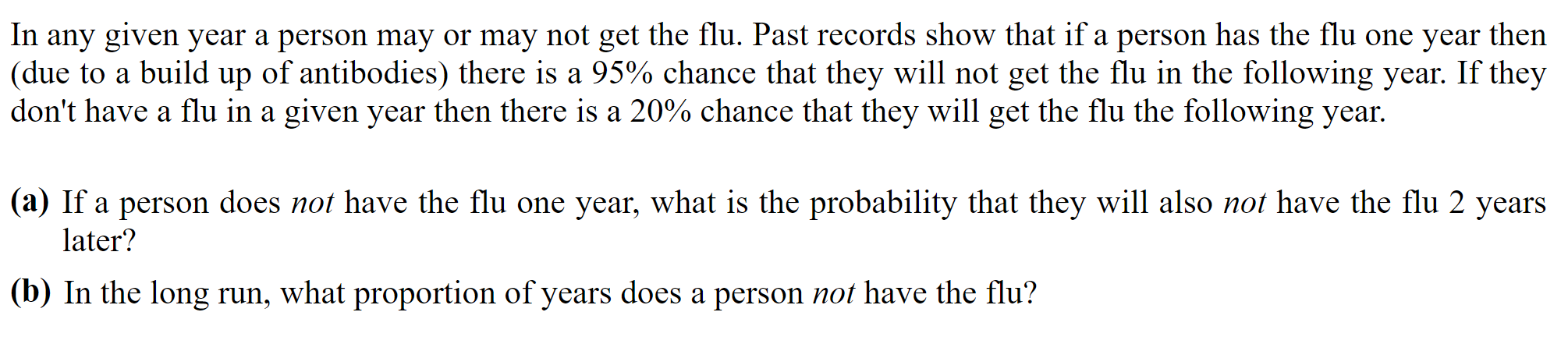
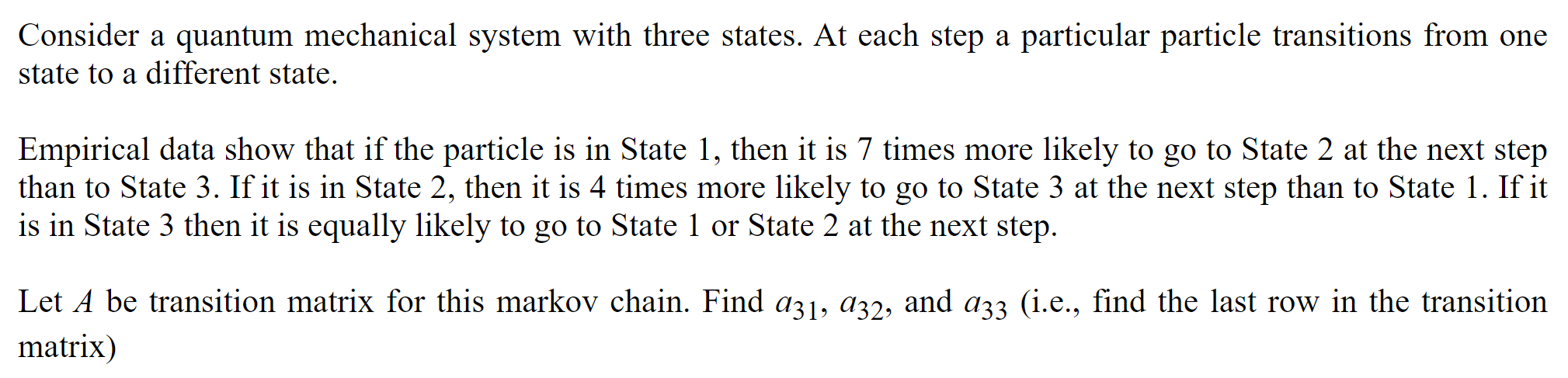
Consider a quantum mechanical system with three states. At each step a particular particle transitions from one state to a different state. Empirical data show that if the particle is in State 1, then it is 7 times more likely to go to State 2 at the next step than to State 3. If it is in State 2, then it is 4 times more likely to go to State 3 at the next step than to State 1. If it is in State 3 then it is equally likely to go to State 1 or State 2 at the next step. Let A be transition matrix for this markoy chain. Find a31, (132, and a33 (i.e., nd the last row in the transition matrix) In any given year a person may or may not get the u. Past records show that if a person has the u one year then (due to a build up of antibodies) there is a 95% chance that they will not get the u in the following year. If they don't have a u in a given year then there is a 20% chance that they Will get the u the following year. (a) If a person does not have the u one year, What is the probability that they Will also not have the u 2 years later? (b) In the long run, What proportion of years does a person nor have the u? Express (% i; i) 61 in the form a + bi. Enter the values of a and b (in that order) into the answer box below, separated With a comma

Step by Step Solution

There are 3 Steps involved in it

1 Expert Approved Answer
Step: 1 Unlock blur-text-image

Question Has Been Solved by an Expert!

Get step-by-step solutions from verified subject matter experts

Step: 2 Unlock
Step: 3 Unlock

Students Have Also Explored These Related Mathematics Questions!