





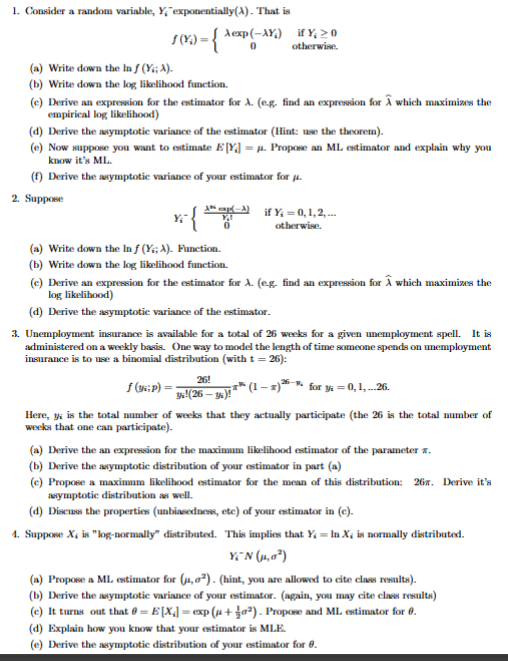
Question: 1. Consider a random variable, Y, exponentially(A). That is 0 1 (Y) = Aexp(-AY.) ifY, 20 otherwise (a) Write down the In f (Y; A).
1. Consider a random variable, Y,
1. Consider a random variable, Y, exponentially(A). That is 0 1 (Y) = Aexp(-AY.) ifY, 20 otherwise (a) Write down the In f (Y; A). (b) Write down the log likelihood function. (c) Derive an expression for the estimator for A. (e.g. find an expression for A which maximizes the empirical log likelihood) (d) Derive the asymptotic variance of the estimator (Hint: use the theorem). (e) Now suppose you want to estimate E[Y] = p. Propose an ML estimator and explain why you know it's ML.. (f) Derive the asymptotic variance of your estimator for p. 2. Suppose Yi if Yi = 0, 1, 2, ... otherwise. (a) Write down the In f (); A). Function. (b) Write down the log likelihood function. (c) Derive an expression for the estimator for A. (e.g. find an expression for A which maximizes the log likelihood) (d) Derive the asymptotic variance of the estimator. 3. Unemployment insurance is available for a total of 26 weeks for a given unemployment spell. It is administered on a weekly basis. One way to model the length of time someone spends on unemployment insurance is to use a binomial distribution (with t = 26): 26! f (y:p) = (1 - x) for yi = 0, 1, ...26. Here, me is the total number of weeks that they actually participate (the 26 is the total number of works that one can participate)- (a) Derive the an expression for the maximum likelihood estimator of the parameter s. (b) Derive the asymptotic distribution of your estimator in part (a) (c) Propose a maximum likelihood estimator for the mean of this distribution: 26w. Derive it's asymptotic distribution as well. (d) Discuss the properties (unbiasedness, etc) of your estimator in (c). 4. Suppose Xi is "log-normally" distributed. This implies that Y's = In X, is normally distributed. (a) Propose a ML estimator for (u, a?) . (hint, you are allowed to cite class results). (b) Derive the asymptotic variance of your estimator. (again, you may cite class results) (c) It turns out that 8 = B [X] = exp (a + jo?) . Propose and ML estimator for 9. (d) Explain how you know that your estimator is MLE. (e) Derive the asymptotic distribution of your estimator for 8

Step by Step Solution

There are 3 Steps involved in it

1 Expert Approved Answer
Step: 1 Unlock blur-text-image

Question Has Been Solved by an Expert!

Get step-by-step solutions from verified subject matter experts

Step: 2 Unlock
Step: 3 Unlock

Students Have Also Explored These Related Mathematics Questions!