







Question: 1. Consider a relation R on the domain {a, b, c}, defined as R = {(a, a), (b, c), (c, a), (c, b)}. (a)
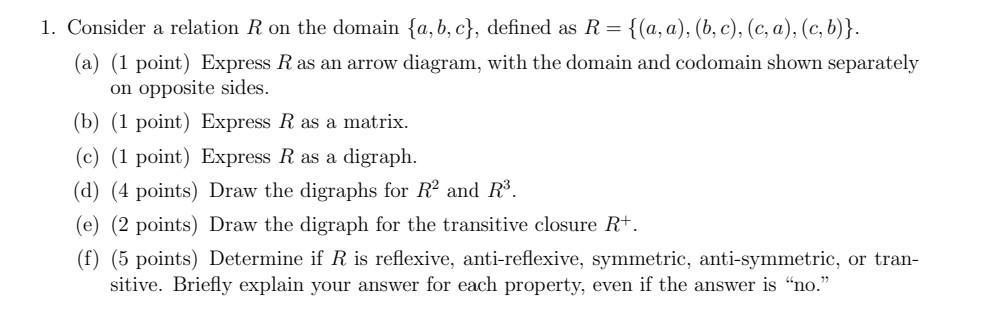
1. Consider a relation R on the domain {a, b, c}, defined as R = {(a, a), (b, c), (c, a), (c, b)}. (a) (1 point) Express R as an arrow diagram, with the domain and codomain shown separately on opposite sides. (b) (1 point) Express R as a matrix. (c) (1 point) Express R as a digraph. (d) (4 points) Draw the digraphs for R and R. (e) (2 points) Draw the digraph for the transitive closure R+. (f) (5 points) Determine if R is reflexive, anti-reflexive, symmetric, anti-symmetric, or tran- sitive. Briefly explain your answer for each property, even if the answer is "no."
Step by Step Solution
There are 3 Steps involved in it
a Arrow diagram representation of relation R a ... View full answer

Get step-by-step solutions from verified subject matter experts
 Study Help