



Question: 1. Consider a system of 9 processes, P = {p1, ..., p9}. Associated with the system are 6 memory cells, M = {M1, M6}.
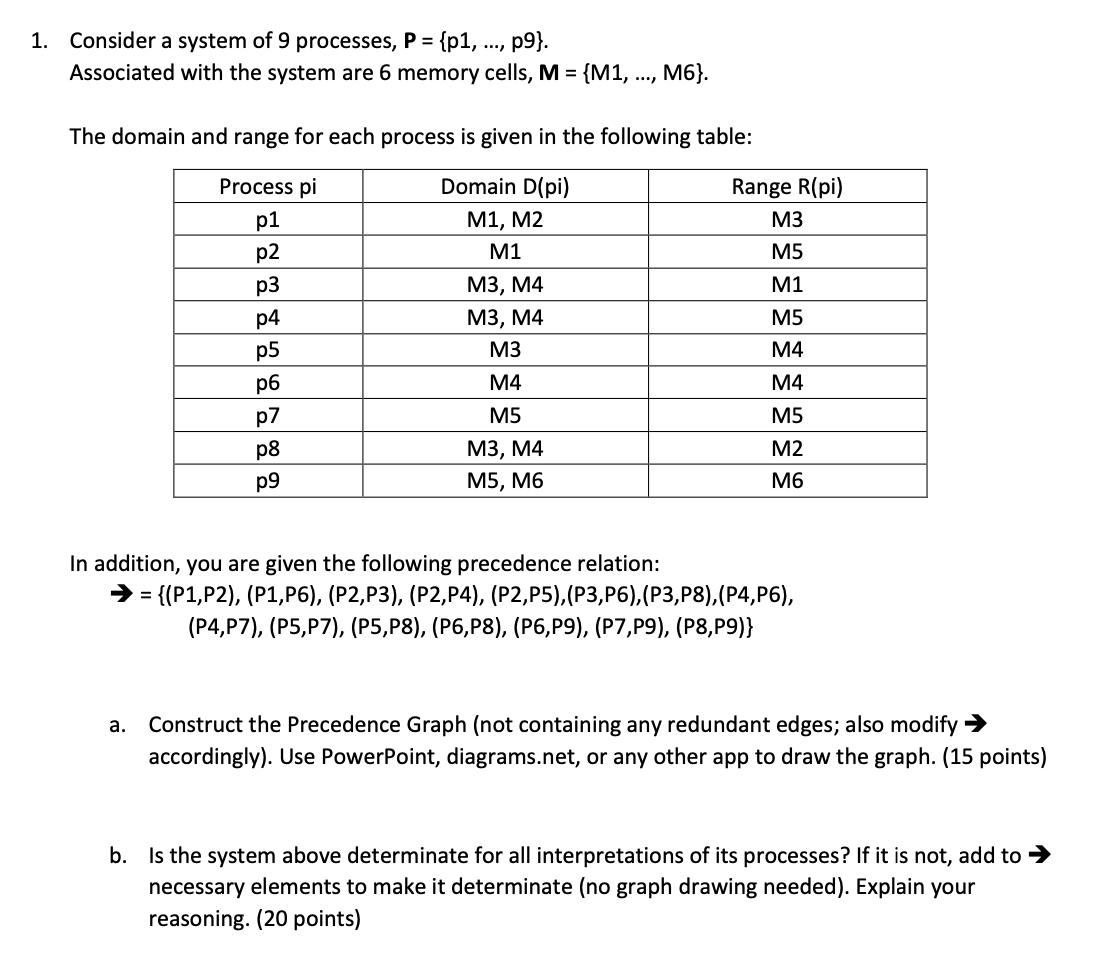
1. Consider a system of 9 processes, P = {p1, ..., p9}. Associated with the system are 6 memory cells, M = {M1, M6}. The domain and range for each process is given in the following table: Process pi Domain D(pi) p1 M1, M2 p2 M1 p3 M3, M4 p4 M3, M4 M3 M4 M5 p5 p6 p7 a. p8 p9 ... M3, M4 M5, M6 In addition, you are given the following precedence relation: Range R(pi) M3 M5 M1 M5 M4 M4 M5 M2 M6 = {(P1,P2), (P1,P6), (P2, P3), (P2,P4), (P2, P5),(P3, P6), (P3,P8), (P4,P6), (P4,P7), (P5,P7), (P5,P8), (P6,P8), (P6,P9), (P7,P9), (P8,P9)} Construct the Precedence Graph (not containing any redundant edges; also modify accordingly). Use PowerPoint, diagrams.net, or any other app to draw the graph. (15 points) b. Is the system above determinate for all interpretations of its processes? If it is not, add to necessary elements to make it determinate (no graph drawing needed). Explain your reasoning. (20 points)
Step by Step Solution
3.35 Rating (139 Votes )
There are 3 Steps involved in it
The table provides 9 processes they are named p1p9 and the name of the D for each of the processes a... View full answer

Get step-by-step solutions from verified subject matter experts