



Question: 1. Consider again the problem of homework 3: M) = % [DeWay = [0 x arm0022)dz=IEerxp((mU)E/2n where U ~ U(0, 1). (a) Use a single
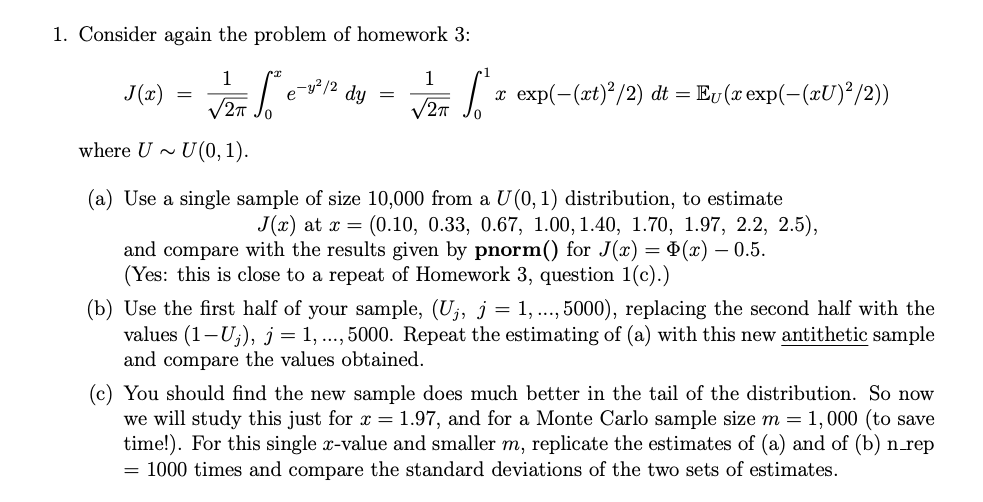
1. Consider again the problem of homework 3: M) = % [DeWay = [0 x arm0022)dz=IEerxp((mU)E/2n where U ~ U(0, 1). (a) Use a single sample of size 10,000 from a U(0, 1) distribution, to estimate J(r) at :1: = (0.10, 0.33, {1.67, 1.00.140, 1.70, 1.97, 2.2, 2.5), and compare with the results given by pnormO for J(.1:) = @(m) 0.5. (Yes: this is close to a repeat of Homework 3, question 1(0).) (b) Use the rst half of your sample, (U5, 3' = 1, ..., 5000), replacing the second half with the values (lUj), j = 1, ..., 5000. Repeat the estimating of (a) with this new antithetio sample and compare the values obtained. (c) You should nd the new sample does much better in the tail of the distribution. So now we will study this just for 2: = 1.97, and for a Monte Carlo sample size m = 1, 000 (to save time!). For this single m-value and smaller m, replicate the estimates of (a) and of (b) n_rep = 1000 times and compare the standard deviations of the two sets of estimates
Step by Step Solution
There are 3 Steps involved in it

Get step-by-step solutions from verified subject matter experts