



Question: 1 . Consider an incompressible, viscous fluid confined between two infinite, horizontal, parallel plates as depicted below. These plates move in opposite directions at constant
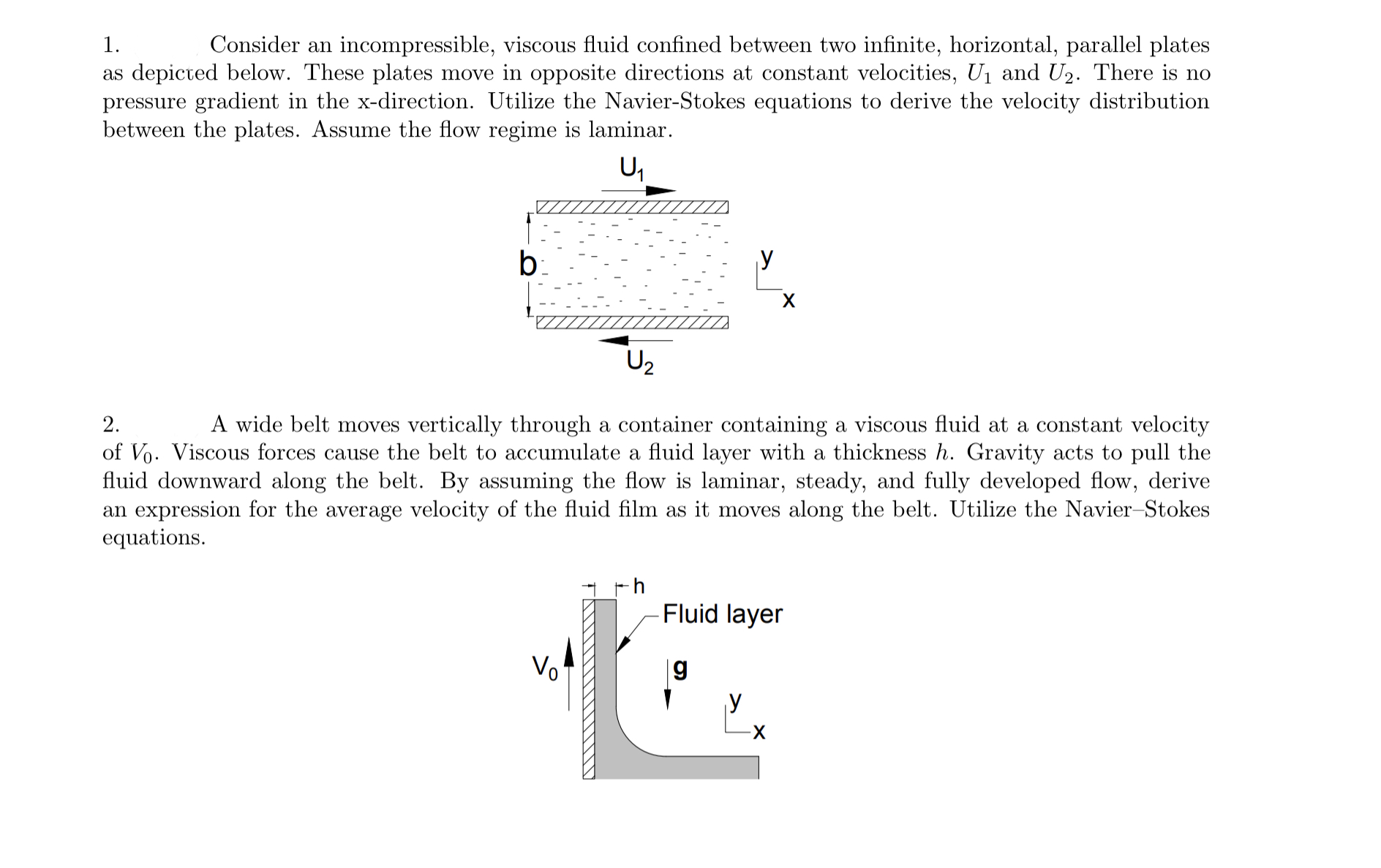
Consider an incompressible, viscous fluid confined between two infinite, horizontal, parallel plates as depicted below. These plates move in opposite directions at constant velocities, U and U There is no pressure gradient in the xdirection. Utilize the NavierStokes equations to derive the velocity distribution between the plates. Assume the flow regime is laminar.
A wide belt moves vertically through a container containing a viscous fluid at a constant velocity of V Viscous forces cause the belt to accumulate a fluid layer with a thickness h Gravity acts to pull the fluid downward along the belt. By assuming the flow is laminar, steady, and fully developed flow, derive an expression for the average velocity of the fluid film as it moves along the belt. Utilize the NavierStokes equations.
Step by Step Solution
There are 3 Steps involved in it
1 Expert Approved Answer
Step: 1 Unlock

Question Has Been Solved by an Expert!
Get step-by-step solutions from verified subject matter experts
Step: 2 Unlock
Step: 3 Unlock