







Question: 1. Consider an OLG model in which No = 100, and the gross population growth rate is equal to n. Each individual only receives y
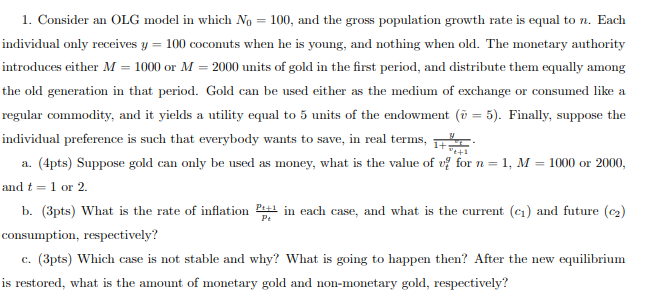
1. Consider an OLG model in which No = 100, and the gross population growth rate is equal to n. Each individual only receives y = 100 coconuts when he is young, and nothing when old. The monetary authority introduces either M = 1000 or M = 2000 units of gold in the first period, and distribute them equally among the old generation in that period. Gold can be used either as the medium of exchange or consumed like a regular commodity, and it yields a utility equal to 5 units of the endowment (i = 5). Finally, suppose the individual preference is such that everybody wants to save, in real terms, the a. (4pts) Suppose gold can only be used as money, what is the value of v for n=1, M = 1000 or 2000, and t = 1 or 2. b. (3pts) What is the rate of inflation et in each case, and what is the current (c) and future (2) consumption, respectively? c. (3pts) Which case is not stable and why? What is going to happen then? After the new equilibrium is restored, what is the amount of monetary gold and non-monetary gold, respectively? +1 1. Consider an OLG model in which No = 100, and the gross population growth rate is equal to n. Each individual only receives y = 100 coconuts when he is young, and nothing when old. The monetary authority introduces either M = 1000 or M = 2000 units of gold in the first period, and distribute them equally among the old generation in that period. Gold can be used either as the medium of exchange or consumed like a regular commodity, and it yields a utility equal to 5 units of the endowment (i = 5). Finally, suppose the individual preference is such that everybody wants to save, in real terms, the a. (4pts) Suppose gold can only be used as money, what is the value of v for n=1, M = 1000 or 2000, and t = 1 or 2. b. (3pts) What is the rate of inflation et in each case, and what is the current (c) and future (2) consumption, respectively? c. (3pts) Which case is not stable and why? What is going to happen then? After the new equilibrium is restored, what is the amount of monetary gold and non-monetary gold, respectively? +1
Step by Step Solution
There are 3 Steps involved in it

Get step-by-step solutions from verified subject matter experts
 Study Help