







Question: 1. Consider running Simons algorithm on the following function acting on 3 bits: f(000) = 000 f(001) = 001 f(010) = 010 f(011) = 011
1. Consider running Simons algorithm on the following function acting on 3 bits: f(000) = 000 f(001) = 001 f(010) = 010 f(011) = 011 f(100) = 011 f(101) = 010 f(110) = 001 f(111) = 000 (a) What is the period a? (b) What is the state after the first set of Hadamards? (c) What is the state after applying the function f(x) ? (d) When the output register is measured, if the outcome is 001, what is the state of the input register? (e) What is the state after the second set of Hadamards? (f) When the input register is measured the outcome is 011. When the algorithm is run again, a measurement of the input register yields 101. Show how to determine the period a from these two outcomes.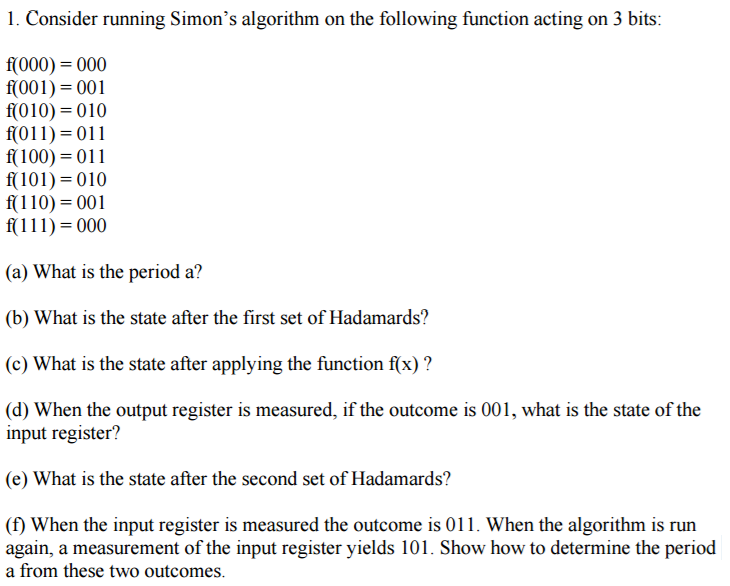
1. Consider running Simon's algorithm on the following function acting on 3 bits f(000) = 000 f(001) 001 f010-010 f(011)-011 f(100) 011 f(101) 010 f(110) = 001 f(111)=000 (a) What is the period a? (b) What is the state after the first set of Hadamards? (c) What is the state after applying the function f(x)? (d) When the output register is measured, if the outcome is 001, what is the state of the input register? (e) What is the state after the second set of Hadamards? (f) When the input register is measured the outcome is 011. When the algorithm is run again, a measurement of the input register yields 101. Show how to determine the period a from these two outcomes
Step by Step Solution
There are 3 Steps involved in it

Get step-by-step solutions from verified subject matter experts
 Study Help