Question: 1. Consider the Cobb-Douglas production function where real aggregate output Y is given by Y=AKa(LxE)1a, in which A=60 is a parameter measuring the productivity of
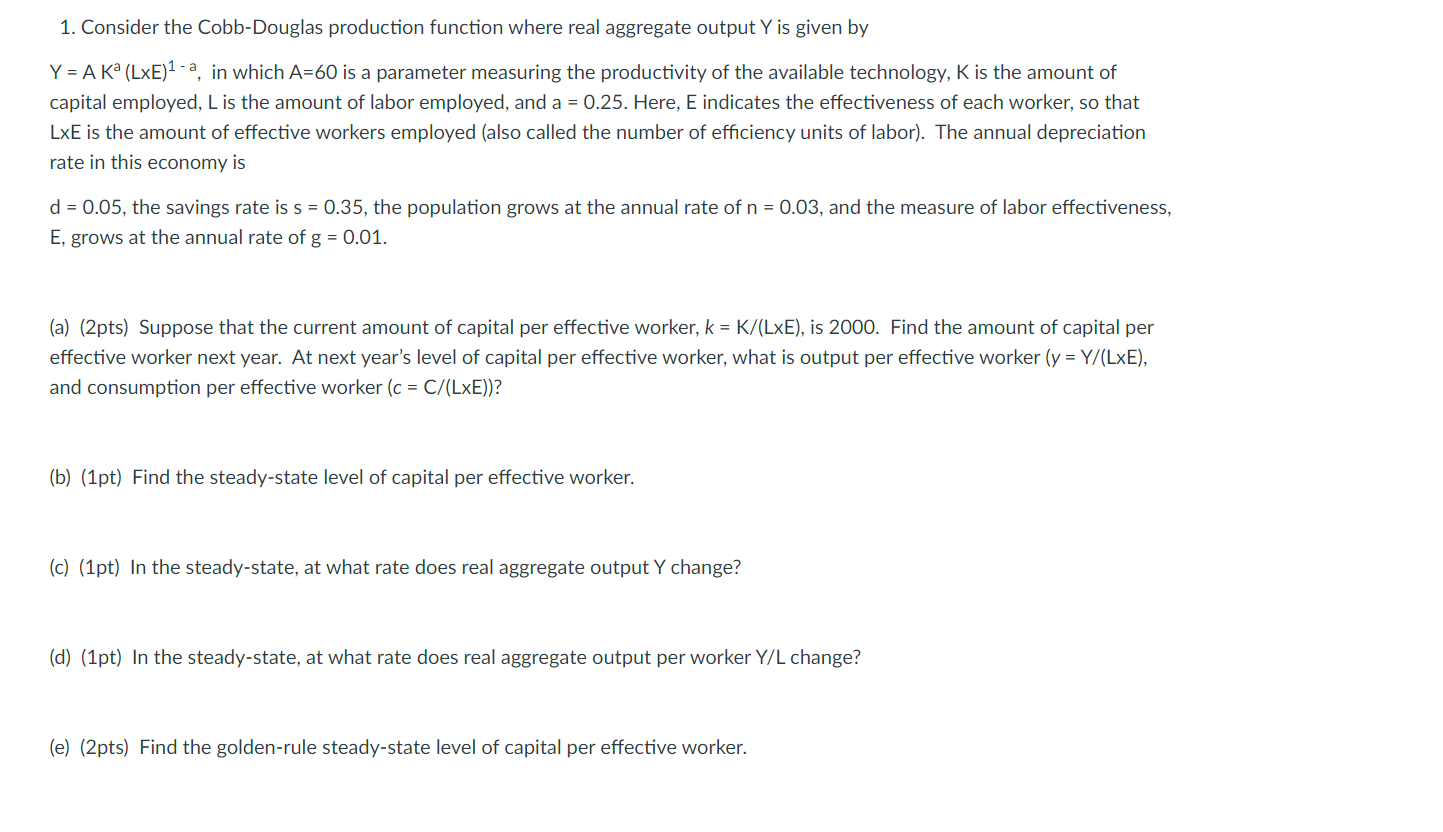
1. Consider the Cobb-Douglas production function where real aggregate output Y is given by Y=AKa(LxE)1a, in which A=60 is a parameter measuring the productivity of the available technology, K is the amount of capital employed, L is the amount of labor employed, and a=0.25. Here, E indicates the effectiveness of each worker, so that LxE is the amount of effective workers employed (also called the number of efficiency units of labor). The annual depreciation rate in this economy is d=0.05, the savings rate is s=0.35, the population grows at the annual rate of n=0.03, and the measure of labor effectiveness, E, grows at the annual rate of g=0.01. (a) (2pts) Suppose that the current amount of capital per effective worker, k=K/(LxE), is 2000 . Find the amount of capital per effective worker next year. At next year's level of capital per effective worker, what is output per effective worker (y=Y/(LxE), and consumption per effective worker (c=C/(LxE)) ? (b) (1pt) Find the steady-state level of capital per effective worker. (c) (1pt) In the steady-state, at what rate does real aggregate output Y change? (d) (1pt) In the steady-state, at what rate does real aggregate output per worker Y/L change? (e) (2pts) Find the golden-rule steady-state level of capital per effective worker. 1. Consider the Cobb-Douglas production function where real aggregate output Y is given by Y=AKa(LxE)1a, in which A=60 is a parameter measuring the productivity of the available technology, K is the amount of capital employed, L is the amount of labor employed, and a=0.25. Here, E indicates the effectiveness of each worker, so that LxE is the amount of effective workers employed (also called the number of efficiency units of labor). The annual depreciation rate in this economy is d=0.05, the savings rate is s=0.35, the population grows at the annual rate of n=0.03, and the measure of labor effectiveness, E, grows at the annual rate of g=0.01. (a) (2pts) Suppose that the current amount of capital per effective worker, k=K/(LxE), is 2000 . Find the amount of capital per effective worker next year. At next year's level of capital per effective worker, what is output per effective worker (y=Y/(LxE), and consumption per effective worker (c=C/(LxE)) ? (b) (1pt) Find the steady-state level of capital per effective worker. (c) (1pt) In the steady-state, at what rate does real aggregate output Y change? (d) (1pt) In the steady-state, at what rate does real aggregate output per worker Y/L change? (e) (2pts) Find the golden-rule steady-state level of capital per effective worker









 Study Help