







Question: 1. Consider the Coulomb-Kepler problem with potential V(r) == ku. In the notes for Week 09, (see p. 11, p. 19) we see that the
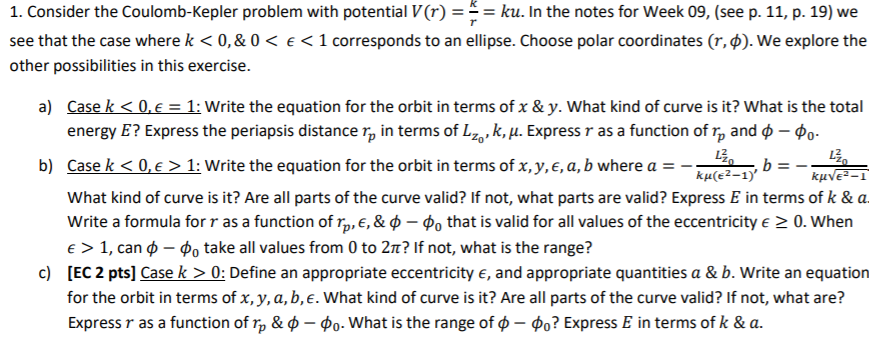
1. Consider the Coulomb-Kepler problem with potential V(r) == ku. In the notes for Week 09, (see p. 11, p. 19) we see that the case where k 1: Write the equation for the orbit in terms of x,y,, a, b where a = b 12 ku(e2-1)' kuve-1 What kind of curve is it? Are all parts of the curve valid? If not, what parts are valid? Express E in terms of k & a. Write a formula for r as a function of Tp,,& $ - Do that is valid for all values of the eccentricity e > 0. When > 1, can - . take all values from 0 to 2n? If not, what is the range? C) [EC 2 pts] Case k > 0: Define an appropriate eccentricity E, and appropriate quantities a & b. Write an equation for the orbit in terms of x, y, a, b,e. What kind of curve is it? Are all parts of the curve valid? If not, what are? Express r as a function of rp & $ - Do. What is the range of $ - Do? Express E in terms of k & a. 1. Consider the Coulomb-Kepler problem with potential V(r) == ku. In the notes for Week 09, (see p. 11, p. 19) we see that the case where k 1: Write the equation for the orbit in terms of x,y,, a, b where a = b 12 ku(e2-1)' kuve-1 What kind of curve is it? Are all parts of the curve valid? If not, what parts are valid? Express E in terms of k & a. Write a formula for r as a function of Tp,,& $ - Do that is valid for all values of the eccentricity e > 0. When > 1, can - . take all values from 0 to 2n? If not, what is the range? C) [EC 2 pts] Case k > 0: Define an appropriate eccentricity E, and appropriate quantities a & b. Write an equation for the orbit in terms of x, y, a, b,e. What kind of curve is it? Are all parts of the curve valid? If not, what are? Express r as a function of rp & $ - Do. What is the range of $ - Do? Express E in terms of k & a
Step by Step Solution
There are 3 Steps involved in it

Get step-by-step solutions from verified subject matter experts
 Study Help