







Question: 1. Consider the following false statement: Allintegers are divisible by 10, 20 is an integer, and 20 is divisible by 10. Why is this not
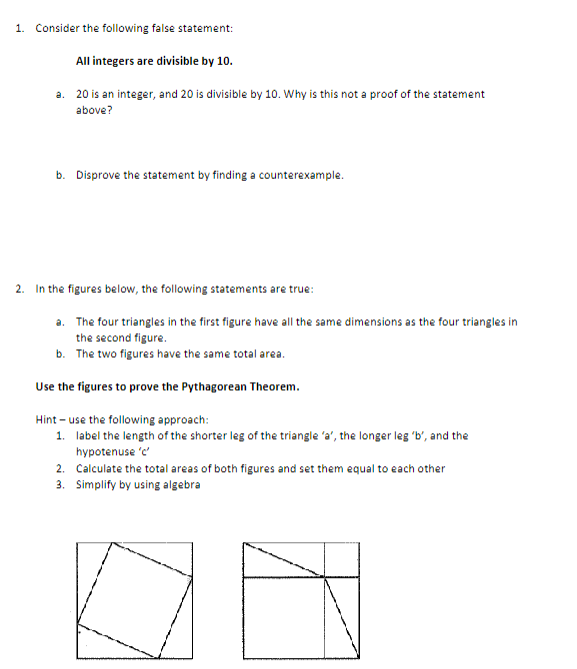
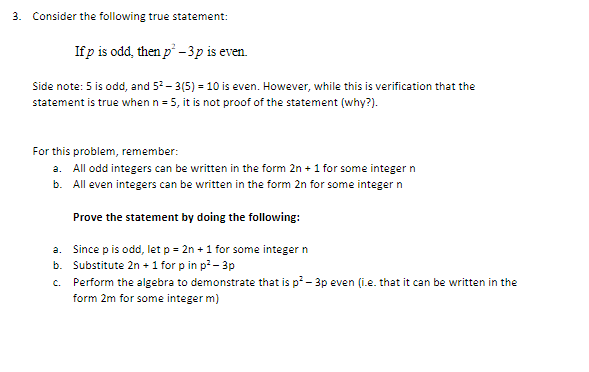
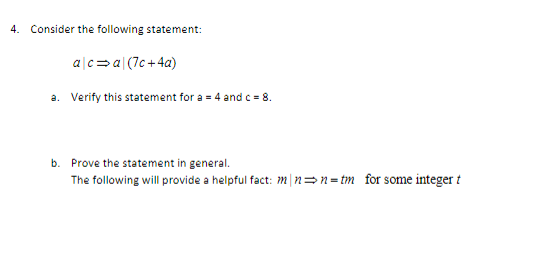
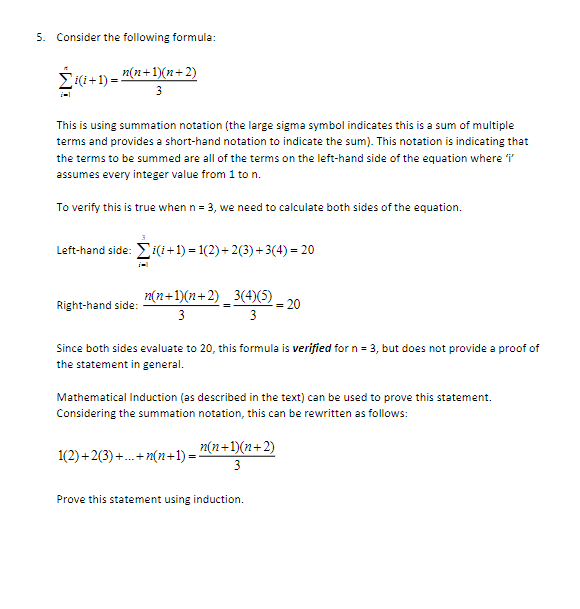
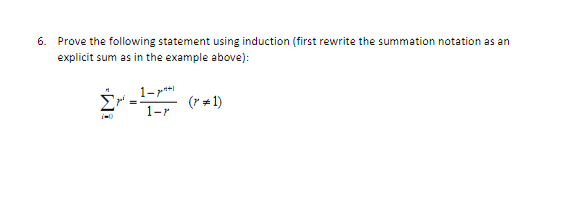
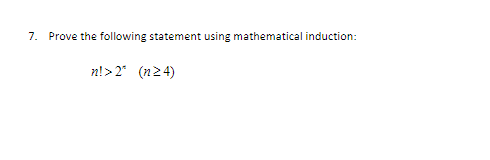
1. Consider the following false statement: Allintegers are divisible by 10, 20 is an integer, and 20 is divisible by 10. Why is this not a proof of the statement above? Disprove the statement by finding a counterexample. 2. Inthe figures below, the following statemants are true: @ b. The four triangles in the first figure have all the same dimensions as the four triangles in the second figure, The two figures have the same total area. Use the figures to prove the Pythagorean Theorem. Hint = use the following approach: 1, label the length of the shorter leg of the triangle '3%, the longer leg 'b, and the hypotenuse '' Calculate the total areas of both figures and set them equal to each other Simplify by using algebra 3. Consider the following true statement: Ifp is odd, then p -3p is even. Side note: 5 is odd, and 53-3(5) = 10 is even. However, while this is verification that the statement is true when n = 5, it is not proof of the statement (why?). For this problem, remember: a. All odd integers can be written in the form 2n + 1 for some integer n b. All even integers can be written in the form 2n for some integer n Prove the statement by doing the following: a. Since p is odd, let p = 2n + 1 for some integer n b. Substitute 2n + 1 for p in p- - 3p C. Perform the algebra to demonstrate that is p -3p even (i.e. that it can be written in the form 2m for some integer m)4. Consider the following statement: alcza (7c+4a) a. Verify this statement for a = 4 and c = 8. b. Prove the statement in general. The following will provide a helpful fact: m | n = n = tm for some integer t5. Consider the following formula: Ei(i+1)= (m+ 1)(n+ 2) 3 This is using summation notation (the large sigma symbol indicates this is a sum of multiple terms and provides a short-hand notation to indicate the sum). This notation is indicating that the terms to be summed are all of the terms on the left-hand side of the equation where 'i" assumes every integer value from 1 to n. To verify this is true when n = 3, we need to calculate both sides of the equation. Left-hand side: Ci(i+1) =1(2) + 2(3) + 3(4) = 20 Right-hand side: n(n+1)(n+2)_3(4)(5)_ ! = 20 3 3 Since both sides evaluate to 20, this formula is verified for n = 3, but does not provide a proof of the statement in general. Mathematical Induction (as described in the text) can be used to prove this statement. Considering the summation notation, this can be rewritten as follows: 1(2)+2(3)+.. + m(m+1) = (#+1)(n+2) 3 Prove this statement using induction.6. Prove the following statement using induction (first rewrite the summation notation as an explicit sum as in the example above]: \" el S =1 r o (r=l) 7. Prove the following statement using mathematical induction: M! > 2" (n 2 4)
Step by Step Solution
There are 3 Steps involved in it

Get step-by-step solutions from verified subject matter experts
 Study Help